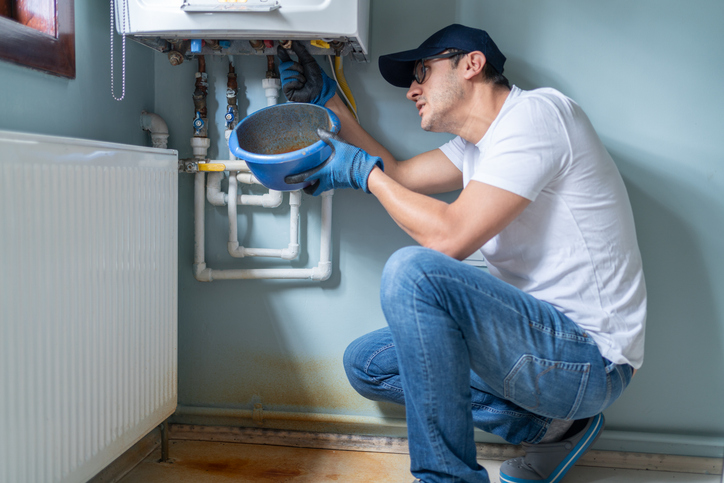
Few homeowners give their water heaters a second thought until these important appliances fail to do their job. “Water heaters are kind of like the offensive line,” says Tucker Yarbrough of Yarbrough & Sons Heating, Cooling & Plumbing in greater Oklahoma City. “No one notices a good one; they only notice a bad one.”
From subtle problem signs to look out for, whether to DIY or call in a pro, and how homeowners can choose a high-quality replacement, Yarbrough answers our burning hot-water-heater questions.
Signs You Need a Water Heater Replacement
No hot water
The most obvious sign that a water heater has a problem—no hot water—sometimes has a simple solution. A circuit breaker might have tripped or, with a gas water heater, the pilot light might be out. Either of these can easily be checked by the homeowner and, in some cases, corrected.
To verify, you’ll need to open the breaker panel, see if the breaker has switched to the off position, and switch it back to the on position if it has.
With a gas water heater, it’s usually possible to see if the pilot light is out without even removing any panels—and relighting it might be as simple as pressing a button. Refer to your owner’s manual for details.
Also, electric water heaters typically have a red “reset” button, typically behind an access panel. Pressing that button might solve a no-hot-water issue, too.
Unfortunately, these simple fixes aren’t always long-term solutions—the breaker might have tripped, or the pilot light might have gone out due to some less-obvious underlying issue. Call a plumber if these simple solutions fail or the issue soon recurs.
Insufficient or inconsistent hot water
At least two potential problems can cause this. The first is excessive sediment in the tank. Calcium and magnesium in water slowly accumulate inside water heater tanks, reducing efficiency and causing corrosion, among other consequences. “You might have so much sediment built up in there that the overall capacity of the tank has actually been reduced,” explains Yarbrough.
If sediment buildup is the issue, flushing the tank could potentially help (more on that below), though Yarbrough warns that if enough sediment has accumulated to noticeably reduce hot water availability, the tank might already be badly corroded.
The second potential cause is a failing heating element: if flushing doesn’t improve hot water availability, that’s likely the culprit, and replacing it requires a plumber.
Leaks
If water is dripping from your hot water heater, there might or might not be something simple you can do about it. If the drip is coming from a connection between the water heater and a pipe, then tightening that connection often solves the problem.
But if the drip is coming from the unit itself, that typically means an interior component is badly corroded or cracked, and it’s probably time for a new water heater. Exception: condensation on the sides of a water heater is common and does not signal a problem.
Strange noises
Popcorn-like sounds coming from a water heater hint at significant sediment accumulation in its tank—the sound is steam bubbles popping as they escape this sediment layer.
Flushing the tank is worth a try, but Yarbrough warns that a water heater is unlikely to have much life left if it’s reached the popcorn-noise stage.
Rust
If rust streaks down the sides of a water heater and/or rust-colored water in the drain pan underneath, these are signs of internal corrosion—and it’s time to buy a new water heater.
Increasing energy bills
A sudden spike in electricity or gas bills could be caused by a struggling water heater. Sediment accumulation in the tank might have created a barrier between the heating element and the water, a failing thermostat might be causing the unit to heat water more than necessary, or hot water might simply be leaking out.
Age
If your water heater’s tenth birthday is well in the past, the odds are high that you’ll need a new one relatively soon. Left well-maintained, a water heater can last considerably longer—see “How to Make Your New Water Heater Last Longer” below.
Repair or Replace: How to Decide
Wondering when to replace a water heater and when to have it repaired? Don’t just consider what’s wrong with the unit—also consider its age.
If the water heater is so young that it’s still under warranty, then repair is likely the answer. If both its warranty and its tenth birthday lie in the past, then replacement usually is the best option, because the water heater is approaching the end of its road even if it’s repaired.
Potential exception: if a plumber reports that your out-of-warranty water heater is in good shape overall and the repair will cost less than $400 to $500, Yarbrough considers repair a valid option. But if the repair is any pricier? “That’s when I start to have that conversation, ‘okay, let’s just go ahead and replace this thing,’” Yarbrough says.
Water Heater Replacement Options
Homeowners have several different water heater types to choose from:
Electric tank water heaters and gas tank water heaters
These are the best-known water heater varieties. Both keep a tank of water heated and ready, though they use different energy sources to do so.
Homeowners rarely have to worry about which of these options to choose, though—whether to go with gas or electric boils down to the availability of natural gas where the home is located.
Natural gas is almost always the more cost-effective option when it’s available, with rare exceptions. “If you’ve got natural gas,” says Yarbrough, “I’d push people towards a natural gas water heater.”
Heat pump water heaters
Heat pump water heaters offer lower energy bills when natural gas isn’t an option. They’re tank-style electric water heaters, but rather than using traditional heating elements, they primarily operate like refrigerators in reverse, drawing in heat from the surrounding air.
They’re more expensive than traditional tank water heaters, except when government subsidies are available, but homeowners typically more than recoup that extra cost in the form of lower electricity bills, particularly in areas with high electricity rates and no natural gas.
“If you’re in a place where you don’t have access to gas and you need a new water heater,” says Yarbrough, “my recommendation would be to go with a heat pump water heater because of the energy savings.”
Tankless water heaters
These heat water on demand rather than keep a tank of water heated at all times. They cost a bit more than traditional tank water heaters but can save homeowners money in the long run due to their higher energy efficiency and longer lifespan.
Tankless water heaters often last 12 to 18 years, though Yarbrough cautions that in his experience gas tankless units are more reliable than electric models.
How to Choose the Right Water Heater
To choose a reliable water heater, Yarbrough suggests buying one of the brands installed by the most experienced, highest-rated plumbers in your area. Many plumbers list the brands they install on their websites, ads, or social media.
Yarbrough’s trusted water heater brands: “We sell a ton of A.O. Smith, we sell a ton of State water heaters, and we sell Bradford White.”
Whichever brand you select, he recommends buying water heaters from local plumbing supply houses rather than big-box home improvement stores. Manufacturers know that big-box store shoppers tend to pick water heaters based on price, so the units they sell there often feature lower-end components and materials to keep prices down.
But those slightly lower prices aren’t worth the significantly lower quality, warns Yarbrough. “The supply house edition is going to be about 12 pounds heavier,” he says. “The reason is better materials, thicker insulation—and the cost is relatively close.”
Water heaters sold at plumbing supply houses also might have longer warranties than seemingly similar models purchased at a big box store, says Yarbrough. A longer warranty can be a sign of a product the manufacturer expects to last.
What size water heater do you need?
A 40- or 50-gallon tank is the right size for the vast majority of US single-family homes:
- 40 gallons: “If we’re looking at a family of no more than 4 or 5, and they’re mostly a shower-taking household, then a 40-gallon tank is perfect,” says Yarbrough.
- 50 gallons: “If it’s a family of more than 5 or we’ve got people taking a long time in the shower, or taking baths or running tons of laundry, then 50 gallons might be better,” he adds.
Water Heater Replacement Cost
If you hire a plumber to replace a typical tank water heater, the total bill is likely to come to $2,800 to $4,000, or potentially more if the tank is being relocated to a different part of the home and/or local code changes mean additional work is needed.
A handy homeowner willing to tackle the job him or herself can save significant money—without installation, a new tank water heater typically costs $900 to $1,300. “I think a homeowner with a YouTube video and enough intestinal fortitude could take care of this,” says Yarbrough. “It might take around six hours.”
A heat pump water heater could cost $1,000 to $2,000 more than a comparable electric water heater. Replacing a tank water heater with a tankless unit might cost somewhere in the neighborhood of $6,200, says Yarbrough.
Water heater installation rates vary regionally and have been rising rapidly, however. Not only have appliance prices been climbing, but there are also labor shortages in many parts of the country. Experienced plumbers are retiring faster than new plumbers are entering the field.
What to Expect During Installation
Yarbrough does warn of a few potential issues for homeowners who choose the DIY route:
- Maneuvering the water heater into position can be the toughest part of the job. Water heaters weigh 100 to 200 pounds, even without water. Transporting that weight up attic stairs or down basement stairs can be a major challenge.
- Specialized tools and parts might be required. Examine how your current water heater is connected to your home’s plumbing system, then watch relevant water-heater-installation YouTube videos. Use these videos to confirm that the job seems within your abilities, and to note every tool and part needed. “Before you start ripping stuff out, do an inventory and make sure you have the right tools,” warns Yarbrough.
- A plumbing inspection might be required. In some regions, an inspector must sign off on the work after a new water heater is installed.
How to Make Your New Water Heater Last Longer
Flush the tank annually
Some basic maintenance can improve water heater lifespans. The most important task is to flush out the tank annually. To do so, follow these steps:
- Turn off the power to the water heater.
- Close the valve in the water line that supplies cold water to the unit.
- Attach a garden hose to the water heater’s drain valve, typically located near the bottom of the unit, and run the other end outside.
- Open a hot water faucet or two in the house to let air into the hot water lines.
- Open the water heater’s drain valve to let the water—and most of the accumulated minerals—flow out from the hose.
- Once the water stops flowing from the hose, reverse the steps above and restart the water heater.
If you haven’t previously flushed a water heater, watch a YouTube video on the topic first, advises Yarbrough. Faithfully flushing a water heater’s tank every year can add years to its life. “A water heater with maintenance, I’d put the floor at something like 14 or 15 years,” says Yarbrough, “and maybe it lasts up to 18 years or so.”
Check (and replace) the anode rod
The second important water heater maintenance task is checking the anode rod every year and replacing it when necessary.
The anode rod is the water heater’s sacrificial lamb, says Yarbrough—its job is to corrode so more important parts don’t. As a rule of thumb, the anode rod generally should be replaced approximately halfway through a water heater’s warranty period.
Replacing it is within most homeowners’ abilities—enter “anode rod” plus your water heater make and model into YouTube to find videos showing how. “There are a thousand good YouTube videos about this,” says Yarbrough. If you don’t want to do annual water heater maintenance, pay a plumbing pro to do so for you.