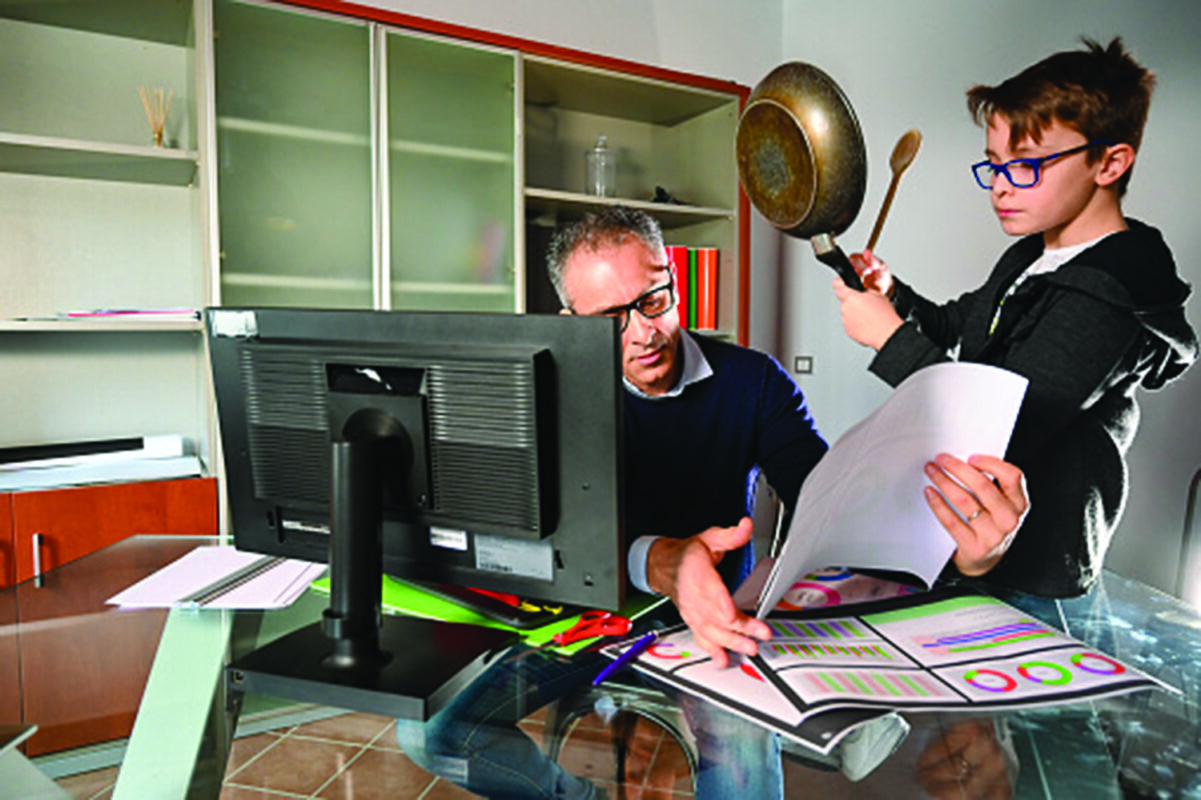
In a noisy, crowded restaurant, can you focus on the conversation at your table and ignore the chatter and clatter all around you? At work, can you zero in on a single task while phone calls, texts, alerts, and other sounds and stimuli compete for your attention?
The ability to concentrate on one particular matter amid focus-seeking distractions is called selective attention, and it’s crucial in helping you be productive and learn new information. “Our attentional capacity is limited,” says Janet Sherman, PhD, clinical director of the Psychology Assessment Center at Massachusetts General Hospital. “We cannot attend to everything in our environment.”
While selective attention develops naturally and is often employed subconsciously, it’s also an ability that can be honed through practice. To boost your skill at filtering out distractions, it helps to understand what selective attention means and how it differs from what you might think of as focus or concentration.
What Is Selective Attention?
Dr. Sherman explains that selective attention is just what it sounds like it is—a process in which you select to attend to one thing and to not attend to others.
“Selective attention helps us accomplish tasks,” she adds. “We often need or want to get something done, and in order to accomplish that, we need to direct our attention to the task at hand. Some individuals find it very difficult to accomplish tasks within an environment with distractions and need to be in a ‘distraction free environment’ to focus.”
Individuals with greater powers of selective attention are less vulnerable to the effects of background noise and other distractions. But what distinguishes selective attention from the ability simply to focus? Doesn’t focus or basic concentration require the skills to tune out stimuli that aren’t helpful?
Well, the main difference between focus and selective attention has to do with whether or not there is a competing stimulus for you to attend to. “If there is nothing else going on, we can focus on the book we are reading,” Dr. Sherman says. “However, if we are reading that book while our family members are getting dinner ready in the kitchen, we need to selectively attend to the book and not attend to the conversation that our family is having about the ingredients they need. When we selectively attend to something, we are not entirely blocking out other stimuli, as is evident by our ability to attend to something else that is meaningful.”
As for the family cooking situation, if your relatives can’t find the paprika, and you know where it is, your attention may be directed toward that. “This is evident in the well-known ‘cocktail party effect,’ where we can selectively attend to a conversation with one individual or group while other conversations are going on around us that we are not attending to,” Dr. Sherman says. “However, when your name is mentioned in another conversation, even if across the room from you, you instantly hear it and attend to that.”
Selective attention differs from a similar concept, known as focused attention. With focused attention, you are directing your awareness toward a specific stimulus, such as a sound or image. It’s the ability of the attention system to be “caught” by a flash of lightning, a slamming door, or an enticing scent wafting in from the kitchen. Focused attention is fleeting, but it is, in a way, the groundwork for other types of attention.
Unlike focused attention, which can be captured by any type of stimuli, selective attention involves the active process of not attending to other stimuli. With selective attention, lightning may be flashing outside the window, but you may remain engrossed in your book.
How Selective Attention Works
The brain filters out millions of bits of sensory data every minute and allows a handful of bits into your conscious awareness. This attention-filtering system means you’re not constantly distracted by the refrigerator’s hum, a mildly sore back, or countless random thoughts or feelings swirling around in the back of your mind. Dr. Sherman explains that selective attention is considered to be a dynamic and adaptive system in which we respond to both “bottom-up” (stimulus-driven) and “top-down” (goal-directed) forces.
Stimulus-driven examples include a loud noise or bright light rather than internal factors, such as plans or expectations. Goal-directed attention includes things you’re going to do later, like make dinner, or are trying to do at that moment, such as find dinner ingredients in a grocery store.
Several brain regions are involved in selective attention. The thalamus, for example, acts as a “gatekeeper” for attention, helping to screen out continuous, redundant background noise and other stimuli. The prefrontal cortex largely governs selective attention, by determining what information or input is relevant to your current goals or survival.
Selective attention allows you to improve your productivity and the quality of your work, while also reducing the stress associated with distractions and feeling too overwhelmed to concentrate.
Examples of Selective Attention
Though you are usually unaware of it, you rely on selective attention—or try to—every day. Selective attention examples can be found at work, at home, and even driving a car. If you’re writing an important email, you use selective attention to tune out the nearby noise and activity. In a meeting, selective attention allows you to focus on the speaker’s words, rather than lose that message to the ambient sounds or peripheral distractions all around you.
Attention filtering also may come into play more often when you are engaged with something you find especially interesting or rewarding. For example, kids absorbed by their favorite game or book may not hear their parents call them to dinner, but if they’re doing homework for a class they don’t like, the dinner bell may ring loud and clear.
For some people, focusing on an important or entertaining task can occur while also giving some attention to other matters. But once you’ve divided your attention among more than one subject, you’ve moved out of selective attention mode.
Selective Attention vs. Divided Attention
If selective attention is about concentrating on a specific stimulus and keeping other stimuli out of your conscious awareness, then divided attention is about letting your brain keep two or more tasks or goals in mind at one time.
Divided attention is the ability to process multiple stimuli or manage more than one task at a time. It’s often referred to as multitasking. When it comes to simple tasks, multitasking is something most people do throughout the day. You can carry on a phone conversation while loading the washing machine or sifting through the day’s mail. But for more challenging or complex undertakings, multitasking and attention can be in competition with each other. What we often think of as high-level multitasking is usually just the rapid switching from one task to another rather than truly doing two or more things at once.
If you’re multitasking, and attention is truly divided among multiple assignments, it’s important to know that your attention is being diluted. Because attention is a limited resource, divided attention can lead to work that is of lesser quality than it would be if you attended to one matter at a time.
Selective Attention and Inattentional Blindness
While selective attention is generally a good thing—an ability that helps you get things done effectively and efficiently— sometimes it can be too much of a good thing. When you are so locked in on something that it’s like your attention has blinders on, important information or stimuli can be missed. This is a concept known as inattentional blindness.
“Inattentional blindness can be thought of as the ‘downside’ of selective attention,” Dr. Sherman says. “It is the failure to consciously notice something in our environment because we are selectively attending to something else. A famous example of this is the ‘invisible gorilla experiment’ in psychology, in which individuals were asked to count basketball passes in a video of a basketball game. Many study participants failed to notice someone walking across the court in a gorilla suit. Both selective attention, which is an intentional tool that we use to focus on one thing and filter out others, and inattentional blindness—our failure to notice something in our environment due to our focus on something else—highlight the fact that our attention is a dynamic process but is also one that is limited.”
Inattentional blindness differs somewhat from a phenomenon called “change blindness,” which also involves missing images that are right in front of you. While inattentional blindness occurs when you’re deeply focused on something else, change blindness occurs when there is some interruption in your view, such as the blink of an eye or an object temporarily blocking your sight, after which the scene has changed.
What Affects Selective Attention?
Like any mental ability, selective attention is subject to positive and negative factors. If you are especially motivated to achieve a certain goal, you may be better able to focus your attention on your objective.
But certain other internal factors can weaken your ability to stay focused and filter distractions. If you are stressed, tired, hungry, or anxious, you may find your mind wandering. Similarly, if your task is complex or particularly challenging, you may find your attention span dwindling.
And if outside distractions are just too loud or otherwise hard to ignore, even highly trained selective attention can be undone.
How to Improve Selective Attention
Given the importance of selective attention, it’s important not to ignore it. When you’re in a situation that requires focus but is filled with distractions, be especially intentional about concentrating on whatever deserves your undivided attention. Tell yourself you need to focus on the task or stimulus right in front of you.
You can also make things easier on yourself by creating environments more conducive to paying attention and not placing unrealistic demands on your time and limited attentional capacity. “There are several strategies that I recommend to my patients to help improve their attention,” Dr. Sherman says:
- Reduce distractions when you have a task you need to focus on and complete.
- Avoid multitasking. To increase your efficiency and to reduce errors, do just one task at a time before transitioning to another task. Single-tasking may not seem as ambitious or productive, but it’s often the most efficient way to get things done.
- Keep your physical environment organized. Have a specific place where you put important belongings, such as your keys, wallet, and cell phone, and always make sure you put them back in this place to avoid frustration and time spent searching for them. This is a way to help you selectively attend within your physical environment.
- Enhance focus and be mindful of the moment. Look directly at a person when they are providing information, and avoid interruptions. If you are unsure about the information, ask questions.
- When you have a larger task to do, first take time to write down all the steps you need to do, and follow each step one at a time. Doing so will help structure the task for you, help you stay focused on the task, and increase your efficiency and reduce frustration.
- When a task requires your sustained attention (e.g., to remain focused on a task over time), take scheduled breaks to increase your focus. For example, work for 40 minutes, and take a short break for 10 minutes to get up and get a glass of water before you return to work.
Attention is the first step in forming memories, so being able to filter out distractions will help with learning and memory, as well as productivity. And while maintaining a high level of selective attention isn’t always easy, you may be able to improve your abilities by acknowledging when unavoidable background noise and other stimuli are around you and telling yourself—repeatedly, if necessary—to keep your focus on the task at hand.