
Tech neck is a particular type of neck pain that comes from the use of tech gadgets. While tech neck is not a new phenomenon, it is becoming more prevalent. “It just comes down to having more people, especially older adults, using devices such as smartphones and iPads,” explains Jonathan Su, DPT, “And I think culturally we’re shifting into this era where we just have technology everywhere…all the time.”
What Is Tech Neck?
“Tech neck is essentially neck pain that results from having a forward head posture while using these devices. It can be a computer or a handheld device, such as a smartphone, iPad or laptop…even gaming stations,” says Dr. Su. But, he adds, it also can happen with your desktop, especially at home if your computer monitor isn’t at eye level (many companies have implemented proper workplace ergonomics so this isn’t as much of a problem at the office).
“Outside of work, people are always multitasking, and they always have some device available. To be ergonomically efficient, we would have to have our hands holding the device in front of us at eye level, and that’s just not possible. Most people hold their devices down below eye level, and that’s what is causing the tech neck.”
One underlying risk factor, says Dr. Su, is that most people don’t know that they can and should exercise their neck muscle. “This muscle atrophies over time if we don’t work it. For someone with weak neck muscles or who is in these forward head positions quite a bit and already has poor posture and poor core strength, pain from tech neck can start in just 20 or 30 minutes,” he warns. And if you don’t correct your improper positioning, it will get progressively worse.
Why Tech Neck Happens: The Science Behind the Strain
Holding handheld devices improperly affects muscles, tendons and more. It’s all a matter of biomechanics, says Dr. Su. “The human head is pretty heavy—10 pounds, on average, or the weight of a bowling ball, and it’s supposed to sit on top of your neck. When your head comes forward by just 15 degrees, which is very small, the effect of carrying that weight doubles. And if you’re at 30 degrees, then you double that weight again, so now it’s essentially like lifting 40 pounds instead of the original 10. That causes a lot of strain, first on the muscles at the back of the neck, the upper back and the lower back,” he says. “Over time, this position also strains the ligaments, the passive structures that are the guidewires that hold things together.”
Common Symptoms of Tech Neck
Neck and shoulder pain are frequent complaints. “Most of the time you’ll have tight sternocleidomastoid muscles,” says Dr. Su. This is the pair of muscles that run from the back of each ear to both the sternum and the collarbone. You may also have tight muscles in the upper back.
“You’ll have pain at the back of the neck, which can result in a type of tension headache called a ram’s horn because it goes from the back and curves around the side of the head above the ear, all the way to the front of the forehead and back of the eye,” he points out. “When our neck moves forward, our brain wants our eyes to be even with the ground, so our chin comes up, compressing that suboccipital area at the base of the head. There are a lot of nerves there that can get compressed and cause that type of headache.”
Who Is at Risk?
Tech neck can affect anyone, but one group at high risk is busy adults who multitask, especially parents who might be picking up and carrying children all day long. “They’re impacted because there’s a lot of tension in their body already,” says Dr. Su. “They have tight shoulders from stress— the upper trapezius muscles, across your upper back, shoulders and neck, are particularly vulnerable.
“I also see a lot of people 50 and older who are on their devices quite a bit. Even if they’re just relaxing on the couch, they have their device on their lap, and they’re spending a lot of time on it, says Dr. Su. “Tech has become so simple to use now that I have patients in their 90s using these devices for YouTube, searches, texting—it’s a pretty active group.”
Dr. Su adds that when people focus very intently on something, they tend to shift forward almost automatically. And if your vision isn’t what it once was and you’re straining to see the small print on your phone or tablet, you’re going to move your head forward even more.
Long-Term Risks of Ignoring Tech Neck
“This type of posture becomes a habit,” says Dr. Su. “Most people don’t even realize it’s happening. When they try to straighten up, it just doesn’t feel right, and that makes it even harder to correct. Also, the muscles become very stiff—it’s hard to soften them and get them back in shape again.”
Besides prolonged pain, there can be severe physiological risks. “Long term, the length of your ligaments and even the shape of your bones can be affected,” says Dr. Su. “For a lot of older adults, when you look at X-rays of their spine years down the line, you’ll see that their vertebrae have become wedge-shaped. Some people start to get kyphosis, the forward curvature of the upper spine commonly called a dowager’s hump. A lot of my patients ask, ‘How do I get rid of this curvature in my upper back?’ I explain that I’m not sure they can at this point because the shape of their vertebrae has changed.”
If you already have some curvature of the spine from other factors, such as scoliosis, osteoporosis, degenerative arthritis, tech neck is going to accelerate it. “When you have forward curvature in the upper trunk, that’s already going to throw the head forward,” Dr. Su explains. “Then, when you’re on your devices and looking down, there’s even more forward movement of the head. This can also cause your shoulders to round forward—what we call the upper cross syndrome, a really tight chest and a really loose upper back.”
How to Prevent Tech Neck: Practical Tips
Some simple steps can help you avoid tech neck, including ergonomic device use…
Use a stand for your device
One inexpensive innovation is a magnetic stand that holds your phone for you at home or at your desk. “The stand eliminates having to hold that device, which can feel heavy over time. Set it down at or close to eye level,” says Dr. Su. “Simultaneously rest your head on a cushion on the back of your couch or chair or on a pillow against the headboard of your bed. This takes the strain off your neck.”
Put down the device every 10 or 15 minutes to take a break
Looking out at the horizon gives the neck a rest and helps you avoid eyestrain as well, Dr. Su says. “We also see cases of tech thumb. So, switch hands often and switch between different devices that are at different angles from your eye.”
Squeeze your elbows to the side of your rib cage when you’re using your device
Now your shoulder doesn’t have to carry the weight of your arm as much, and the phone’s closer to your eye, so there’s less strain on the neck. If the font is too small to read without straining, go into “Settings” and increase the point size, contrast and brightness to what’s most comfortable for you.
Get a physical therapy consult
“We’re used to the idea of seeing a primary care physician every year and a dentist once or twice a year, but we haven’t gotten to the point where people are seeing a physical therapist to check on their musculoskeletal health yearly, and that’s something everyone needs,” suggests Dr. Su. “Think of it as a tune-up and to learn what preventive measures you can take to avoid tech neck (as well as falls) and manage any strains or shoulder or back pain.”
Simple Stretches and Exercises for Relief
“A lot of people just want to stretch, but at the end of the day, you need strengthening and stretching,” says Dr. Su. “And it’s typically better to strengthen first, then stretch.”
Neck strengthening
One very simple thing that most people don’t know to do is strengthening the deep neck muscles, says Dr. Su. The neck muscles are as important as the core muscles to the body in general, and they provide needed support for your head.
What to do: Lie down flat on your bed or a mat on the floor, knees bent, feet flat. Tuck in the chin and lift your head just a half inch, keeping your neck straight. Hold for one minute, then relax. 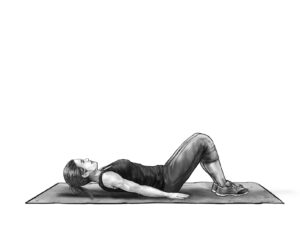
“You’ll be surprised by how challenging that is,” says Dr. Su. “At first, you may be able to hold the exercise for only five or 10 seconds. Then lower your head, take a breath, and hold your head up again. If you held the position for 10 seconds the first time, now try for 11, 12 or 13 seconds. You might have to lift and rest five or six times before you hit 60 seconds. Do this exercise two or three times a day at first. After a week or two, reduce to once a day…after a few weeks, three times a week. In the beginning, you need to do it more often to build up the neck muscles. Then as you start feeling better over time, you can transition to a maintenance program. Ideally, once a week should be enough.”
Upper-back strengthening
“The head sits on top of the neck, and the neck is on top of the upper-back muscles, so you want to work the upper-back muscles with exercises that have a pulling motion, like a dumbbell row or cable pulldowns,” says Dr. Su.
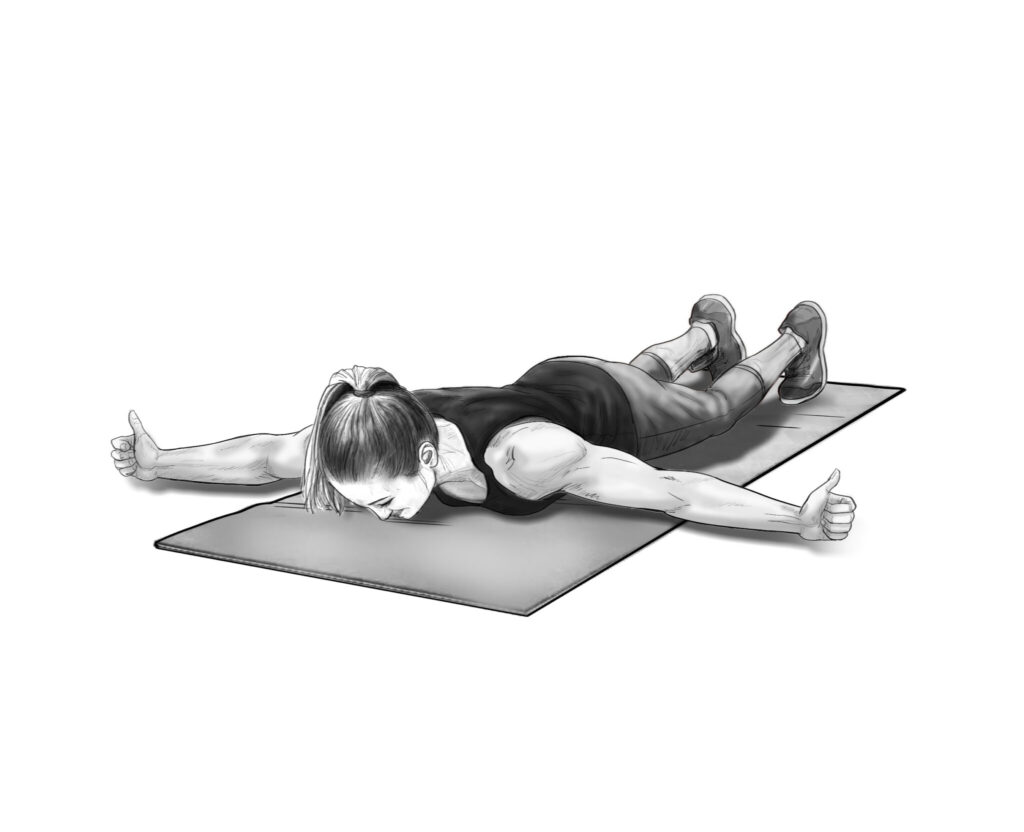
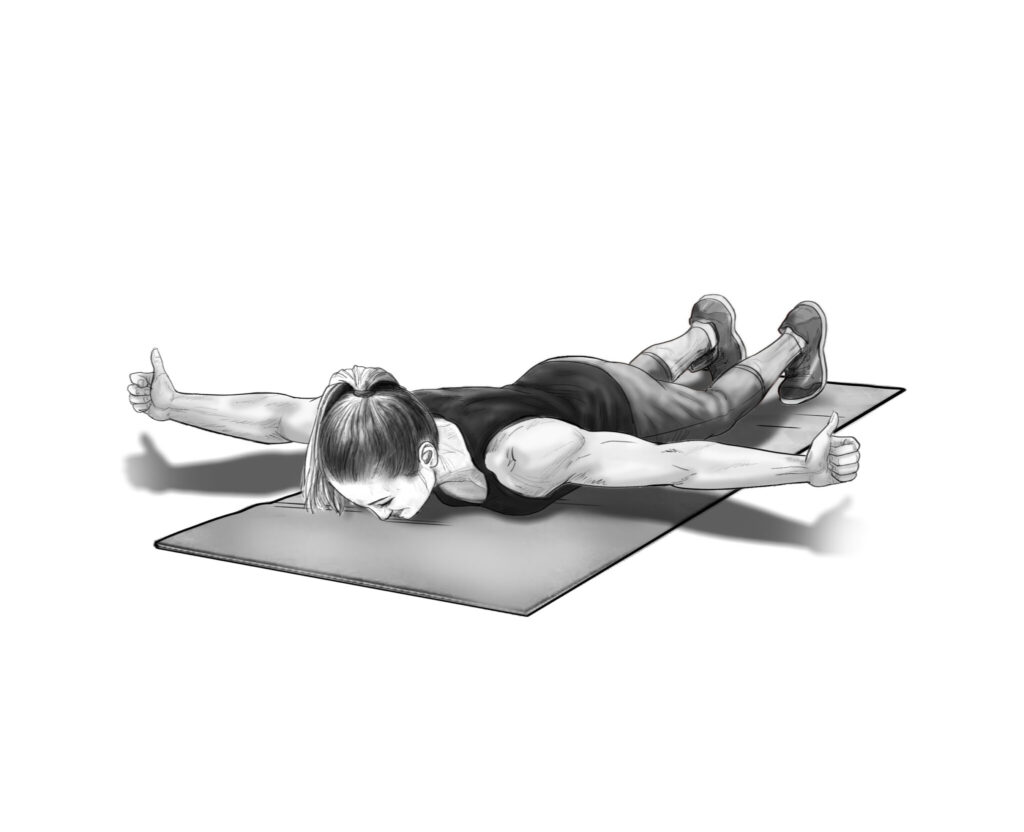
What to do: Lie face down, and form the shape of the letter T with your arms on the floor and your thumbs pointed up. Slowly lift your arms three to six inches off the floor. Hold for three seconds, then slowly bring your arms back to the floor. Perform 12 to 20 repetitions. To increase the challenge of this modification, add one- or two-pound dumbbells in each hand and gradually increase the resistance. Aim for in two or three sets of 15 to 20 repetitions. Start off by doing two sessions a day, says Dr. Su. As you start feeling stronger, reduce workouts to once a day, then to three times a week, and then to twice a week.
Chest stretch
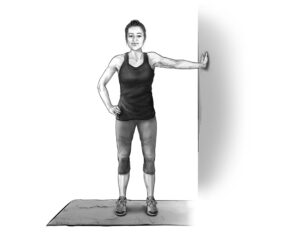
“This is great way to open up the chest and ease tightness,” says Dr. Su.
What to do: Place one hand on a wall at chest level with your other arm bent at your side and your hand on your hip. Rotate your upper body away from the wall. If your left hand is on the wall, you’ll want to rotate your entire body to the right side. The best way to do this is by picking up your feet and turning your entire body. Hold briefly. Repeat twice more, then switch sides and repeat.
Upper trap stretch
This exercise stretches the upper trapezius muscles just below the neck muscles.
What to do: Sit in a chair, and hook your right hand on the edge of the seat. Bring your left hand over the top of your head and cup your right ear. Gently pull your head toward your left shoulder…hold briefly. Repeat twice more, then switch sides and repeat. 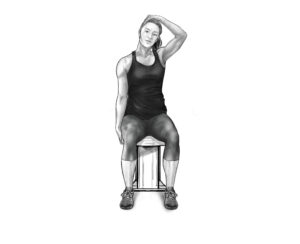
When to Seek Medical Attention
If you’ve adjusted how you hold your devices…strengthened and stretched…and still feel pain, it’s time to see a physical therapist or another professional. Using heat, cold packs or a percussive massage device such as the Theragun can make you feel better temporarily, says Dr. Su. “These strategies are Band-aids. They don’t fix the root cause of the problem. If you continue having weakness from poor body mechanics, that strain is going to come back.”