Keeping your energy up can be challenging no matter what daily demands come your way. Whether you require a morning charge, afternoon pick-me-up, late night jolt, or an extra boost to give you a physical advantage, finding the healthiest energy drink is probably on your wish list.
“Healthy” in the energy drink arena is most accurately defined by the amount and type of sugar and caffeine, and the quality of ingredients. An energy drink with natural ingredients—those that are familiar rather than those with chemical terms you can’t pronounce—is likely the healthier option. If you’re looking for the healthiest energy drink to suit you, your lifestyle, and goals, you’ve got options. Here’s how to make the best choice.
Key Ingredients to Look For
Finding the healthiest energy drink begins with knowing what ingredients to look for in the many products available. “Energy drinks have varying formulations,” explains dietitian Sharon Palmer, MSFS, RDN. “It’s important to read the label and understand what you are getting in that bottle.”
Lower Sugar
Start by looking for a low-sugar energy drink. Sugar is an energy source, but added sugar is not the healthiest way to boost your energy. Check the Nutrition Facts label under “added sugars.” It should say zero or be low for the recommended daily amount. Keep in mind the American Heart Association suggests no more than 25 grams (6 teaspoons) of sugar per day for women and no more than 36 grams (9 teaspoons) for men. The best healthy energy drink is one with a low amount of added sugar. Next, look at the ingredients list. You may prefer one that contains a small amount of cane sugar or a more natural sweetener like stevia or monk fruit, or one sweetened with a zero-calorie artificial sweetener, like aspartame or sucralose.
Moderate Caffeine
There are perks to moderate caffeine consumption in better energy drinks. “The greatest area of research on benefits is for caffeine, which has been shown to increase reaction time, concentration, memory, and endurance,” Palmer says.
While caffeine can certainly support alertness, more is not necessarily better and, in fact, can be too much. According to the U.S. Food and Drug Administration (FDA), 400 milligrams (mg) of caffeine per day is the maximum safe amount for most healthy adults. Energy drinks can contain up to 400 mg of caffeine in a 16-ounce bottle—the equivalent of four cups of caffeinated coffee or 10 cans of a caffeinated soft drink. Some energy drinks list the amount of caffeine on their packaging, but the FDA does not require that the amount be listed on food or beverage labels. Look at the ingredients list, where the type of caffeine must be listed. It may appear as caffeine or caffeine anhydrous (a dehydrated form), or as natural forms of caffeine from botanical sources like guarana, green tea extract, or yerba mate.
Simple Ingredient List
As with any food or beverage ingredient list, simple and shorter generally means a healthier product that will probably be better for your body because you know the ingredients you’re ingesting. Chemicals produced in a lab are not natural or from whole foods. Chances are they are an artificial sweetener, preservative, dye, or other additive that has no nutritive value. A good rule of thumb when looking for the healthiest energy drink is to pass on those with lengthy ingredient lists and take a closer look at those with simple and short lists.
Added Vitamins and Electrolytes
Some energy drinks contain B vitamins. Some research supports B vitamins’ positive effect on energy, but unless you’re deficient in these vitamins, you probably won’t gain these benefits. Still, the Nutrition Facts panel on the packaging will show how much of the various B vitamins the energy drink contains, as well as the percentage of the recommended daily amount.
Pay attention when those percentages are over 100%. Some products may be hundreds or thousands of this percentage, which are considered megadoses. The safety of this high level of intake has not necessarily been determined, though some, like vitamin B12, have a low toxicity risk, while vitamins B3 (niacin) and B6 may cause issues in some people because they accumulate in the body over time.
Electrolytes are another common addition to energy drinks. Generally used in athletic endeavors such as long workout sessions when you might need to replenish sweat loss, those minerals, or electrolytes, added to energy drinks may include sodium, potassium, calcium, and magnesium. “If you are an endurance athlete looking for an energy boost, you might be better off with sports drinks, such as an isotonic electrolyte solution,” Palmer says. “Yet, even for endurance athletes, you can get the performance benefits from dates or a banana with salt along with water if you’re searching for a whole food replacement.”
Ingredients to Avoid or Limit
Just as you might look for certain ingredients when searching for the healthiest energy drink, be on the lookout for certain ingredient no-nos.
High Sugar Content
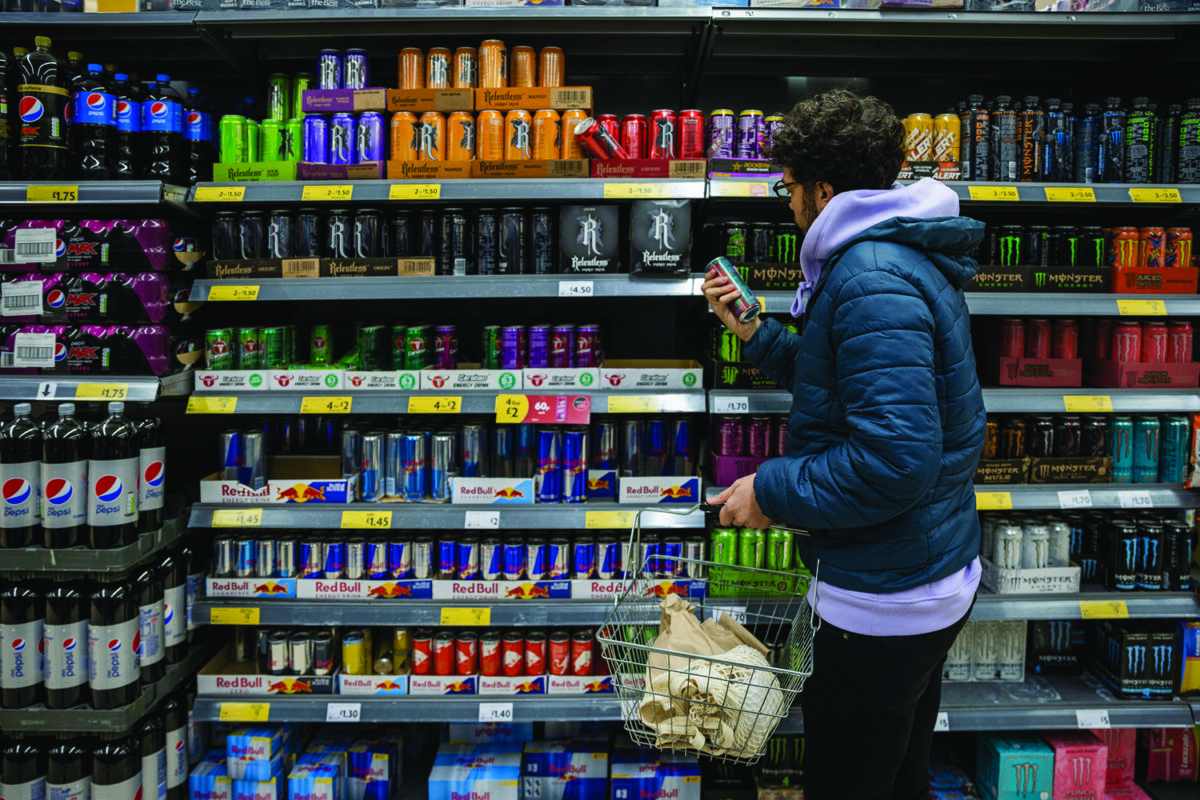
High sugar can quickly turn an energy drink into more of a treat than a health-conscious choice. It’s easy to be lured by the brightly colored bottles and cans promising a boost along with great taste. Too much added sugar is not healthy. It can lead to unwanted weight gain and increase the risk of type 2 diabetes and cardiovascular disease, so it’s best to avoid it.
“Energy drinks can be quite high in added sugars—equal or even greater than sodas,” Palmer says. A typical 12-ounce can of sugar-sweetened soda contains upwards of 46 grams of sugar (about 11 teaspoons). Energy drinks have similar amounts of sugar per ounce. The difference is the standard size of an energy drink is 16 ounces, which means it has as much as 63 grams of sugar (about 16 teaspoons). Aim to limit the amount of added sugar in your energy drink. A natural sweetener can lower the amount.
Excess Caffeine
As exciting as the quick energy boost from a caffeinated energy drink may be, too much caffeine can have unwanted effects that you may not realize. Excess caffeine can cause effects such as jitters (e.g., shaking hands or twitching muscles), upset stomach, sleep disruption, headache, dizziness, rapid heartbeat or palpitations, and others. It’s important to look not only for the amount of caffeine in an energy drink, but also for its inclusion on the ingredients list. Caffeine may be the energy buzzword for energy drinks, but other energy-producing ingredients common in energy drinks include:
- Taurine
- Guarana
- Glucuronolactone
- B vitamins
- L-Carnitine.
These ingredients may not necessarily be bad in moderation, but they can increase the effects of caffeine and the effects that go along with it.
Artificial Additives
If you’re looking for a clean energy drink, one that doesn’t contain artificial colors, flavors, and sweeteners, there are options available. You’ll have to sort through many to find those few that meet your goals, but it is possible. Check the labels carefully to help narrow down and find those that suit your needs.
How to Choose the Healthiest Energy Drink for Your Needs
Your specific requirements for the healthiest energy drink may be quite different from someone else’s. Fortunately, there are better energy drinks to suit most any lifestyle. Here’s how to find the match for you.
For Everyday Energy
If you’re interested in a helpful energy booster for a typical day, look for a drink with modest caffeine, low sugar, and minimal extras. “You might be better off with a simple cup of coffee. It’s cheaper and you limit the other ingredients,” Palmer says. You also might like Zevia, a sugar-free energy drink with no artificial colors or preservatives. It’s sweetened with stevia, and it contains 120 milligrams of caffeine from green tea leaves per 12-ounce can.
For Workout Support
Athletes and others who are looking for energy before a workout or endurance activity may want a healthy caffeine drink. Research supports the effectiveness of energy drinks for increased physical performance. If you’re interested in an energy drink with electrolytes to increase hydration minerals, stamina, and to help prevent cramping, you might try Zoa, which contains sodium, magnesium, and potassium, no sugar, and 160 milligrams of caffeine per 12-ounce can.
For Long Workdays
When the workday goes on longer than your natural energy does, you may be looking to kick up the caffeine a bit higher than usual. Your choice of energy drink needs to deliver steady energy to carry you through extra hours, while avoiding large sugar spikes. Alani Nu sugar-free energy drink has 200 milligrams of caffeine per 12-ounce can, with zero sugar and lots of flavors to lift your spirits, too.
Safety Tips for Energy Drink Use
The best healthy energy drink is the one that feels best for you. Try to choose those that limit sugar, excessive caffeine, and artificial ingredients. Try one out to see how your body responds. This feedback will tell you if the caffeine jolt was too high or if you should switch to a zero-sugar rather than a low-sugar energy drink, for example. Too much caffeine might make you feel jittery or agitated, while too much sugar may not be supporting your weight management goals. Brands may contain different ingredients that can agree with your body or not. You may need to shop around to find the best formula for you.
Do not combine energy drinks with alcohol, as the combination of caffeine and alcohol may increase the alcohol intake more than when you’re drinking alcohol alone. The potential result: binge drinking and otherwise overly high consumption of alcohol, which can lead to adverse health and even fatal events.