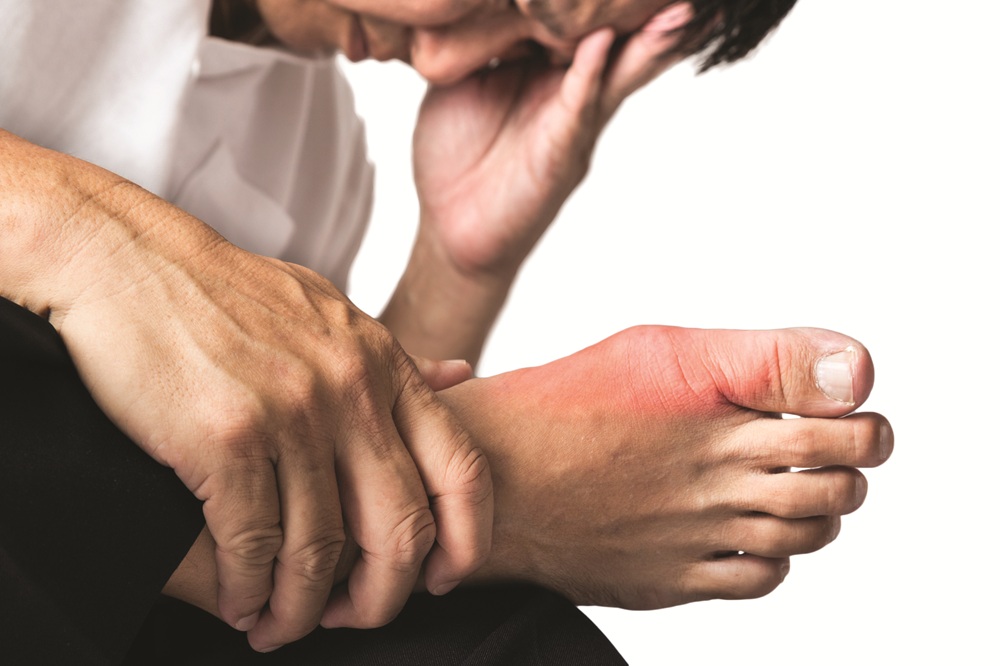
If you are experiencing intermittent periods of extreme pain in your big toe joint, it’s likely that you have gout.
These periods, known as gout flares, can vary in duration, from a few days to several weeks, depending on how quickly and effectively it’s treated.
Gout is a fairly common condition—about 9 million Americans suffer from it, according to the American College of Rheumatology. While men are particularly vulnerable to gout, women become increasingly susceptible after menopause.
“The big toe joint is most often affected, but gout also can affect other joints, such as the small joints in the hands, the wrists, the elbows, the ankle, and the knee joint,” says Emily Carroll, MD, a Mount Sinai rheumatologist. “Previous research has linked gout to a greater risk for several serious chronic health issues, so managing it is important.”
What Is Gout?
Gout is a form of arthritis that occurs when a substance called uric acid forms crystal-like deposits in the joints. “The body produces uric acid when it metabolizes substances called purines,” Dr. Carroll explains. “Purines are naturally present in the body and also are found in certain foods and beverages.”
Uric acid normally dissolves in the blood and is removed from the body in urine via the kidneys. “However, if the kidneys fail to excrete it properly, hyperuricemia—high uric acid levels—can develop,” Dr. Carroll says.
She adds that even though most people with gout have hyperuricemia, only about one-third of people with hyperuricemia develop gout. Those who do tend to consume more alcohol, meat and seafood, which is why gout traditionally was referred to as the “disease of kings.”
Gout also is more common in people with a family history of the condition and those with high blood pressure, kidney disease, diabetes, and obesity, partly because all of these conditions affect the way the kidneys process uric acid. “Additionally, many people with these conditions may be taking thiazide diuretics and/or daily low-dose aspirin, both of which can inhibit the excretion of uric acid by the kidneys,” Dr. Carroll says.
How Long Does a Gout Flare Last?
Gout flare duration usually ranges from three days to two weeks. “The shorter end of this timeline is most likely to apply if gout is treated promptly, with a longer duration more likely if the gout flare goes untreated and instead subsides on its own,” Dr. Carroll says.
If it’s the first attack of gout you’ve experienced, you may be lucky and never suffer from gout again. However, more than half of people who experience a gout flare will suffer from more than one attack, and subsequent attacks often take longer to subside.
Stages of a Gout Flare
A gout flare presents with the sudden onset of intense pain, burning sensations, swelling, and tenderness in a joint. In younger people, gout symptoms commonly start in one joint, but older adults may experience pain in several joints, and in upper-body joints like the hands and wrists. The pain may develop during the night or early morning hours, and the affected joint will appear red and may be warm and tender to the touch.
Dr. Carroll says the pain of a gout flare usually peaks about 12 to 24 hours after it first sets in. “This stage often is described as throbbing, crushing, and/or excruciating,” she notes. “The gout flare may be accompanied by fever and chills. By day three to four, the pain typically begins to subside, but the swelling takes longer to resolve. After the pain has resolved, the joint may be stiffer than usual for a couple of weeks. If gout is not treated, the different stages of a gout flare may last longer.”
Factors That Affect Gout Flare Duration
Gout flares can last longer if uric acid levels are particularly high and if gout is not treated. Which joint is affected also is a factor in the gout flare timeline—if the attack centers on the big toe joint, it typically will resolve more rapidly than if other joints are affected.
“If you are dehydrated, this also can cause a gout flare to last longer,” Dr. Carroll adds. “Not drinking sufficient fluids makes it more difficult for your kidneys to flush excess uric acid from the body, which results in a greater concentration of uric acid in the blood. Gout flares also may last longer if you have poor kidney function, and if this is not your first gout attack.”
What to Do During a Gout Flare
As well as taking medications your doctor has prescribed for gout flares, there are strategies that can provide added relief. Try to avoid using the affected joint, and if your big toe joint is affected, rest with your foot elevated higher than your heart to help reduce any swelling.
Using an ice pack for 15-minute periods two or three times per day also may be helpful. If you do not have an ice pack, wrap a bag of frozen peas or corn in a towel and use that instead. (Don’t apply ice directly to your skin, as doing so can cause ice burns.) Also drink plenty of water, to help your kidneys flush uric acid from your body.
Treatment Options for Gout
It is important to properly manage gout, since the associated pain and swelling can significantly impair your mobility. Studies have shown that older adults who regularly suffer from gout in the toe joint walk more slowly than older adults who do not have the condition and may not get the physical activity they need to preserve their bone mass and muscle strength. People whose gout is not treated also are at risk of chronic tophaceous gout. In this advanced form of gout, uric acid deposits form hard swellings (tophi) that can cause joint damage and loss of motion.
Medical treatment options for gout are aimed at managing acute attacks and preventing recurrent attacks. Acute gout flares are managed with over-the-counter nonsteroidal anti-inflammatory drugs (NSAIDs), like ibuprofen (Advil, Motrin) and naproxen (Aleve). Your doctor also may prescribe stronger NSAIDs, such as indomethacin (Indocin, Tivormex).
“Older adults are vulnerable to potentially serious side effects from NSAIDs,” Dr. Carroll cautions. “It is important to discuss these risks with your health-care provider, who may recommend other or additional medications to decrease your risks.” Corticosteroids also are a common treatment option for acute gout—a steroid injection directly into the affected joint can help. Colchicine (Colcrys) may be prescribed to quell an acute attack and works by reducing inflammation in the affected joint.
Colchicine, NSAIDs, and corticosteroids do not reduce uric acid levels, so if you experience recurrent gout flares, your doctor may recommend you take a medication to lower your uric acid production. The most commonly used options are allopurinol (Zyloprim) and febuxostat (Uloric). Another drug option for chronic gout management is probenecid (Probalan), which helps the kidneys process uric acid for excretion. For tophaceous gout, an injectable drug known as pegloticase (Krystexxa) may be used to dissolve tophi.
“All of these drugs are associated with potential side effects and can interact with other medications, so be sure to ask your doctor about using them safely and being monitored appropriately,” Dr. Carroll advises.
Preventing Future Gout Attacks
If you experience frequent gout flares, you may benefit from cutting back on foods that are high in purines, such as red meat, organ meat (for example, liver), and seafood. It also may be helpful to reduce your intake of animal-source protein in favor of protein from low-fat dairy foods.
Studies have shown that following the DASH (Dietary Approaches to Stop Hypertension) diet may help prevent gout flares. The DASH diet prioritizes fruits, vegetables, low-fat dairy, and whole grains. Other research suggests that a probiotic called Ligilactobacillus salivarius (L. salivarius) may reduce the frequency of gout flares and reduce the need for gout medications. Probiotics are beneficial bacteria that populate the gastrointestinal tract.
Dr. Carroll also recommends watching alcohol intake, particularly if you often drink beer and hard liquor. “And stay well hydrated, too,” she adds. “There is evidence this can be helpful in preventing gout attacks.”