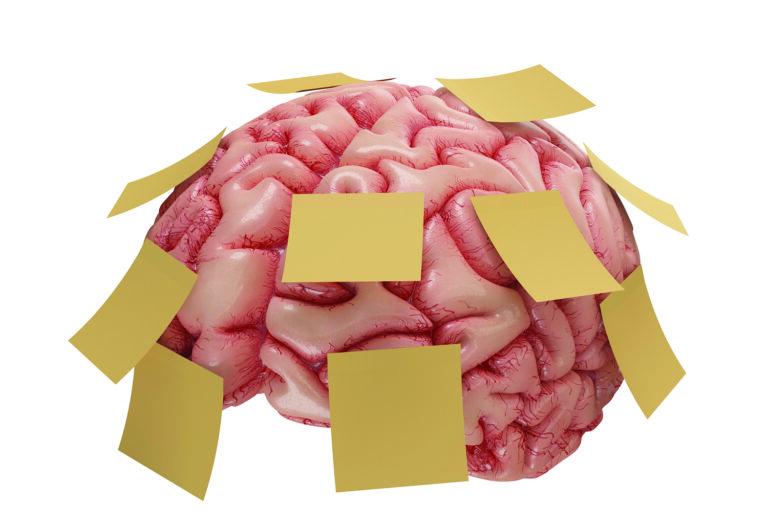
Short-term memory refers to recently learned information that the brain holds onto for a few seconds up to a few minutes. That information may move into your long-term memory or it may be forgotten. Many factors, including those within and beyond your control, can affect how well your short-term memory works.
What Is Short-Term Memory?
Your short-term memory is like a temporary storage space for items or units of information you’ve just learned. “Short-term memory has a surprisingly limited capacity,” says Molly Colvin, PhD, a Massachusetts General Hospital neuropsychologist. “For adults, four to seven meaningful units is typical, although capacity varies depending on the person and the material.”
The length of time a unit of information lasts in short-term memory retention also varies from person to person. Certain types of information also will last longer than others. You may remember how much you paid at the grocery store checkout line for several minutes but forget what the customer in front of you was wearing in a matter of seconds.
How Short-Term Memory Works
Information processing begins with your sight, hearing, and other senses. How sensory information finds space in your short-term memory involves two key aspects of cognitive function:
- Attention, which acts as the gatekeeper for your sensory memory
- Active processing, which refers to how the brain maintains and transforms the information for immediate use. Active processing might include rehearsing the newly learned information or otherwise manipulating it so it won’t disappear too quickly.
Most short-term memories don’t go on to become long-term memories, because the brain deems them expendable. You can take many steps to actively store new information in long-term memory. And the brain also can subconsciously transfer units of information into your long-term memory if they are somehow considered worth keeping.
How Long Does Short-Term Memory Last?
There is no precise and consistent time frame to describe short-term memory retention. Some experts suggest that short-term memory really describes information you’re holding onto for up to 30 seconds or so. Repeating information aloud or to yourself can also give it a slightly longer “shelf life” in your short-term memory. “Without rehearsal, new information may remain readily available for less than a minute,” Dr. Colvin says.
And if you become distracted as new information is coming your way, it may be lost even faster. Distractions can also keep you from encoding information in the first place, so it may never really reach your short-term memory.
Even though short-term memory seems almost too short to be of value, it’s a brain function you rely on every day. For example, short-term memory allows you to get to the end of this sentence while still remembering how the sentence began.
How Much Can Short-Term Memory Hold?
Dr. Colvin notes that an adult’s short-term memory can hold around four to seven units of information at a time. But what constitutes a unit? That depends on the nature of the information.
If you were given a list of 12 digits and treated each one individually, that might be more than your short-term memory could handle. But by chunking those numbers into groups of three or four—like the way we think about phone numbers—then you could probably remember all 12.
Repeating information back to the person who provided it or visualizing the information in your mind are ways to keep data alive a little longer in your short-term memory.
Your short-term memory also may be able to better hold onto words, images, and other information that is familiar or easily recognizable compared with unfamiliar or challenging information that requires more mental energy to grasp.
Short-Term Memory vs. Working Memory
The terms “short-term memory” and “working memory” are sometimes used interchangeably, but they don’t quite mean the same thing. Short-term memory is simply the information that is stored temporarily, while working memory refers to the immediate use of that temporarily stored information. You have plenty of bits and pieces of information that move in and out of your short-term memory that are never used for any purpose.
If someone gives you a phone number and you call that number immediately, you’re relying on your working memory. Dr. Colvin explains that your short-term memory and working memory are similar, but working memory involves the application of information and not simply the passive, brief storage of data.
“Both involve keeping information in mind for short periods of time, so there is considerable overlap,” she says. “The important distinction is that working memory is an active mental workspace that allows us to use information to guide thinking and behavior.”
Signs of Short-Term Memory Problems
The signs of short-term memory loss can be obvious, and very frustrating, in the moment. “Short-term memory problems can show up as difficulty retaining something that was just said, repeatedly asking for information, losing track of steps in a process, or having trouble remembering information long enough to use it,” Dr. Colvin says.
It’s worth understanding that the occasional struggle to keep up in a conversation or the inability to remember a phone number, directions, or other bit of newly acquired information isn’t always a sign of something serious. A little too much background noise or thinking about your to-do list can keep you from absorbing information. Distractions are everywhere, and they can interfere with anyone’s best efforts to pay attention.
What Can Cause Short-Term Memory Issues?
Short-term memory problems can stem from minor and predictable circumstances, such as a stressful situation, poor sleep, or a distraction-filled environment. But they can also be signs of more serious cognitive issues. A head injury or certain cardiovascular conditions can affect brain functions, including short-term memory. The early stages of Alzheimer’s disease or other neurodegenerative conditions also can affect short-term memory, as well as recently learned information that had been part of long-term memory but seems elusive when trying to recall it.
If you notice more frequent episodes of short-term memory issues, don’t assume the worst. Be aware of when they happen and take a moment to consider whether they may be due to challenges with attention and distraction first.
“Short-term memory problems can feel very similar in everyday life, but they may have quite different causes,” Dr. Colvin says. “Sometimes the issue is with attention, or taking in information in the first place. Sometimes the issue is with executive functioning, like sequencing or prioritizing. And sometimes the issue is with the broader memory system that is involved in learning and retention of new information.”
How Short-Term Memory Is Tested
Short-term memory tests are relatively simple. Your healthcare provider may show you a series of images or read you a list of numbers or words. After a brief pause, you’ll be asked to recall the images, numbers, or words. The test may ask you to recall them in order.
Your performance on the tests is interpreted relative to standardized norms—the scores of people like you (similar age, education level, etc.). If you had trouble with short memory tests in your doctor’s office, you may be referred for further memory and thinking skills tests with a specialist.
How to Support Short-Term Memory
You can take a few basic steps to give your short-term memory the best chance at taking in and holding on to new information, Dr. Colvin says.
“Helpful strategies include reducing distractions when taking in important information, repeating or paraphrasing information, grouping it into meaningful chunks, and using external supports such as notes and reminders,” she recommends. “If there has been a meaningful change from someone’s usual functioning, however, the important question is why it has changed rather than simply how to compensate for it.”
Focus and paying close attention can become a little harder as you get older, so allow yourself some “can you repeat that” moments and do what you can to make your environment conducive to learning and conversation. If, for example, background noise is too distracting, try to find quieter, less crowded places to talk with others.
When to Talk to a Doctor
If you have concerns about possible short-term memory loss or any aspect of cognitive function, don’t hesitate to bring them up with your healthcare providers. You may find that what you’re experiencing is normal and not a sign of any major medical problem. Or you may learn that new-onset memory struggles are due to an underlying condition that can be treated.
And if it appears that your memory issues indicate something more serious might be going on, starting the conversation earlier than later allows more time for interventions and lifestyle changes, if needed.
“For most people noticing a new change in memory, a primary care physician is an excellent place to start,” Dr. Colvin says. “Memory concerns can have many causes, some quite treatable, including medication effects, sleep problems, anxiety or mood symptoms, and other medical conditions. A primary care clinician can look at the whole picture and determine whether additional evaluation is warranted.”