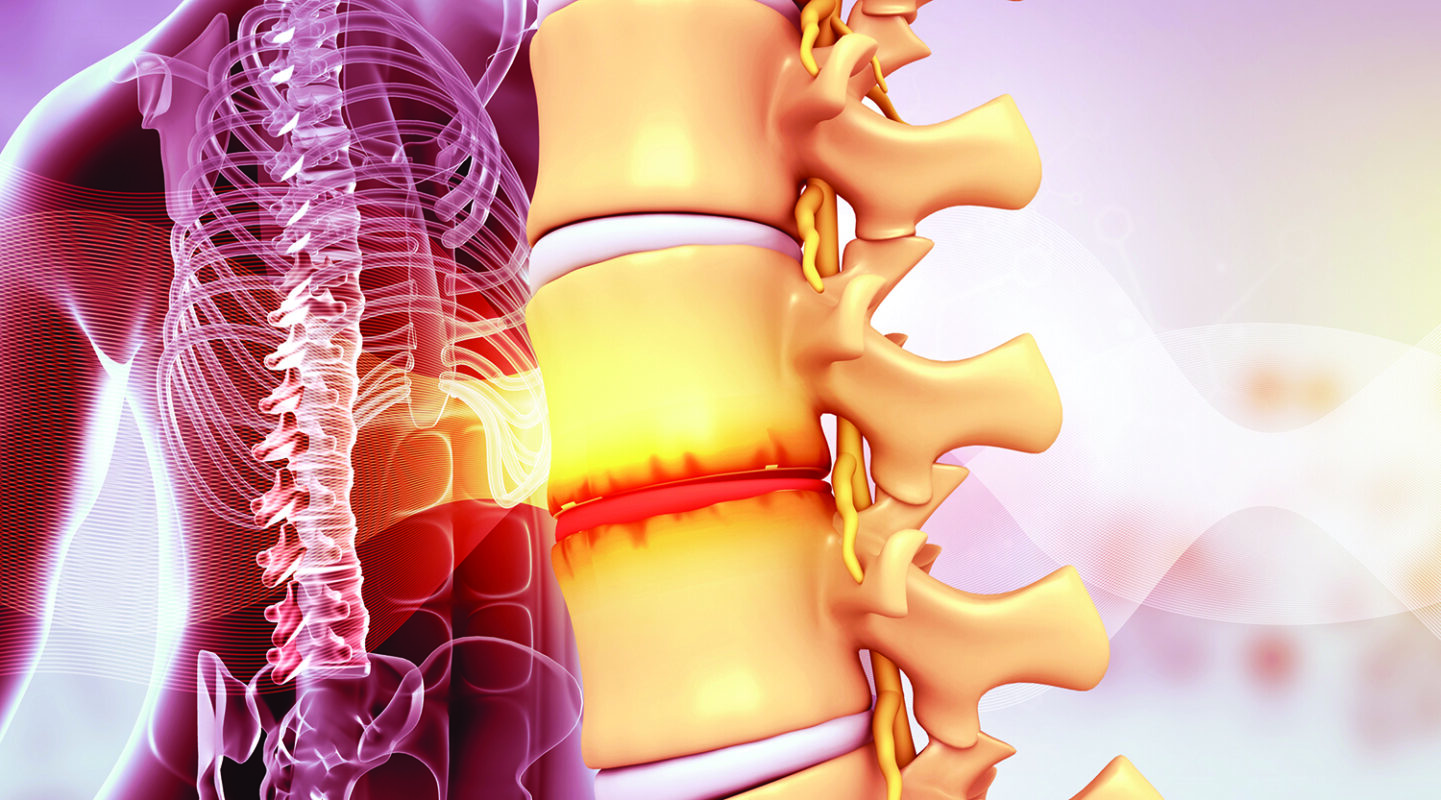
Time takes its toll on your bones and muscles—you may well be feeling the effects of cumulative wear and tear as you read this. Your spine is especially vulnerable to aches and pains, given that it is made up of multiple small bones (vertebrae) and joints, and it can be difficult to avoid placing them under stress.
One term used to describe the damage that can result from this stress is degenerative disc disease, which is characterized by age-related changes in the discs that cushion each vertebra. The condition most often affects the neck, (where it is known as cervical degenerative disc disease) and the lower back (lumbar degenerative disc disease).
Degenerative disc disease symptoms can be unpleasant, but you can take steps to relieve the discomfort and keep your spine as healthy as possible in older age.
What Is Degenerative Disc Disease?
Degenerative disc disease isn’t really a disease but rather a term doctors often use to describe ordinary wear and tear on the spinal discs. Most of us have 23 of these—they consist of a tough outer layer encasing a soft, gel-like nucleus and provide shock absorption up and down through the spine.
“Think about your daily walk or weekly game of pickleball,” says David C. Thomas, MD, MS, MHPE, of the Icahn School of Medicine at Mount Sinai. “With every step or lunge, your feet hit the ground and send a small jolt of impact up through your legs and spine. Your spinal discs help absorb that impact, cushioning the bones in your back. Physical activity would be much less comfortable and enjoyable without those discs.”
He adds that smooth movement would be harder, too, since the discs also help you maintain flexibility in your spine. For example, turning your head to check your blind spot while driving is more difficult if you have cervical degenerative disc disease.
What Are the Symptoms?
Some people with degenerative disc disease experience occasional discomfort if they bend at the waist or pick up a particularly heavy item. But at its worse, the condition can be persistent and painful enough to disrupt normal activities. The symptoms may include:
- Back pain and stiffness, particularly in the lower back if you have lumbar degenerative disc disease. The pain typically manifests as a dull ache that may be mild, moderate, or more severe and may radiate to the hips and buttocks.
- Neck pain and stiffness that may spread to the shoulders and upper back.
- Sciatic nerve pain. If a degenerated disc presses on the nerve roots that form the sciatic nerve (roots that leave the spinal canal through small openings between the vertebrae in the lower back), pain can travel through the buttock and down the leg, usually on one side but sometimes both. “The sciatic nerve is the largest nerve in the body and carries signals between your brain and your lower body,” Dr. Thomas explains. “Irritation of its roots can cause burning, sharp, or shooting pain that may be severe, along with numbness, tingling, or weakness in the affected leg or foot.”
Keep in mind that while these symptoms often reflect degenerative disc disease, you shouldn’t simply assume that’s the underlying cause. “Any new pain, numbness, tingling, and poor coordination when walking should be evaluated by your doctor, especially if you also are experiencing loss of bladder or bowel control,” Dr. Thomas advises.
What Causes Degenerative Disc Disease?
Your spinal discs are able to cushion your vertebrae from the impact of motion because they contain water that keeps them plump and flexible—in fact, in your younger years, your spinal discs are made of 80% to 90% water. But as you age, the discs lose water, becoming thinner in the process. Without the extra padding provided by water, they are less able to withstand pressure and also lose height.
Thinner discs narrow the space between the vertebrae, subjecting the small joints that link them to stress that may contribute to arthritis and the development of bone spurs, small outgrowths of extra bone that may narrow the spinal canal and the spaces through which the spinal nerves exit the spinal column. This narrowing is known as spinal stenosis.
“Lower water content also makes the discs vulnerable to cracks and tears that may allow the gel-like inner material to protrude,” Dr. Thomas explains. “This is known as a herniated disc or slipped disc, and it can cause pain, numbness, and tingling if the displaced material comes into contact with adjacent nerves.”
Who Is at Risk?
Age is the main risk factor for degenerative disc disease—it reduces the elasticity of the spinal discs, and more years on the clock mean more wear and tear on your spine. Dr. Thomas notes that the risk also is greater if you have suffered a back injury at any time, or you frequently engage in physically demanding activities such as bending, twisting, and lifting. “When it comes to physical activity, the other end of the spectrum is important, too,” he adds. “Insufficient exercise weakens the muscles that support your spine.”
Other factors that can play a role in degenerative spinal changes include smoking and excess weight. Tobacco smoke contains substances that narrow arteries, reducing the flow of oxygen- and nutrient-rich blood to the spinal tissues, while excess weight increases mechanical stress on the spine.
How Is It Diagnosed?
Before seeing your doctor about your back problem, make a note of when you first experienced symptoms, whether they are persistent or intermittent, and whether anything makes them worse. Dr. Thomas says your doctor probably will ask you about the nature of the pain (a dull ache or a sharp, burning sensation), whether it radiates through your shoulder and upper back or down through your hips and buttocks, and if the pain is accompanied by tingling and/or numbness. “They also likely will want to know about any injuries that might be contributing to the problem,” Dr. Thomas adds. “A physical exam will be conducted to assess your spinal motion, posture, walking abilities, and muscle strength.”
A degenerative disc disease diagnosis doesn’t always require imaging tests, but your doctor may refer you for an x-ray to check if the spaces between your vertebrae are narrowed or bone spurs are present. If more detailed images of your discs and spinal nerves are required, you may be referred for magnetic resonance imaging (MRI). “These scans can take detailed pictures of the soft tissues that should reveal if you have a cracked or herniated disc or your spinal nerves are being pinched,” Dr. Thomas says.
How Is Degenerative Disc Disease Treated?
Conservative approaches can be quite effective at easing degenerative disc disease symptoms, so you’ll be advised to try these first.
Nonsurgical Treatment Options
Expect to be referred to a physical therapist, who can work with you to establish an exercise program aimed at strengthening your abdominal and back muscles, boosting your flexibility, and improving your posture.
If you need painkillers, stick to acetaminophen (Tylenol), since nonsteroidal anti-inflammatory drugs like ibuprofen (Advil, Motrin) and naproxen (Aleve) are associated with potentially serious bleeding in older adults.
Dr. Thomas adds that steroids administered through spinal injection may be an option if you are experiencing symptoms due to nerve irritation, but he cautions that these cannot be given frequently since they can weaken the vertebrae and surrounding tissues.
At-Home Care and Self-Management
Your physical therapist will show you gentle stretches you can do at home to maintain range of motion in your spine. The therapist also can show you how to move in a way that doesn’t aggravate your symptoms. Dr. Thomas recommends you also add cold packs and heat packs to your degenerative disc disease self-care regimen. “The former can ease a flare-up, while the latter can help relax tense muscles,” he says.
We all slouch in front of the TV at times, but it’s best to try to avoid this by supporting your lower back with a pillow to keep your spine straight. “Also don’t sit for hours on end,” Dr. Thomas advises. “Getting up and walking around every hour or so will help prevent stiff muscles.”
If your symptoms are affecting your sleep, placing a pillow between your knees if you are a side sleeper may help. If you sleep on your back, try putting a pillow under your knees.
When Surgery May Be Needed
Degenerative disc disease treatment may involve back surgery if nonsurgical approaches don’t provide sufficient symptom relief and your condition is significantly affecting your mobility, function, and quality of life. “People who do have surgery tend to be those affected by significant nerve pain due to a herniated disc or spinal stenosis,” Dr. Thomas says. “A herniated disc can be trimmed so that it no longer compresses a nearby nerve, or bone spurs that are contributing to spinal stenosis can be removed.”
If you are debating whether to have surgery, carefully weigh the possible benefits against the risks, which may include infections, bleeding, nerve injuries, and lengthy recovery times.
Can You Prevent It From Getting Worse?
There isn’t really anything you can do to prevent natural age-related deterioration of your spinal discs, but there are things you can do to keep your spine strong:
- Stay active. Regular physical activity boosts muscle strength and helps control weight gain. Ask your physical therapist for tips on safe exercises to do at home, and take advantage of your local swimming pool—the buoyancy provided by water makes it easier to move painful muscles. What you definitely don’t want to do is take to your bed, since inactivity will exacerbate back pain and stiffness as well as weaken the muscles that support the spine.
- Take care when lifting. When lifting an item, bend at the knees, not the waist. Hold the item close to your body, and avoid twisting while carrying it.
- Maintain a healthy weight to avoid placing excessive stress on your spine and other joints.
- Fall-proof your home to avoid injury. Remove tripping hazards (e.g., throw rugs, extension cords), wear shoes and slippers with nonslip soles, and ensure that stairwells are adequately lit. Use nightlights.
- Quit smoking if you still engage in the habit. Quitting won’t reverse disc degeneration, but it may help prevent its progression.