

“If it’s a plant, eat it. If it was made in a plant, don’t.”
That’s sage advice from author Michael Pollan’s 2009 best-selling book Food Rules: An Eater’s Manual. It’s also a core principle of the new food pyramid and the Dietary Guidelines for Americans, 2025–2030.
The dietary guidelines feature a new take on the traditional food pyramid and emphasize minimizing or avoiding highly processed (ultraprocessed) foods, such as packaged products containing artificial ingredients, petroleum-based dyes and other additives.
Instead, the dietary guidelines encourage eating more “real” foods, including heart-healthy fruits, vegetables, and whole grains, but also traditional dietary no-no’s like red meat and full-fat dairy. While the advice about ultraprocessed foods has garnered praise, some experts have raised concerns about how other aspects of the dietary guidelines will be interpreted and implemented, as well as how affordable and accessible “real” foods are.
As such, Cleveland Clinic dietitian Kristin Kirkpatrick, MS, RD, LD, stresses the need to personalize the nutrition recommendations based on your individual health, finances and other factors.
“On an individual level, there’s a lot of positivity with this new idea of the guidelines,” she says. “But it still warrants having a conversation with a healthcare provider to make these recommendations fit within your own health profile and goals.”
What Is the Food Pyramid?
The U.S. Department of Agriculture (USDA) introduced a food pyramid to the United States in 1992 as an educational tool to help guide decisions about healthy eating. The initial food pyramid placed grains at the base, followed above on the second-largest level by fruits and vegetables—this structure meant that these food groups should comprise the bulk of Americans’ diets. Immediately above this tier were dairy products and proteins, with fats and sweets placed atop the pyramid in the smallest section, reflecting guidance to limit consumption of these foods.
This food pyramid was updated in 2005 as MyPyramid, which listed the food groups in vertical wedges and featured a figure climbing a set of stairs alongside the pyramid to represent the significance of physical activity. Only six years later, the USDA replaced this food pyramid with MyPlate, showing a plate divided into four sections—fruit, vegetables, protein and grains—with a circle outside the plate reserved for dairy.
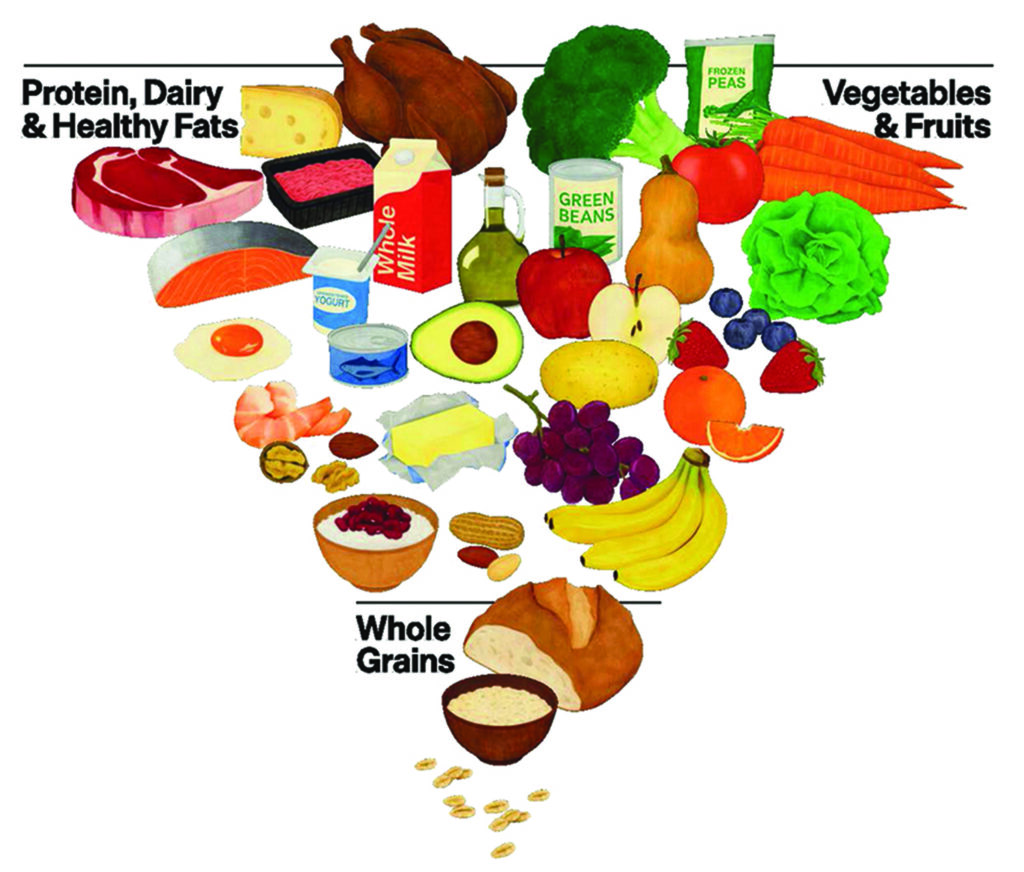
With the release of the 2025–2030 dietary guidelines comes a new food pyramid, which, like its predecessors, is designed to educate the public about food choices while also guiding federal nutrition programs. Perhaps the most noticeable change to the pyramid is that it’s flipped upside-down, thereby placing the foods recommended for greater consumption in the broader category at the top.
What’s New in the Food Pyramid
Ultraprocessed foods comprise about 70% of the food supply in the United States and have been linked to greater risks of cardiovascular disease, type 2 diabetes, obesity, certain cancers, and other health problems. These foods are typically high in sodium and added sugars and include prepackaged and ready-to-consume products like potato chips, deli meats, chicken nuggets, frozen pizzas, instant rice/pasta dishes, and soft drinks.
The overarching theme of the food pyramid and dietary guidelines is to replace these foods with healthier, more nutritious whole foods.
“We have plenty of data showing the inclusion of processed foods, especially ultraprocessed foods, contributes to poor health,” Kirkpatrick says. “It really is the opposite of what we would consider real food.”
Recommended Amounts
The latest Dietary Guidelines for Americans recommend these daily serving amounts based on a 2,000-calorie-per-day diet:
| FOOD GROUP | SERVING SIZE EXAMPLES | DAILY SERVINGS |
| Fruits | 1 cup raw (fresh, frozen or canned); ½ cup dried fruit | 2 |
| Vegetables | 1 cup raw or cooked (fresh, frozen, canned); 2 cups leafy greens | 3 |
| Whole Grains* | ½ cup cooked oats, brown rice, barley, quinoa or buckwheat; 1 slice whole-grain bread; 1 whole-grain tortilla | 2–4 |
| Protein Foods | 3 oz cooked meat, poultry, seafood; 1 egg; ½ cup beans, peas, lentils; 1 oz nuts/seeds; 2 Tbsp nut/seed butter; 3 oz soy | 3–4 |
| Dairy | 1 cup milk; ¾ cup yogurt; 1 oz cheese | 3 |
| Healthy Fats | 1 tsp olive oil or butter | 4 ½ |
* Most true whole-grain foods have ≥1 gram of fiber for every 8 grams of carbohydrate.
Note: Your caloric needs (and number of servings) depend on your age, height, weight and physical activity level. Discuss your individual needs with your physician and/or dietitian.
Other recommendations
Added sugars: No more than 10 grams per meal
Sodium: Less than 2,300 mg/day
Key Principles of the New Food Pyramid
Not surprisingly, the “real” foods emphasized in the dietary guidelines and food pyramid include whole foods like fruits, vegetables, and whole grains (see table for recommended daily servings and examples). The dietary guidelines also prioritize other nutrient-dense options, including protein-rich foods, dairy products and healthy fat sources.
Here are some key tenets of the guidelines:
- Put aside processed foods: Avoid highly processed foods. Limit your intake of added sugars to no more than 10 grams per meal and sodium to less than 2,300 milligrams a day. To achieve these goals, carefully review the ingredients and Nutrition Facts labels of all products you purchase.
- Increase protein intake: The food pyramid now places protein-rich foods in the top tier of consumption, alongside fruits and vegetables. The nutrition recommendations include prioritizing protein at every meal by eating foods including poultry, seafood, red meat, eggs, and plant sources like beans, peas, lentils, and soy. Whereas the National Academy of Medicine’s recommended dietary allowance for protein is 0.8 grams per kilogram of body weight per day for healthy adults, the recommended protein intake in the 2025–2030 dietary guidelines is 1.2 to 1.6 grams per kilogram of body weight per day. (For a 200-pound man, that equates to 109 to 145 grams of protein per day to meet the recommendation—200 divided by 2.2 multiplied by 1.2 or 1.6.)
- Choose healthy fats: The guidelines identify omega-3-rich fatty fish and other seafood, poultry, nuts (and nut butters), seeds, olives, olive oil and avocados as sources of healthy fats, along with full-fat dairy and meats. They label small amounts of butter and beef tallow as “options” for cooking with or adding fats to meals. Additionally, they recommend limiting unhealthy saturated fat to less than 10% of your total daily calories.
Questions About the Dietary Guidelines
Kirkpatrick stresses the need to focus on healthful protein foods, particularly plant sources, seafood, and skinless poultry, while still limiting consumption of red meat. She also points out that while consuming sufficient protein is critical for rebuilding and maintaining muscle, especially as you get older, excessive protein intake can tax the kidneys and be problematic if you have reduced kidney function.
“The protein recommendations may be a bit high for some, but average for others,” Kirkpatrick says. “That is definitely a calculation you could do with your physician or dietitian to determine how much you need.”
Kirkpatrick and other dietary experts also have reservations about the dietary guidelines’ advice regarding fats. They generally agree with most of the recommended healthy-fat options and the advice to limit saturated fat to less than 10% of daily calories. However, Kirkpatrick questions the listing of full-fat dairy and meats among the choices for healthy fats, as well as the inclusion of small amounts of butter and beef tallow. Also, she notes that using butter or beef tallow will make it difficult to stay within the recommended saturated fat limit.
“I am concerned in some ways,” Kirkpatrick says. “I think it could cause people who have been more plant-based to go more animal-based, and the studies don’t show that helps with longevity. I wouldn’t want people to look at this and say, ‘I guess I have to start eating butter and I never have before.’”
Practical Tips for Applying (and Affording) the Food Pyramid
One of the reasons why ultraprocessed foods are so ubiquitous is that they’re convenient, easily accessible, and affordable for many people. With “real” food comes real costs, as fresh produce, meats, and seafood tend to come with a higher price tag.
Still, with a little creativity and education, you can eat healthfully on a limited budget, Kirkpatrick advises. For example:
- Choose frozen or canned produce: As lower-cost alternatives to fresh produce, opt for frozen fruits and vegetables, try fruit canned in its own juice (not syrup), or rinse canned vegetables before eating them.
- Choose lower-cost protein options: Use canned or dried beans or other legumes, which are economical sources of protein and fiber, and buy poultry in bulk (think a bag of frozen chicken breasts).
- Get the most out of your ingredients: You might use frozen spinach and brown rice in a meal one day and then reuse the rest of it for a different dish the next day, Kirkpatrick says.
“Dietitians are going to look at a patient and understand their budget,” she says. “This new food pyramid has brought the conversation about real food and having less processed food to the limelight, and that’s great. But, within dietetic offices across the country, the conversation is still going to be based on what people can afford, what people have access to, what people like and what fits within someone’s health goals.
“You could disagree with some of the guideline recommendations,” she adds. “But I would be confident as a health-care provider to say the guidelines that we’ve had have not contributed to better longevity and health. We need some sort of change. It goes back to each person’s ability to interpret and perhaps utilize someone else to help them figure out what’s best for them. At the end of the day, it’s all going to boil down to personalization, what works for someone and what makes sense for someone based on a lot of factors.”
