
If a beneficiary dies before you do, who receives that person’s inheritance? The answer depends on whether your will or trust uses “per stirpes” or “per capita” distribution.
The distinction between these legal terms can significantly affect who ultimately inherits your assets. “We want our clients to know exactly where their assets will go, and then we just use the legalese in the documents where it’s required,” says Ellen Cookman, JD, founder of the estate-planning firm Cookman Law.
While your attorney may not ask you to explicitly choose between per stirpes and per capita in those exact words, understanding these estate distribution methods can help you better conceptualize your plans.
What Do “Per Stirpes” and “Per Capita” Mean?
Although both per stirpes and per capita address what happens when a beneficiary dies before you do, they determine who inherits that person’s shares in different ways. That’s to say, beneficiary designation is only the prelude to the story… Let’s take a close look:
Per Stirpes Definition
This term comes from the Latin for “by the branch,” and it refers to a method of estate distribution in which the assets are divided equally among each line of the deceased’s descendants.
For example: if the person had five children, the assets would be split into fifths, with the grandchild of a deceased child stepping into the place of the deceased child.
Per Capita Definition
From the Latin “by the head,” per capita is a method of dividing an inheritance equally among the surviving beneficiaries rather than by family branch. The exact rules vary by state and by the language of the will.
Why These Terms Matter in Estate Planning
Whether an estate is planned to be distributed per stirpes vs. per capita can have an enormous impact on the fortunes and feelings of the heirs. Depending on a family’s individual structure and circumstances, either of these methods could feel greatly unjust.
Attorneys insert language regarding per stirpes vs. per capita in wills and trusts to help avoid uncertainty and potential disputes by clearly stating whether a deceased beneficiary’s share should pass to that person’s descendants (“per stirpes”) or be redistributed among the remaining beneficiaries (“per capita”).
To better understand how these concepts work, let’s illustrate some examples.
How Per Stirpes Distribution Works
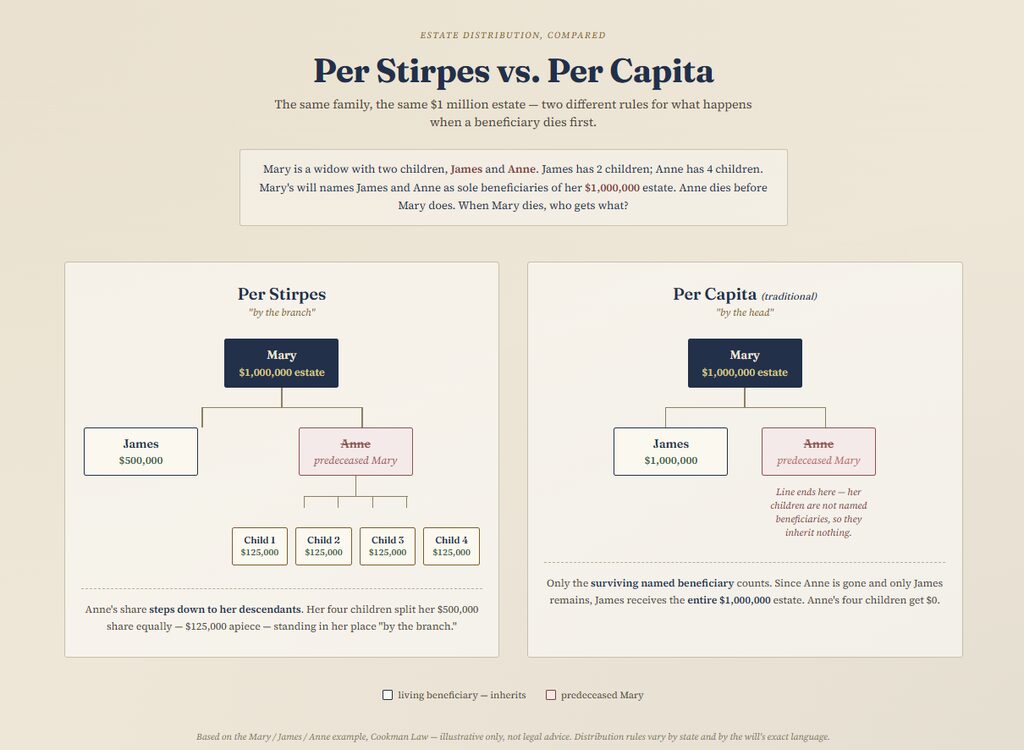
Per stirpes example: Let’s imagine that Mary is a widow with two adult children named James and Anne. James has two children of his own, and Anne has four children. When Mary makes her will, she names James and Anne as her sole beneficiaries and stipulates that her estate is to be passed on per stirpes.
Tragically, Mary’s adult daughter Anne passes away a few years before Mary. When Mary dies, her $1 million estate is divided equally between James and Anne—except that Anne has passed away, so her four children inherit her $500,000 share of the estate. In other words, James gets $500,000, and each of Anne’s four children gets $125,000.
How Per Capita Distribution Works
Per capita example: Now let’s take the exact same set of circumstances and change only the method of estate distribution. So rather than the estate passing on per stirpes, it will be distributed per capita.
Under the traditional per capita model, James would receive the entire $1 million estate. That’s because the only other named beneficiary, Anne, is no longer living. Anne’s children get nothing.
However, because of the obvious injustice inherent to such an outcome, traditional per capita is seldom used today. Instead, states have adopted various versions designed to treat descendants of the same generation more equitably.
Terms associated with these alternative methods include “per capita at each generation,” “by representation,” and “modern per stirpes.” When it comes to the precise legal definitions of these terms pertaining to per stirpes vs per capita, state laws vary.
Generally, in a state using per capita at each generation, James will receive his $500,000 share immediately. The other $500,000 isn’t permanently assigned to Anne’s branch yet.
Now we look down to the second generation and see that the only eligible grandchildren are Anne’s four kids. The remaining $500,000 is distributed to those four equally, for $125,000 apiece. Notice that this is the same result as achieved in our per stirpes example.
But let’s imagine what would have happened if James had also predeceased Mary so that the only living heirs were his two children and Anne’s four…
Under traditional per stirpes, each of the two branches would receive a $500,000 share to split among themselves. James’s two children would each get $250,000, while each of Anne’s four kids would receive only $125,000. That doesn’t feel equitable.
Using per capita at each generation, the two unclaimed shares are combined back into $1 million, and the six grandchildren all share the estate equally, receiving about $166,000 apiece. That feels fairer to most people.
Per Stirpes vs. Per Capita: Key Differences
|
Key differences |
Per stirpes |
Per capita |
|
Meaning |
“By the branch” of the family tree |
“By the head” or “by the person” |
|
Basic idea |
A deceased beneficiary’s share passes to that beneficiary’s descendants |
The estate is divided among the beneficiaries according to the applicable distribution rules, generally based on the surviving beneficiaries rather than family branches
|
|
In simple terms |
“My children shall inherit equally, and if any child dies before me, that child’s descendants shall receive that child’s share”
|
“My beneficiaries shall share equally according to the applicable per capita method” |
|
Effect on grandchildren |
Grandchildren only inherit through their deceased parent’s share |
Grandchildren may or may not inherit, depending on the specific per capita method and state law, but if they do, they inherit directly, not through a deceased parent’s share.
|
Pros and Cons of Each Method
In a vacuum, there really are no inherent advantages or disadvantages to either model. A preference for one or the other will be highly individualistic. “A lot just depends on the family dynamics,” Cookman says. “One kid might turn out to be a Wall Street guru while the other one’s a schoolteacher.”
It’s therefore up to individual families to decide on their values and the needs of their offspring. “Sometimes it’s about who the family thinks is going to do a better job with investing and making the assets grow,” Cookman adds. “It can go any number of ways.”
Choosing the Right Option for Your Estate Plan
As confusing as these models are, it’s encouraging to know that a good estate-planning attorney can guide you through the process. Your job is simply to lay out your family tree and make your wishes known. The attorney can take it from there.
“For our clients, we usually prepare a flow chart so people can see visually where the money would go when they’re gone,” Cookman says. “The most important thing is to know your own family and where you want your stuff to go. Then we just find the right words that fit.”