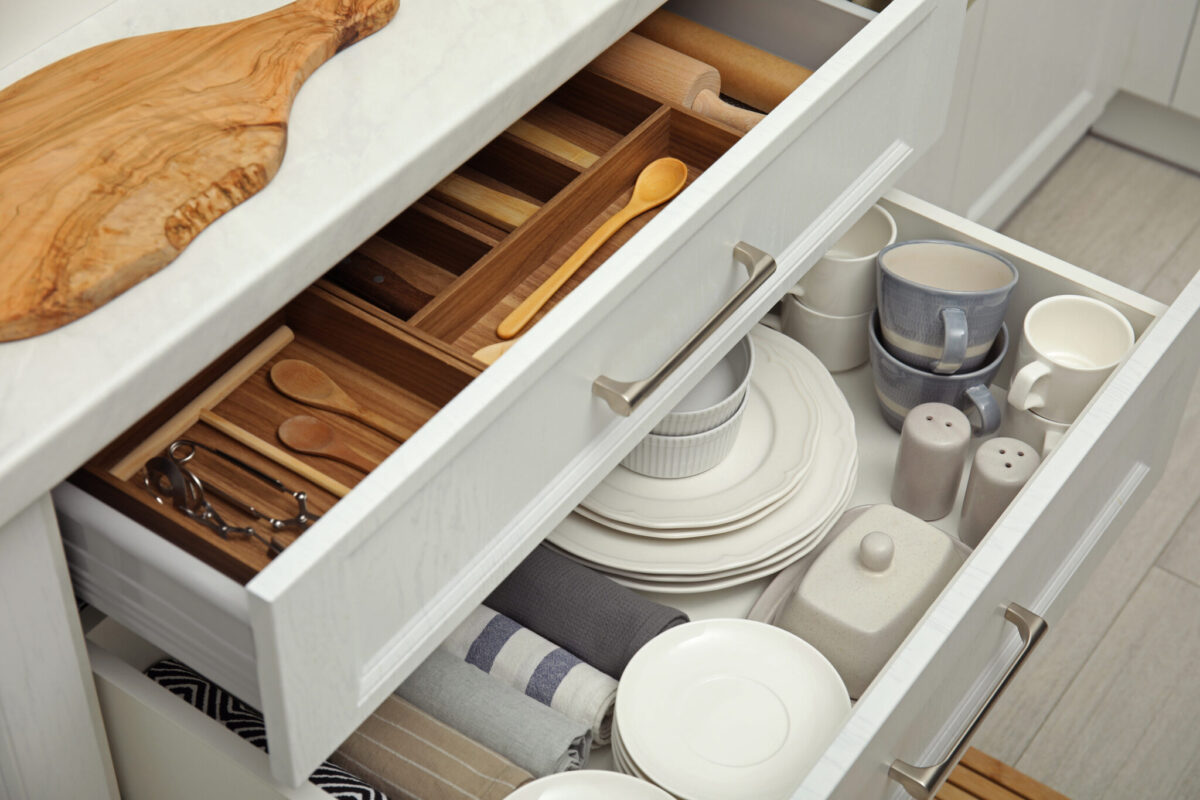
There are lots of places to start when organizing your kitchen, but your drawers often are the neglected catch-alls that cause frustration. Whether you’re grabbing a quick snack, cooking up a big meal or jotting down a few things you need from the store, having organized drawers can makes those tasks easier. We spoke to Tanisha Lyons-Porter, founder and professional organizer at Natural Born Organizer, for the best way to approach organizing your kitchen drawers.
Assess Your Kitchen Drawers
Start by looking through your drawers. Lyons-Porter says, “Ask yourself if you have to dig or shuffle items to find what you need or if there are similar items or categories scattered across various drawers.” As you search…
- Make note of the items used daily or weekly. Determine whether you can move them to easier-to-grab-from drawers or combine them with similar items.
- Put aside anything that is rarely used or brought out for only special occasions.
- Identify and remove anything that prevents a drawer from opening or keeps it cluttered. “If drawers are getting stuck or not opening all the way…or you are irritated every time you have to look for something…that is a sign that you need to start organizing,” says Lyons-Porter.
Declutter Before You Organize
Before organizing your drawers, start with decluttering. “Identify what is used daily and weekly,” says Lyons-Porter. “The items that are not high frequency can then be reviewed.” Take a look at each item, and place it into one of the following piles…
- Keep (items used daily or weekly)
- Store elsewhere (special occasions only)
- Donate
- Return to owner (if borrowed)
- Trash or recycle
If you are having trouble figuring out whether something needs to stay or go, Lyons-Porter suggests, “Frequency of use helps a lot if we’re honest with ourselves.” Move occasional-use items, such as holiday-only casserole dishes and rarely used kitchen appliances, out of primary storage spots.
Once you’ve cut down on what you’re storing in your kitchen, it is time to select organizers that work with what drawers and cabinets you have.
Choose the Right Organizers and Dividers
Choose organizers that meet specific organizational needs. Here are a few commonly found options…
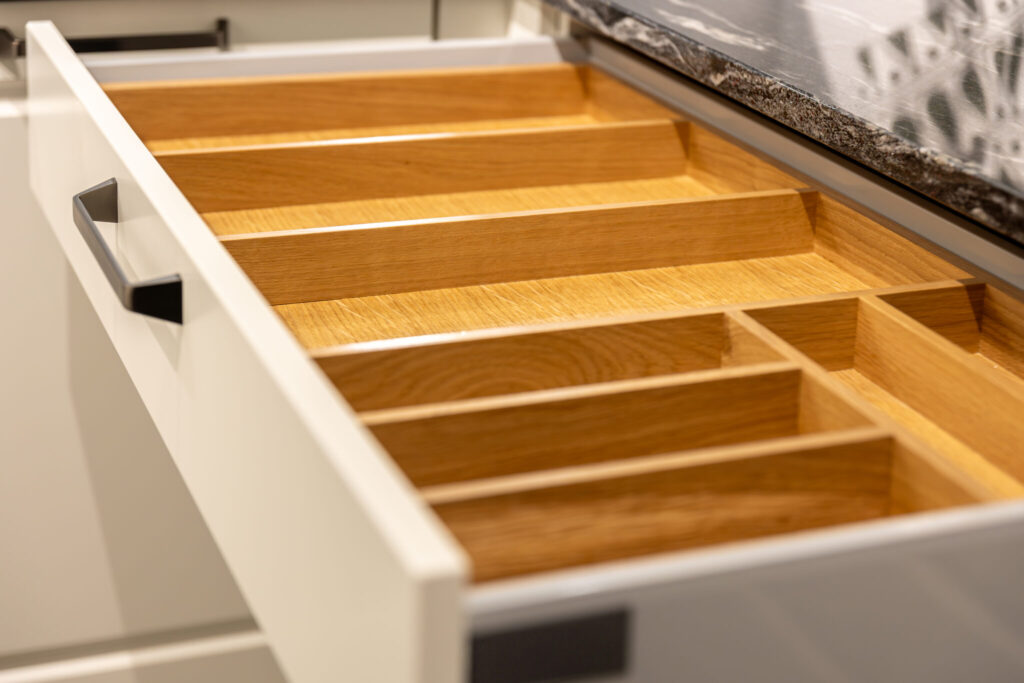
- Drawer dividers that can be inserted into drawers to segment drawer space. These work for most different types of drawers except very deep ones, which are best for larger pots and pans.
- Pegboard organizer that includes standing pegs to secure items in place, such as bowls, plates or plastic containers.
- Divided trays: These are perfect for multifunctional drawers, including junk drawers, that hold a variety of items.
- Flatware and cutlery organizers: “Flatware trays are predivided and sized perfectly for most flatware,” says Lyons-Porter. A cutlery organizer is similar but can hold a wider range of kitchen utensils, including wine openers, grilling accessories and more.
- Specialty organizer comes in handy for specific objects, such as spice bottles, coffee pods and more.
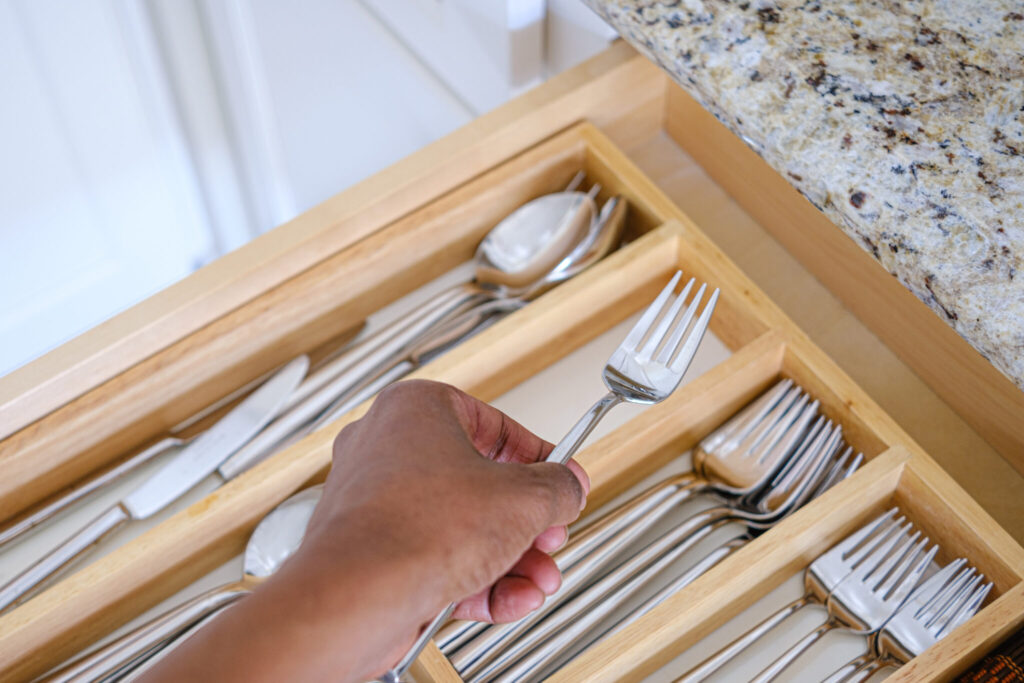
Reminder: Before making a purchase, measure and make note of the height, weight and depth of each drawer. Consider purchasing tension dividers that can be adapted to different sizes and are flexible enough that you can move them to other drawers, if needed.
Also keep in mind aesthetics and budget. There are many materials to choose from, including “clear, wood, white or plastic,” says Lyons-Porter. Organizers made with certain materials and styles can be costly. “If budget-friendly is the top priority, then bamboo trays or dividers are not a good fit,” she adds.
Organizing Different Types of Kitchen Drawers
Now that you’ve decluttered and you have your organizers ready, it is time to make sense of your kitchen drawers. Give each drawer a purpose to make it easier to keep things in their place. “An open space with no boundaries is the enemy of organization,” says Lyons-Porter. Consider these options…
Flatware and cutlery drawers
Designate an official flatware or cutlery drawer. Choose one that’s easy to access. Lyons-Porter recommends putting “everyday flatware in the front,” where it’s most accessible in the tray. “Place any low-frequency-use items like crab picks toward the back.”
If you don’t already have a knife block, consider a drawer organizer that is designed to safely hold sharp knives. “Place each knife in its own slot to prevent accidents,” says Lyons-Porter.
Deep drawers (pots, pans and bakeware)
Use deep drawers to hold large items, such as pots, pans and bakeware. “Deep bins and tension dividers are great for [this area],” says Lyons-Porter. Once again, store regularly used items in the front. Pair lids with matching pots in the same drawer if there is room…or storelids “upright like files in a file cabinet [to] create easy access.”
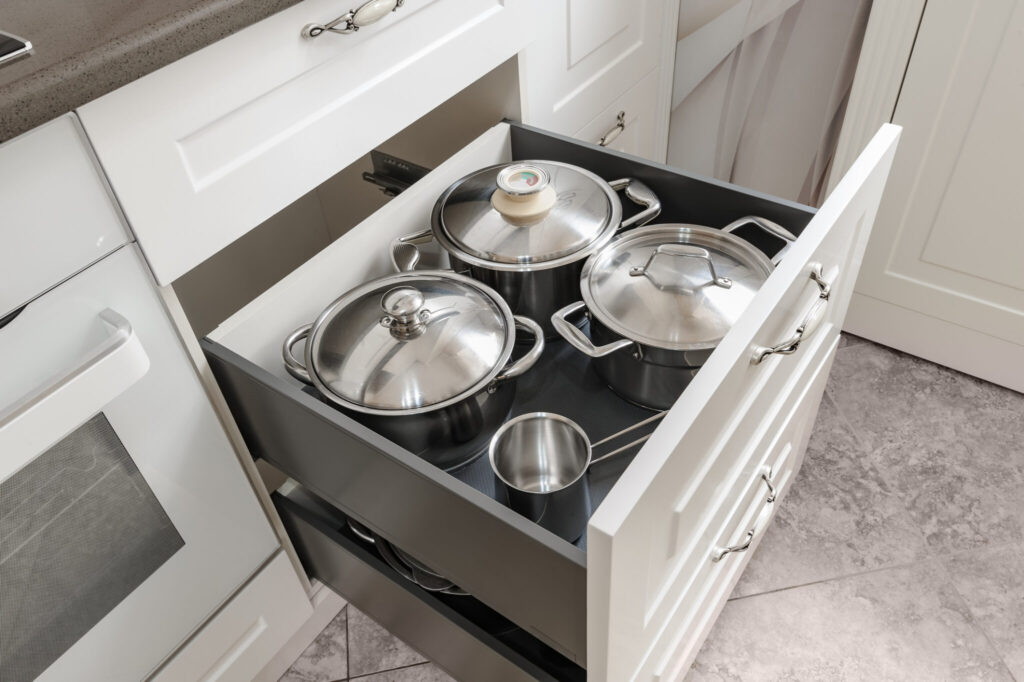
Lyons-Porter advises, “Avoid stacking too many pots and pans” so it is easy to find and grab a specific pot or pan without moving others out of the way.
Food-storage-container drawers
Designate a drawer for food-storage containers to make it easy to find what you need for leftovers, a picnic lunch or goodies for a loved one. Best: Use nesting containers for storage, and match food storage sets—both lid and container—before organizing them into drawers.
Small or miscellaneous drawers
Small or miscellaneous objects—typically found in the junk drawer—serve a purpose in every kitchen. Lyons-Porter says, “The goal of a miscellaneous drawer is to still be able to find the random items you need from time to time.” Use trays or drawer organizers to hold loose items, such as batteries (make sure they still work) or rubber bands. Also, store compatible items together. Example: Store office supplies (such as paper clips, extra staples, pens, pencils and notepads), appliance manuals and charger cords in the same place.
Tips for Maintaining Organized Drawers
After you’ve organized your kitchen drawers, you will want to keep them that way. Here’s how…
- Set a monthly reminder to review each item in the drawer. If you have to dig through drawers to find something, it’s a sign it’s time to reorganize again.
- Toss broken or non-working gadgets or kitchen supplies. Leaving them in drawers just lets junk pile up.
- Replace organizers as they break or show signs of wear and tear.
Maximizing Space in Small Kitchens
Remember to use vertical space, advises Lyons-Porter. For deep drawers, add organizers that add levels, such as tiered trays, stackable bins or expandable inserts so you can store more without becoming disorganized.
She also recommends making use of your cabinets. “If your cabinets don’t already have built-in tiers or shelves, create them using expandable shelves,” she advises.
When you’re working with smaller drawers, it’s important to be intentional about what you keep. Make sure that each item has a purpose in your kitchen. Lyons-Porter says, “Create zones—such as activity and storage—to determine how to use the space you are given.” Consider…
- Daily-use drawer for things you use the most (such as utensils, notepads for grocery lists or storage items, such as containers, baggies and more).
- “Drop zone” for items, such as keys, batteries, remotes and other items that tend to be found throughout the house and need a central location
- Kid-accessible drawer so your child can easily grab a snack, for example.
Tanisha adds, “Don’t waste storage space.” Fill awkward gaps or narrow spaces with pull-out trays or adjustable dividers.