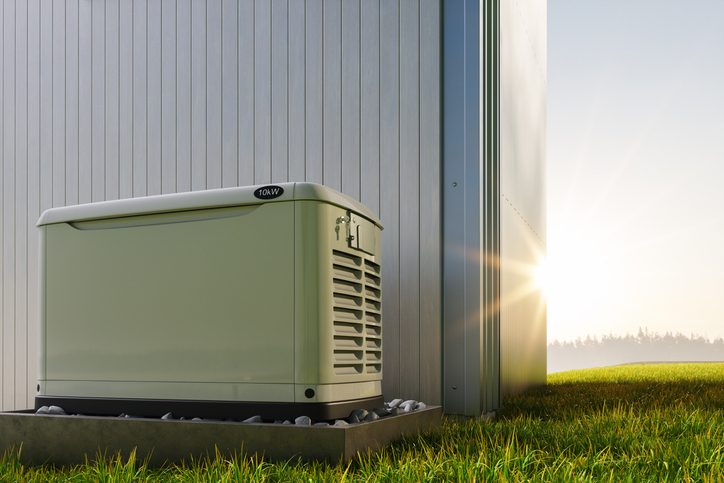
One in four United States households experience power outages each year. Of those, 70% have at least one outage lasting 6 hours or longer. In these situations, whole-house generators provide reliable backup power so you can keep using your lights, appliances, and HVAC system. If you’re thinking about installing a generator, how do you know which size you need or which unit to choose?
John Pountnay, Generator Expert and Department Manager at TriStar Electric, walked us through how whole-home generators work, their costs, and the technical factors involved in sizing them. He also offered his top product recommendations for homeowners considering this type of installation. Overall, he suggests sticking with the following:
What a Whole-House Generator Does
Whole-house generators provide backup power to your entire home. They’re hardwired into your main electrical panel via an automatic transfer switch. During a power outage, the system detects the loss of power and turns on automatically.
When properly sized, a whole-home generator can power every single circuit, from your lights and refrigeration to your entire heating and cooling system.
Whole-house standby generators differ from portable generators—the kind that’s mounted on a wheeled cart, stored away, and brought out during a power outage. These have significantly lower output, so you’re limited in what you can run. Whole-home generators offer many benefits over portable systems, including:
Automatic operation
“It’ll come on within 30 seconds of the outage and without you having to lift a finger,” Pountnay says.
Portable generators require you to move the generator out of storage, connect it to a specially installed outlet, turn off the main breaker, turn on the backfeed breaker, and manually start the unit.
Reliability
Portable generators are usually stored away for months or years between uses. Pountnay explains that a lot could have gone wrong in this time: carburetors might have clogged, gas might have gone bad, spark plugs might have needed service, or mice could have chewed through wires.
When you go to use the system, you might find that it doesn’t work. Just like a car, “the worst thing that can happen to an engine is if you let it sit,” Pountnay says.
Every week, whole-home standby units start up and run through a cycle. This process is called an “exercise.” It gives the generator a chance to trigger error codes in case something is wrong.
Many times, whole-home generators have cellular monitoring, so you and your generator company will be notified if the system needs maintenance. All of this ensures your generator works when you need it.
Longer Runtimes
“Most fuel tanks on portable generators only have a seven or nine-hour runtime,” Pountnay explains. You either need fuel on hand or hope that the gas station has power to pump it.
Whole-home generators are often powered directly by your natural gas lines, so they’ll never run out of fuel. Sometimes they’re powered by large propane tanks—500-gallon and two 100-gallon tanks are the most common configurations. But even with two 100-gallon tanks, Pountnay says you can run your generator for over 100 hours.
How to Choose the Right Size Generator
The most important factor when selecting a whole-home generator is size. If you install a system that’s too small, the generator can easily overload and turn itself off. If you install one that’s too big, you’re wasting money.
“Whole-home generators are sized by load calculation,” Pountnay explains. During a generator load calculation, your installer will tally the wattage of your electrical panels, HVAC system, appliances, and any other electrical equipment. The total reflects the minimum wattage rating your generator needs. 24 kW is the most common.
However, it gets more complicated when using natural gas. “Natural gas actually derates the power output of air-cooled generators,” Pountnay says.
For example, a dual-fuel (meaning it can run on natural gas or propane) Generac generator rated at 26 kW for propane will only support 22.5 kW on natural gas. This is why it’s important to work with an electrician who understands the nuances of generator size calculations.
Air-Cooled vs. Liquid-Cooled Generators
Home backup generators come in two varieties: air-cooled and liquid-cooled. Each has its own pros, cons, and ideal use cases.
Air-cooled generators use a fan to blow ambient air across the generator’s motor to prevent it from overheating. They are the most affordable option, but their output is limited to 28 kW.
They also lack enough cooling power to function well in extremely hot environments. However, “an air-cooled unit is going to do just fine for 90% of houses out there,” Pountnay says.
Liquid-cooled generators use a radiator and coolant and work similarly to a vehicle. The coolant is pumped throughout the generator’s motor, where it absorbs and removes heat. The coolant then goes back to the radiator. It then cools down, and the cycle begins again.
Liquid-cooled is larger with a more complex design—and is therefore more expensive. But liquid-cooled also offers significantly higher power output and cooling capability. They’re ideal for large, luxury homes with heavy electrical loads, or homes in very hot climates. “The smallest liquid-cooled you can get from Generac is a 25 kW, but in a residential / light commercial application, you can have up to a 150 kW installed at your home,” says Pountnay.
The functional difference between air- and liquid-cooled generators is how much you can power, and when. “The liquid-cooled, when sized properly, allows you to use all of your heavy electric loads at the same time. The air-cooled allows you to use all of your heavy electric loads, just not all of them at the same time,” Pountnay explains.
Power Management: Do You Need Full-Home Backup or Prioritized Loads?
Whole-home generators don’t have to power the entire house. Instead, you can install a select-circuit standby generator. These units are still automatic and hardwired into the electrical system, but they’re connected to a subpanel rather than the main panel.
This subpanel has a limited number of priority loads—things like lights, your refrigerator, your water pump (if your house has a water well), and your sump pump. You can only use those circuits during a power outage.
Select-circuit generators are smaller, and thus less expensive, but the price difference is often only $1,000 to $3,000. Installing select-circuit generators can just as labor-intensive as whole-home units, which doesn’t leave much room for savings.
Pountnay explains that the main electrical panel is often incorrectly or poorly labeled. So, the electrician has to spend time going through the home, testing circuits, and relabeling them to ensure the correct circuits get backed up by the generator. “When you have a whole-home generator installed, you don’t have to worry about this; it covers everything,” Pountnay adds.
There’s another caveat—according to Pountnay, select-circuit generators have a lower return-on-investment when it comes to resale than a true, whole-home system.
“The reason behind that is because it’s custom to what you want the generator to back up, not the next homeowner,” he says. “With the whole house, it’s more attractive to say, ‘Yep, everything’s backed up.’ So, it adds a lot more value.”
With the minimal upfront cost difference, investing in a select-circuit system might not be worth it. “I always recommend that people install a whole-home generator,” Pountnay says.
Smart management modules
Smart management modules are an alternative way to reduce your generator size and upfront installation costs. If your generator ever reaches full capacity, these modules perform load shedding.
They drop every load, and then slowly reintroduce each individual load to the generator at timed intervals, based on which loads you’ve programmed it to prioritize.
Pountnay explains that power management generators with these power management modules are subject to different load calculation rules: “If we put a smart management module on your car charger, your pool, your sauna, your dryer, your range — now I get to count those appliances as zero load in my load calculation, so that decreases the size of generator you need.”
Best Whole-House Generator for Different Home Types
The best generator depends on a home’s size and electrical load, its appliances (electric vs. gas), and the climate.
- Small to Medium Homes: Air-cooled generators are sufficient for normal-sized homes in moderate climates. The size depends on whether the home has all-electric or gas appliances. All-electric homes will require a 24-kW generator. Homes with a gas water heater, oven, and range can get away with a 14- or 18-kW system.
- Large Homes With Heavy Loads: The bigger a home is, the larger its electrical load likely is. Generators for large homes need higher output ratings and better cooling mechanisms to prevent overheating. Choose a liquid-cooled 48 kW unit or larger.
- Homes in Hot Climates: If you live in a very hot climate like Arizona, you might want to consider a liquid-cooled generator. With summer temperatures reaching 115 degrees, there could be real concerns for an air-cooled generator. Liquid-cooled systems are generally only available in 22 kW or larger configurations.
- Homes in Cold Climates: Air-cooled generators are sufficient for cold-climate homes with a rating down to –20 degrees, and sizing depends on your electrical load. Pountnay says ask your installer about a cold weather kit. “It’s basically heaters and warmers throughout the generator to keep things from freezing,” he explains.
Pountnay also recommends sticking to Generac or Kohler generators, since they account for about 72% and 15% of the market, respectively.
|
Type of Home |
Best Generator Options |
|
|
|
Generac |
Kohler |
|
Small to Medium Homes |
Model #: 7326 · 24 kW · Air-Cooled · W/ Transfer Switch
Starting Price: $7,789 |
Model #: 26RCAL · 26 kW · Air-Cooled · W/ Transfer Switch
Starting Price: $8,515 |
|
Large Homes w/ Heavy Loads |
Model #: XG04845ANAX · 48 kW · Liquid-Cooled
Starting Price: $25,179 |
Model #: 48RCLC · 48 kW · Liquid-Cooled
Starting Price: $25,703 |
|
Normal-Sized Homes in Hot Climates |
Model #: RG02515A · 25 kW · Liquid-Cooled
Starting Price: $13,669 |
Model #: 30RCLA · 30 kW · Liquid-Cooled
Starting Price: $20,399 |
|
Normal-Sized Homes in Cold Climates |
Model #: 7326 & Generac Cold Weather Kit · 24 kW · Air-Cooled · W/ Transfer Switch
Starting Price: $7,789 & $142 |
Model #: 26RCAL & Kohler Cold Weather Kit · 26 kW · Air-Cooled · W/ Transfer Switch
Starting Price: $8,515 & $756 |
Cost Factors to Consider
Many factors contribute to the total cost of a whole-home generator installation. Despite what you might think, the generator itself is not the most expensive part—the installation is. “It’s actually a much bigger undertaking than a lot of people realize,” Pountnay says.
Expect to pay $17,000 – $30,000 for a full, turnkey installation with a standard air-cooled generator. This range depends on how much additional work is needed, such as burying a propane tank. Additionally, in lower cost of living states, you can possibly expect a slightly lower range for a turn-key whole-home generator installation.
Some contractors may offer bids closer to $14,000 – $15,000, but don’t expect it to include any gas work. Large, liquid-cooled generator installations are much more expensive.
Ongoing costs should also be considered. Fuel, whether natural gas or propane, adds up after extended generator use. You’ll also need to pay for maintenance.
“There is a list that Generac and all the other brands put out for maintenance items that need to be checked off in order to keep your warranty from being voided,” Pountnay says.
He emphasizes the importance of keeping up with yearly maintenance and enrolling in a cellular monitoring plan with your generator installer so someone watches over your system.
How to Decide Between Options
A whole-home generator isn’t a DIY project, so you don’t necessarily have to know which generator you need. Your installer will figure that out during their load calculation. But if you want a rough idea going into the project, stick to these general rules of thumb:
- Normal-sized homes in moderate climates — use a 24 kW air-cooled generator.
- Large home with heavy electrical loads — use a 48+ kW liquid-cooled generator.
- Hot climates — consider a liquid-cooled generator.
- Cold climates — use a generator with a cold weather package.