The acromioclavicular (AC) joint is formed where the collarbone (clavicle) meets the top of the shoulder blade. This joint can develop arthritis or be injured, usually after a direct blow to the shoulder.
“It’s common to see arthritic changes on x-rays and MRIs, and the vast majority of those findings are incidental and do not cause symptoms,” says Cleveland Clinic orthopedic surgeon Mark Schickendantz, MD.
In other words, arthritis seen on imaging often is not the reason for AC joint-related shoulder pain. Rather, AC joint pain is more often caused by an injury. Treatment for AC joint problems may be nonsurgical or surgical, depending on how severe the injury is and the types of activity you hope to resume after you recover.
What Is the AC Joint?
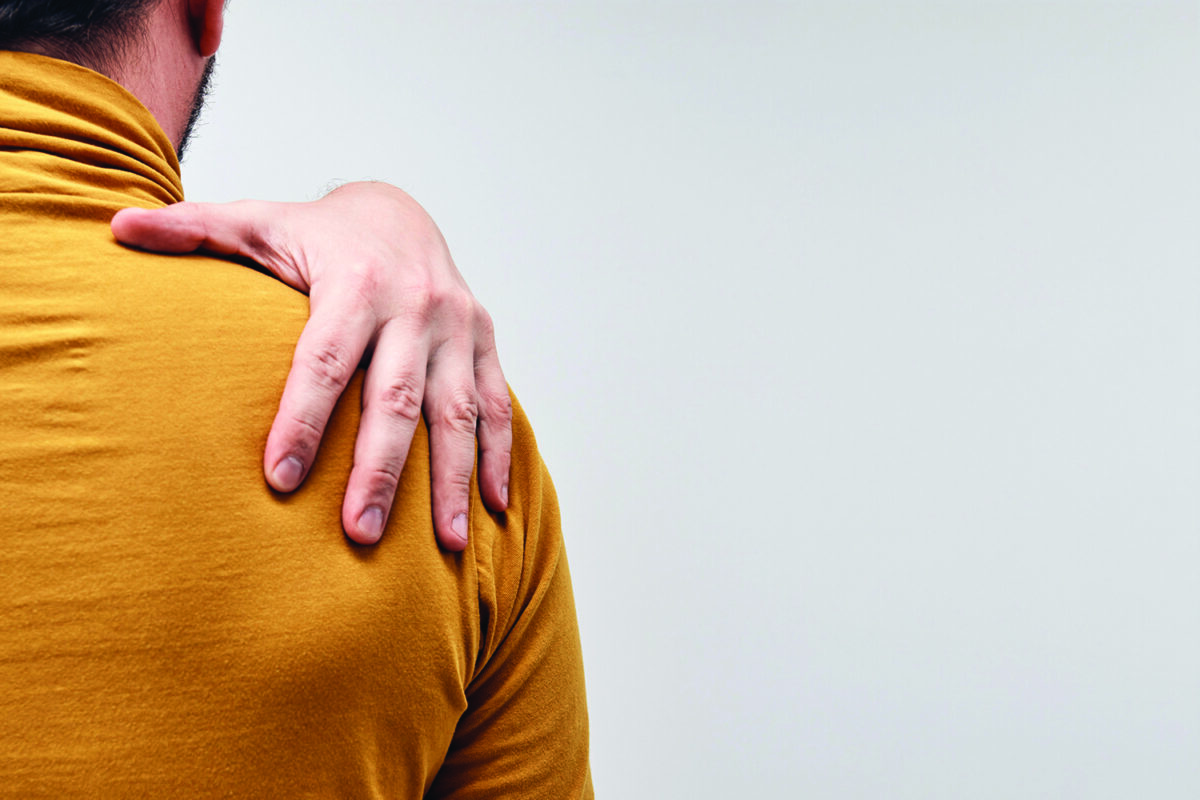
The AC joint is the small bump you can feel on the top of your shoulder. It connects the clavicle, or collarbone, to the acromion, located at the top of the scapula, or shoulder blade. This joint helps your shoulder move when you lift your arm overhead, reach across your body or move your arm behind you.
Causes and Risk Factors of AC Joint Injuries
AC joint injuries are usually caused by falls or sports injuries.
“Somebody who falls and lands on their shoulder directly can damage the joint,” Dr. Schickendantz says. “This can happen in bike crashes or falls onto an outstretched arm.”
Collision sports such as football, rugby, and hockey also raise the risk. In baseball, the injury often happens to the glove-side shoulder when a player crashes into a wall while trying to make a catch.
Although arthritis is common in the AC joint, it rarely causes symptoms by itself. Many people have signs of wear and tear on imaging without any pain.
Radiologists will often note the arthritic changes in the joint when reviewing x-rays or magnetic resonance imaging (MRI) scans, and sometimes people come to Dr. Schickendantz asking if the AC joint arthritis is the cause of their shoulder symptoms. Usually, the answer is no.
“It’s pretty unusual to have isolated AC joint arthritis that is painful and the cause of symptoms in any age group,” he says.
Symptoms of AC Joint Injuries
Common symptoms of AC joint problems include pain, swelling, limited motion in the arm, or a visible bump on top of the shoulder.
“Tenderness in that AC joint location on top of the shoulder is diagnostic of injury,” Dr. Schickendantz says.
Types and Classification of AC Joint Injuries
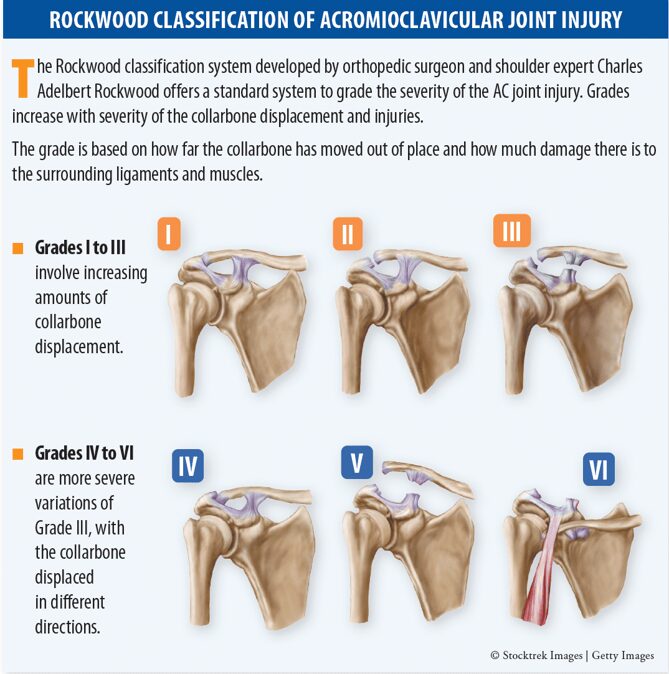
AC joint injuries are graded from I to VI based on how badly the ligaments are injured and how far the collarbone has moved out of place. Higher-grade injuries are more likely to cause visible deformity and may be more likely to need surgery.
“If the joint is unstable enough, the collarbone will rise up above the AC joint, and you can see that on an x-ray,” Dr. Schickendantz explains.
The amount of collarbone displacement and injuries to the ligaments and muscles around the joints determine the Rockwood grade, a system used to determine the severity and recommended treatment for AC joint injuries. Grade I injuries are the most common and the least severe, with the smallest displacement of the collarbone. Grade VI injuries are the most severe and least common. Grade VI injuries are so rare that in his 35 years of practice, Dr. Schickendantz has never seen a grade VI injury.
Diagnosing AC Joint Injuries
To diagnose an AC joint injury, your doctor will review your medical history, physical exam and x-rays. An MRI may be ordered if your provider suspects another shoulder injury, such as a rotator cuff tear. MRI can also show the ligaments around the AC joint.
Unlike rotator cuff pain, AC joint pain is usually felt right on top of the shoulder, though it can sometimes travel up the neck.
“I see patients every day who have pain from rotator cuff injuries and have arthritic changes in their AC joints that they learn about on their x-ray reports,” Dr. Schickendantz says. “They often ask me about the arthritis in the AC joints noted in their x-ray results. The answer is it’s usually an incidental finding. It happens to be there. It’s very common. It’s not symptomatic. It usually has nothing to do with the symptoms that they’re having with their rotator cuff problem.”
Treatment Options for AC Joint Injuries
Nonsurgical treatments—including rest, ice, physical therapy, and immobilization of the affected joint—are the preferred approach for the more common lower-grade AC joint injuries. Over-the-counter anti-inflammatory medicines such as ibuprofen (Advil, Motrin) and naproxen (Aleve) also may be used. A sling helps protect the shoulder early on. Physical therapy can then help restore strength and movement.
Surgery may be an option for people with more severe injuries, especially active people and athletes who want to return to high-demand activities. During surgery, the surgeon puts the joint back in position and repairs or reinforces the damaged ligaments, sometimes using a graft made from a piece of hamstring tendon taken from the leg. After surgery, patients usually wear a sling for about a month, removing it only for specific exercises and light activity.
There is no age limit for surgery. Surgery carries added risks from anesthesia and infections and is not necessary for many AC joint injuries to heal.
Recovery and Rehabilitation
Recovery time depends on the severity of the injury and whether surgery is needed. Dr. Schickendantz tells patients that it often takes “every bit of six months to get these AC injuries better.”
After surgery, it usually takes three to four months for the ligaments and graft to heal, followed by more physical therapy. Rehab is tailored to the person’s goals. Athletes may follow a sport-specific return-to-play program.