One of the most important tools of independence you have as you get older is dexterous fingers. Think about it: You use them for fastening buttons, meal prep, eating, using your phone and TV remote control, and undoing the cap of medication bottles. So, finger injuries—including finger dislocation—can be surprisingly disruptive.
Unfortunately, it is all-too-easy to sustain a finger dislocation. You might fall and land awkwardly, catch your finger in something, or dislocate your finger while playing pickleball. The good news is that most uncomplicated finger dislocations heal quite well with medical treatment and physical therapy.
What Is a Dislocated Finger?
A finger dislocation means that your finger bones—called phalanges—have been forced out of alignment at one of the joints in your fingers, so that the ends of the phalanges are no longer in contact with each other. (In another type of injury, called finger subluxation, the ends of the phalanges maintain some contact.)
The misalignment that characterizes finger dislocation happens because a sudden force or impact pushes your finger backward, beyond its safe range of motion. When this happens, the ligaments and tough, flexible layer of tissue (known as the joint capsule) that hold a joint together come under great stress. If they are overstretched, they may tear—and without their stabilizing force, the joints can dislocate.
“In some cases, the dislocation also causes a small fracture or pulls off a tiny piece of bone to which a ligament was attached—called an avulsion fracture,” says Jaehon M. Kim, MD, a Mount Sinai orthopedic surgeon. “However, nerves and arteries are very elastic, and in most cases, they are not significantly damaged.”
Research published in the Journal of Hand Surgery in May suggests that older adults are most likely to dislocate their middle or index finger during a fall (in contrast, younger people are more likely to dislocate their pinky finger during sports). The middle joint of the finger—called the proximal interphalangeal joint—is the one that is most prone to dislocation.
Dislocated Finger Symptoms
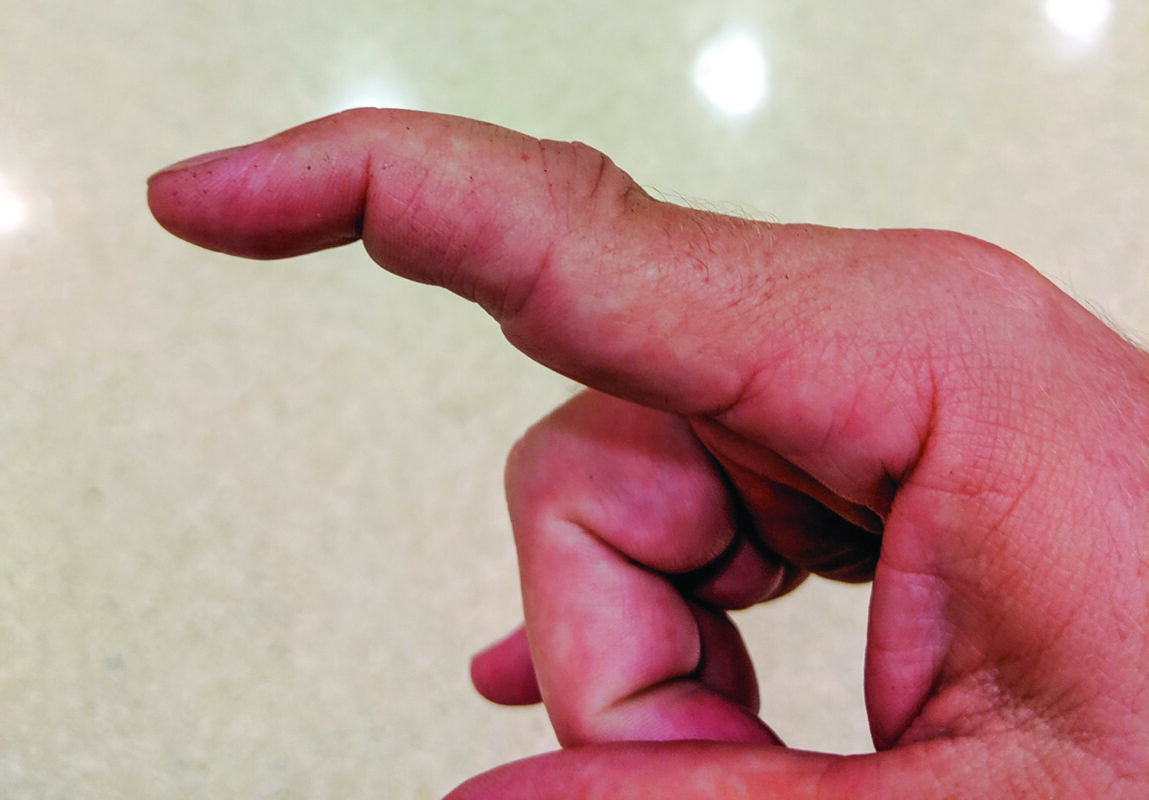
A finger that has been dislocated usually looks unnaturally bent, crooked, or misaligned. Other dislocated finger symptoms include:
- Sharp pain right after the dislocation occurs, followed by throbbing pain
- Rapid swelling
- Bruising due to bleeding around the joint
- Inability to straighten or bend the finger
- Numbness or a tingling sensation if there is any nerve injury
Dislocated Finger vs. Broken Finger
Some dislocated finger symptoms are the same as those that occur with a broken finger. For example, both injuries cause pain and swelling, both limit motion in the joint, and both can cause the finger to appear deformed (keep in mind too, that a finger dislocation and a finger fracture can occur simultaneously). However, there are some differences between the two injuries.
“A finger dislocation often causes an unnatural angle at the affected joint, making it look like it shifted to one side, and there may be a gap between the ends of the bones,” Dr. Kim says. “The swelling tends to center on the joint, whereas the entire finger may swell if it is broken. Also, a broken finger will often retain some mobility unless the break is severe, while you won’t be able to naturally move a dislocated finger.”
Your doctor will check for all of these physical symptoms in making the diagnosis. They also will ask you how you incurred the injury, since this information can provide clues as to whether the finger is dislocated or broken. Dr. Kim says a finger dislocation is more likely to result from sudden twisting or extreme bending of the finger, but a hard blow to the finger is more likely to cause a fracture. “X-rays are critical for confirming the diagnosis and will also show whether an avulsion fracture occurred,” he notes.
What to Do Right Away
You’ve probably seen many television dramas and movies in which the hero has a dislocated shoulder “popped” back into place (officially known as reducing a dislocation). But don’t be tempted to reduce a dislocated finger yourself, since you could permanently injure adjacent nerves and blood vessels. Instead, immediately remove any rings before the swelling worsens, and then head for the closest urgent care facility or emergency department for finger dislocation treatment. A word of caution here: Sometimes a dislocated finger will spontaneously return to its normal position, but Dr. Kim emphasizes that it still is important to seek medical assessment, since there could be a soft tissue injury or a fracture.
“X-rays are essential, since some dislocations can be accompanied by a complex fracture,” Dr. Kim observes. “Not getting an x-ray would be like going to a cardiologist and not getting an EKG.” He adds that because of swelling, some dislocations don’t show obvious angulation. “I’ve had many patients who showed up in my office several weeks after the injury because their finger felt fine,” he says. “Unfortunately, a delayed diagnosis can cause significant complications to finger function after a dislocation and, in some cases, may result in permanent loss of motion.”
Dr. Kim recommends treating a finger injury as an urgent matter, adding that you should focus on comfort care until you see a doctor. Step one is to immobilize the finger. A good way to do this is to use tape, a bandage, or a strip of cloth to gently secure it to the finger right next to it (called buddy taping). Apply an ice pack for 15 to 20 minutes (wrap a bag of frozen diced vegetables in a towel and use that if you don’t have a proper ice pack). Also, rest your hand on a couple of pillows so that it is resting above heart level, since doing so will help reduce the swelling. You may take acetaminophen (Tylenol) for pain relief.
How Is a Dislocated Finger Treated?
After x-rays to determine the extent of your injury, the doctor will administer local anesthesia before gently manipulating the joint back into its normal position (called reduction). You may have another finger x-ray afterward to confirm that the bones are aligned correctly.
“Your doctor likely will buddy-tape the finger to provide support while damaged tissues heal or may use a finger splint to help prevent movement that could interfere with the healing process,” Dr. Kim says. “The length of time such support is needed will depend on how severely your finger was dislocated, but it generally is short—a few days to a week.”
He adds that more severe finger dislocations may require surgical correction, particularly if there is significant soft tissue damage or an associated fracture, or if interposed structures (surrounding soft tissues that have become trapped in the joint space) make the injury unreducible.
Recovery and Healing Time
An uncomplicated finger dislocation should feel better within about six to 12 weeks, but there probably will be some residual stiffness, weakness, and aching even after this time has elapsed. You’ll be advised on when you can start moving your finger—careful movement is encouraged fairly early during recovery, to help prevent permanent stiffness in the joint. “Older adults often struggle with regaining motion of the joint after a finger dislocation,” Dr. Kim says. “Occupational and physical therapy are important for optimizing function.”
Certain factors can affect recovery from this type of injury. For example, if you have arthritis in your fingers, you may not recover your full range of motion after finger dislocation and the arthritis in the affected finger may worsen. People who do not have arthritis in their fingers may develop it afterward due to the dislocation. “Arthritis reflects erosion of the cartilage that coats the ends of the bones in a joint and enables smooth movement, but a finger dislocation sometimes damages the cartilage,” Dr. Kim says.
When to Seek Emergency Care
Finger dislocation requires immediate treatment. Go to your nearest emergency department if you have any of these symptoms:
- Signs of possible interrupted blood flow. “These include a noticeably colder finger that is numb or tingling, and/or turns very pale or takes on a bluish-gray tinge,” Dr. Kim says. People of color should stay alert for the injured finger to become darker or different in color than their other fingers, along with the other symptoms.
- An open wound over the injured joint, and/or bone being visible.
- A finger that is bent at an extreme angle.
- Severe pain that is making you feel nauseated and/or dizzy.