Depression affects millions of Americans, but not everyone responds to standard treatments. For some people, antidepressant medications and psychotherapy provide only partial relief, or no relief at all. In these cases, transcranial magnetic stimulation (TMS) therapy may offer another option.
What Is TMS Therapy?
TMS therapy is a form of noninvasive brain stimulation that uses magnetic pulses to target specific brain regions involved in mood regulation. The treatment has gained U.S. Food and Drug Administration (FDA) approval for major depressive disorder and has become an increasingly important tool for people with treatment-resistant depression. The treatment can be transformative for people who have exhausted other options, says Andrew Leuchter, MD, a UCLA psychiatrist.
“Most of our patients have suffered from depression for years, have tried many antidepressant drugs, and feel hopeless about getting well,” he adds. “One of our patients recently told me after treatment, ‘I have not felt this way in years. I am able to play with my children again. I am actually enjoying life.’”
How Does TMS Therapy Work?
Unlike medication, TMS works directly on brain circuits rather than circulating throughout the body.
It generates rapidly changing magnetic fields that create small electrical currents in targeted areas of the brain. These currents stimulate nerve cells and help modify the activity of brain networks involved in mood regulation.
Most TMS protocols for depression target the dorsolateral prefrontal cortex, a region involved in decision-making, motivation, emotional processing, and mood control. Research suggests that this area may function differently in people with major depressive disorder, especially those with treatment-resistant depression. By repeatedly stimulating the dorsolateral prefrontal cortex, TMS aims to strengthen communication within neural networks associated with healthy mood regulation.
Treatment is delivered repeatedly over a series of sessions, allowing changes in brain activity to build gradually over time. Patients often notice improvements not only in mood but also in energy, motivation, and engagement with daily life.
“The most surprising thing is how many patients report an ‘awakening,’ where energy is better, colors are lighter, and they suddenly feel re-engaged with their lives,” Dr. Leuchter says. “It is remarkable to see someone’s whole perspective on life improve so quickly.”
Who Is TMS Therapy For?
TMS therapy is primarily used to treat treatment-resistant depression and major depressive disorder. Certain forms of obsessive-compulsive disorder (OCD) also may be treated with TMS, as some FDA-cleared devices target the brain circuits involved in intrusive thoughts and compulsive behaviors.
Patients may be good candidates for TMS if they have tried multiple antidepressant medications without experiencing sufficient improvement, have difficulty tolerating medication side effects, or continue to struggle with depression despite a combination of therapy and medication. TMS therapy also may appeal to individuals who are seeking a noninvasive treatment option that does not require surgery, anesthesia, or recovery time. Researchers are also investigating potential applications for chronic pain and other psychiatric conditions.
Although TMS is safe for most people, it is not appropriate for everyone. Before treatment begins, healthcare providers conduct a thorough evaluation to identify factors that could increase risk. TMS may not be recommended for people who have certain metallic implants in or near the head, including some cochlear implants, aneurysm clips, or implanted stimulators that could be affected by magnetic fields.
Individuals with seizure disorders or certain neurological conditions may require additional assessment before treatment. A healthcare provider can determine whether TMS is an appropriate option based on a person’s medical history and overall health.
What to Expect During a TMS Session
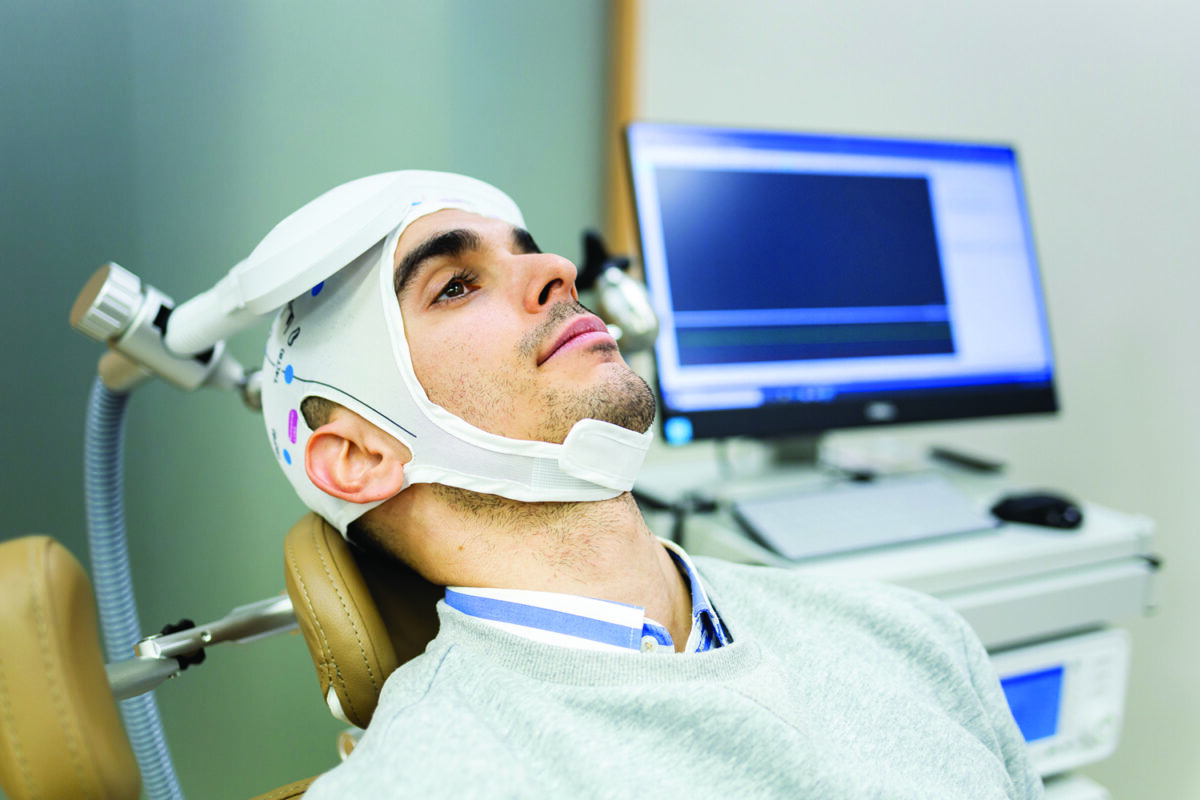
TMS is performed in an outpatient setting and does not require anesthesia, sedation, or recovery time. Patients remain awake and alert throughout the procedure.
Many patients describe the sensation as a tapping or clicking feeling on the scalp. Mild discomfort or sensitivity during early sessions is common, but most people adjust quickly. Because the procedure is noninvasive, patients can return immediately to work, school, driving, or other daily activities after treatment. Traditional TMS schedules involve one session per day, five days per week, for six to eight weeks, but that time commitment can be a barrier.
Newer accelerated approaches are changing that model. Dr. Leuchter and colleagues evaluated a “5×5” protocol that delivers five treatment sessions per day over five consecutive days, condensing what once required weeks into a single treatment week and found that it may produce comparable results for many people, potentially making the therapy accessible to individuals for whom the traditional schedule is a barrier.
“We have many patients who would like to receive TMS treatment, but for whom once-daily treatments for six to eight weeks are just not practical,” Dr. Leuchter says. “Daily trips to and from treatment would mean too much time away from work or family.”
Effectiveness of TMS Therapy
Research consistently shows that TMS therapy can be effective for people with treatment-resistant depression. Large studies have found that approximately 60% to 70% of patients experience meaningful symptom improvement, while about 25% to 35% achieve remission.
One of the study’s most clinically significant findings involves a subgroup of participants in the accelerated group who showed little improvement immediately after finishing their five-day course. When researchers followed up two to four weeks later, those same people showed meaningful symptom improvement of a 36% reduction in depression scores, on average.
“All patients in this study had not benefitted from multiple trials of antidepressant medication, yet they obtained great benefit from 5×5 treatment,” Dr. Leuchter says. “Some patients need to wait a few days or weeks to see benefit, and we encourage them not to give up too quickly if they don’t feel better right away.” He adds, “We are finding that the benefits of 5×5 can be even greater with an extra one to two weeks of treatment after.”
Research also suggests that the benefits of TMS can last for months or longer. Some people maintain improvements for extended periods, while others may benefit from maintenance sessions or repeat treatment courses if symptoms return.
Side Effects and Safety
One reason TMS has become increasingly popular is its favorable safety profile. Common side effects of TMS include mild scalp discomfort, headaches, temporary facial muscle twitching, and tingling sensations near the treatment site, but these side effects are usually mild and tend to improve as treatment continues.
Serious complications are rare. Although seizures can occur, the risk is extremely low when people are properly screened and treatment follows established safety protocols.
TMS Therapy Vs. Other Treatments
TMS occupies a unique position among depression treatments because it is more targeted than medication while being less invasive than electroconvulsive therapy (ECT). Compared with antidepressants, TMS directly stimulates brain circuits involved in mood regulation rather than affecting neurotransmitters throughout the body. For people who have not responded to medication or who cannot tolerate medication side effects, this can be a significant advantage.
When comparing TMS versus electroconvulsive therapy, several important differences emerge. TMS therapy offers noninvasive brain stimulation without anesthesia. Patients remain awake during treatment, and there are only minimal cognitive side effects. ECT remains an important treatment for severe or life-threatening depression, but many patients prefer TMS because it does not require hospitalization, anesthesia, or recovery time.
Overall, TMS therapy has become an important option for people with major depressive disorder and treatment-resistant depression who have not found adequate relief from traditional treatments. By targeting the dorsolateral prefrontal cortex and other mood-related brain circuits, this form of noninvasive brain stimulation can help reduce symptoms without many of the side effects associated with medication or more invasive procedures.
Research continues to expand our understanding of how TMS works and how treatment can be delivered more efficiently. Accelerated protocols such as UCLA’s 5×5 approach may make the therapy more accessible for patients who cannot commit to weeks of daily appointments.
For people who have struggled with depression for years, the results can be life-changing. As Dr. Leuchter says, “It is really amazing to see people recover from long years of depression in a matter of days.”