The way a person walks varies across their lifespan and where they are walking. A baby toddles while learning to walk. The way you stroll on a sandy beach is different from how you walk on a sidewalk with a dog or while walking for exercise.
Your gait, or the way you walk, can offer clues about your demeanor—think of the purposeful stride of a confident individual or the more relaxed gait of a carefree person. Importantly, an abnormal walking pattern may signal potential health issues—such as growing pain from osteoarthritis or other musculoskeletal problems or a neurological disorder—and can increase your risk of complications such as falls and fall-related injuries.
Cleveland Clinic’s Movement Analysis, Profiling and Phenotyping (MAPP) program team, co-led by orthopedic surgeon Nicolas Piuzzi, MD, identifies and works with patients to correct gait abnormalities. Here, Dr. Piuzzi and his colleagues in MAPP explain gait and what it can tell you about your health.
What Is Gait?
Gait is the pattern of walking movements. A person’s gait is unique, like a fingerprint.
“We lean on our ability to walk, and walk in an efficient way, so that we can engage in the things that we all want to do,” says Pat Corrigan, DPT, PhD, a physical therapist with a doctorate in biomechanics and a co-leader of the Cleveland Clinic MAPP program.
To gain insight into your overall health, doctors measure your vital signs, such as your heart rate, breathing (respiration), blood pressure, and body temperature. Gait is another significant indicator of health, which makes measuring it important.
“Gait is considered a vital sign that we’re now measuring,” adds Julien Mihy, PhD, a postdoctoral fellow studying gait.
“Musculoskeletal conditions remain the number one burden of disease worldwide, and we want to be able to have ways of objectively assessing how our patients move,” Dr. Piuzzi adds.
How Normal Gait Works
If you’re like most people, you don’t think twice about your gait. By the time you learn to walk, it simply becomes second nature.
However, walking is a series of coordinated movements produced by your musculoskeletal, nervous and balance systems and involving your brain, nerves, bones, muscles, and other tissues throughout your body. Each stride you take includes five stages/phases:
- Heel-strike: The heel of your front (leading) foot touches the ground.
- Support: The rest of your foot contacts the ground.
- Toe-off: The foot leaves the ground, heel first and toes last.
- Leg lift: The lower leg raises the foot.
- Swing: The raised leg moves ahead, pushing the body forward.
Because everyone walks differently, it is hard to define what a normal gait is, Dr. Piuzzi explains. “Each patient has a specific gait that has been developed over their entire lifespan that is a combination of factors,” he says. “Some factors are mechanical, some are physical, and some others are that fear of falling can change gait.”
Simply put, a normal gait allows people to get efficiently where they want to go without pain.
What Are Gait Disorders?
Some data suggest that while 85% of people have a normal gait at age 60, that figure drops to about 20% at age 85.
A number of factors can affect how you walk and alter your gait, including an array of foot problems (e.g., calluses, sores, ingrown toenails, flat feet), poor footwear, musculoskeletal deformities, arthritis, spinal stenosis, neurological conditions, inner ear (vestibular) disorders, vision problems, and circulatory problems in the lower extremities (e.g., peripheral artery disease).
“Disease often accelerates how gait changes,” Mihy says.
“A lot of people start modifying their gait pattern to try to accommodate and reduce the amount of pain that they have,” says Dr. Corrigan, noting that a person with painful knee osteoarthritis, for example, might start by slowing their walking speed. “When they start slowing down, those muscle loads as well as the joint loads reduce, and they find relief.”
Those individuals could also start reducing the motion of the knee while walking, which can change knee angles and gait. Sometimes people do not notice their gait changes because they happen gradually.
Common Types of Gait Abnormalities
Simply slowing down your walking speed is one common gait irregularity. Other examples of gait abnormalities include:
- Limping, which can occur when you avoid putting weight on a painful joint or limb.
- Shuffling, which occurs when you stop lifting your feet fully and instead drag your feet along the ground while walking.
- Waddling, which can occur when you avoid moving your hips and instead lift the whole side of your body, creating a walking pattern that resembles that of a duck.
“The natural human response to pain is to avoid movement when something hurts,” Dr. Piuzzi says. “Over time, that avoidance leads to muscle and soft-tissue changes, loss of motion, diminished function, and changes in the entire biomechanical profile.”
Symptoms and When to Seek Help
Changes in your gait or pain while walking may signal it is time to consult a healthcare provider to get treatment. You might notice gait problems or become aware that you are avoiding some activities, such as climbing stairs or going for longer walks. Walking slower is an important sign people sometimes notice.
Diagnosis: How Gait Problems Are Identified
Gait evaluation methods range from a simple chair-and-stopwatch method to technology that seems like science fiction. A simple timed-up-and-go test measures the time it takes for you to stand from a seated position, walk about 10 feet, turn around, walk back, and sit down.
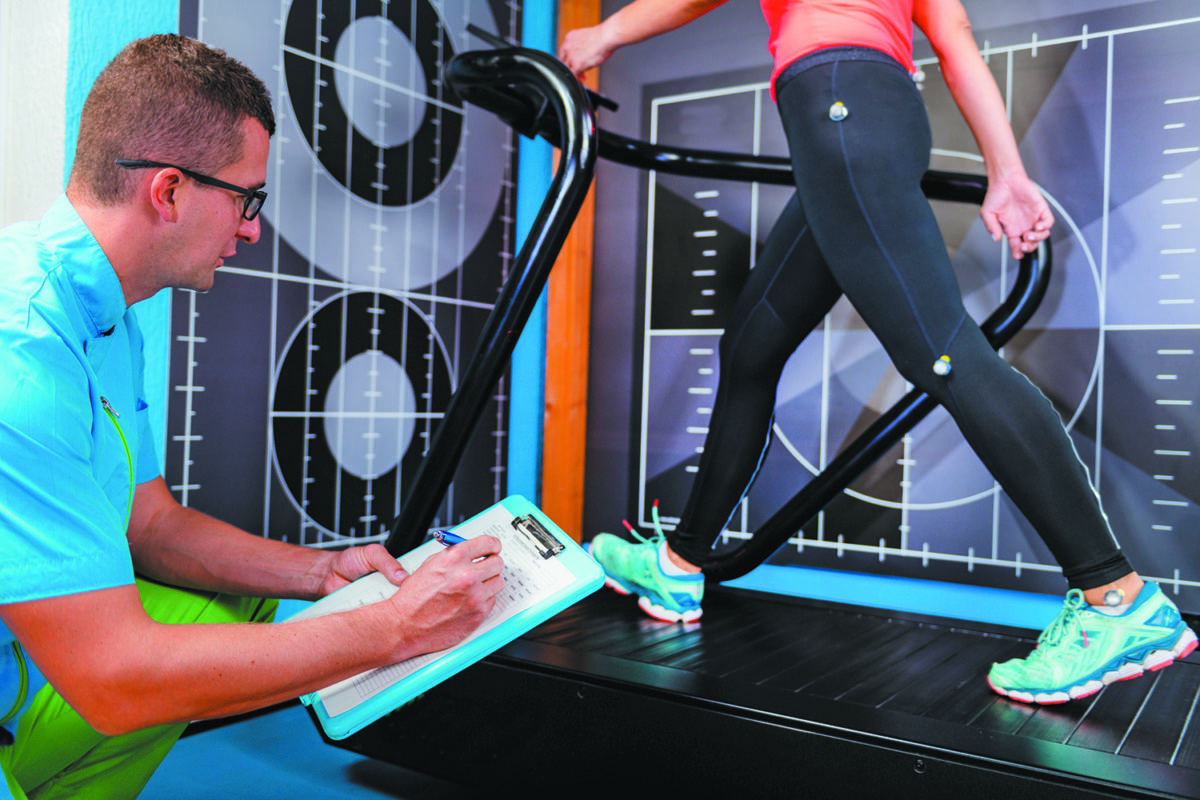
Cleveland Clinic’s gait analysis lab has an active waiting room where people can have their gait analyzed while waiting for their appointment. Sophisticated cameras capture people walking and analyze their gait before their appointment begins. By the time they are in the room with their clinician, an analysis of the way they move has been generated.
Wearable technologies like pedometers and phone apps can track walking. An imaging technology called biplanar radiography is like a three-dimensional video x-ray that reveals how bones and joints work inside a moving body. People with knee replacements now can have a microchip in their new joint that communicates information to their care team about how well they are walking after surgery. At MAPP, clinicians measure “not only the quantity of how many steps and the gait speed, but also the quality of movement,” Dr. Piuzzi says.
Treatment and Management Options
Treatment for gait abnormalities is highly individual. At MAPP, the care team focuses on giving people tools to recover the best gait possible for them, Dr. Piuzzi explains. It’s important to treat the underlying cause of the gait change, if possible. That treatment might include medication, surgery, or physical therapy.
Gait retraining is usually embedded in a 10- to 12-week period of physical therapy. It involves “training somebody into a new movement pattern and then making it robust enough that they can actually apply that movement pattern automatically in different contexts,” Dr. Corrigan says. “It requires being able to transfer the movement they learned on a treadmill to walking in a clinic space to then being able to apply it when they’re walking in the park or to the bathroom in the middle of the night.”
Practical Tips for Maintaining Healthy Gait
You can’t prevent gait abnormalities caused by an underlying medical condition, but you can prevent injuries that might cause a problem with walking. And you can notice when your gait changes and seek help with underlying conditions.
“Our great-grandparents had few options when arthritis began to limit their lives. Pain often meant slowing down, giving up activities, and eventually sitting in the rocking chair,” Dr. Piuzzi says. “Today, joint replacement allows millions of patients to regain mobility and quality of life, and we continue to advance and optimize those procedures. But our ultimate goal extends even further: to understand the origins of osteoarthritis and develop therapies that prevent, slow, or even eliminate the need for joint replacement altogether.”