
Don’t Let Sciatica Pain Control Your Life!
Understand what’s behind your sciatica—and give yourself something every sciatica sufferer needs: a reason to believe better days are possible.
You wake up hoping today will be different. Maybe that shooting pain will be gone. Maybe you’ll be able to sit comfortably, or take a pain-free walk, or get through the grocery store without thinking about pain. But then you climb out of bed and there it is again: the burning sensation that sends a jolt from your lower back or buttock down your leg.
You can’t help but wonder, “Will I ever feel like myself again? Or will I have to learn to live with the pain?”
You don’t have to. There are ways to manage sciatica. Start by understanding what might be causing your pain… how to interpret your symptoms… and which strategies may make a difference.
You’ll find the answers you need in Understanding Sciatica: Causes, Diagnoses, and Treatments. Created by BottomLine Personal’s medical experts, this practical, reassuring guide can help you make sense of sciatica… and teach you what you can do about it.
Find Out How To Take Control of Sciatica
Think of Understanding Sciatica as a knowledgeable companion—one you can turn to when you’re hurting… when you have questions… or when you simply want to understand your condition better.
You can’t always control when sciatica strikes. But you can take steps to understand it, manage it, and protect your ability to move comfortably… because the quality of your life is too important to give sciatica the final word.
You or a loved one may already be experiencing the reality that a sciatic nerve flare-up can make even simple acts feel like challenges. And when the pain returns regularly—without notice—it’s easy to become discouraged.
You’re left with recurring questions: Why does my leg hurt when the problem seems to be in my back? Could something in my regular routine make it worse? Are there movements and exercises I should be doing—and others I should avoid? How can I get comfortable enough to sleep? When should I see a doctor?
Understanding Sciatica walks you through these questions in clear, accessible language accompanied by illustrations that add clarity.
You’ll discover practical approaches you can try at home—including stretches for areas commonly involved in sciatica… ways to position your body more comfortably… and everyday strategies that may help ease discomfort.
Seize The Moment!
Don’t put it off. The science-backed information compiled in our guide can give you something you may be missing right now: a clearer understanding of what’s happening—and a better idea of what to do next.
Understanding Sciatica focuses on practical ways to manage sciatica and find relief. You’ll learn:
… which exercises can help strengthen the muscles supporting your lower back, hips, and core.
… how posture and sitting habits can affect sciatica.
… which low-impact activities may be less likely to aggravate sciatica.
… what you can do to sleep better.
… why your mental state can matter. (Anxiety and depression have been associated with more than a 50% increased risk of sciatic nerve pain.)
Not every case of sciatica is the same. That’s why Understanding Sciatica explains medical treatments worth considering when conservative approaches aren’t enough. Options may include physical therapy… medications… acupuncture… or, in some cases, surgical treatment.
The bottom line: If you suffer from sciatica, learning more about it can give you something precious—hope that better days are possible.
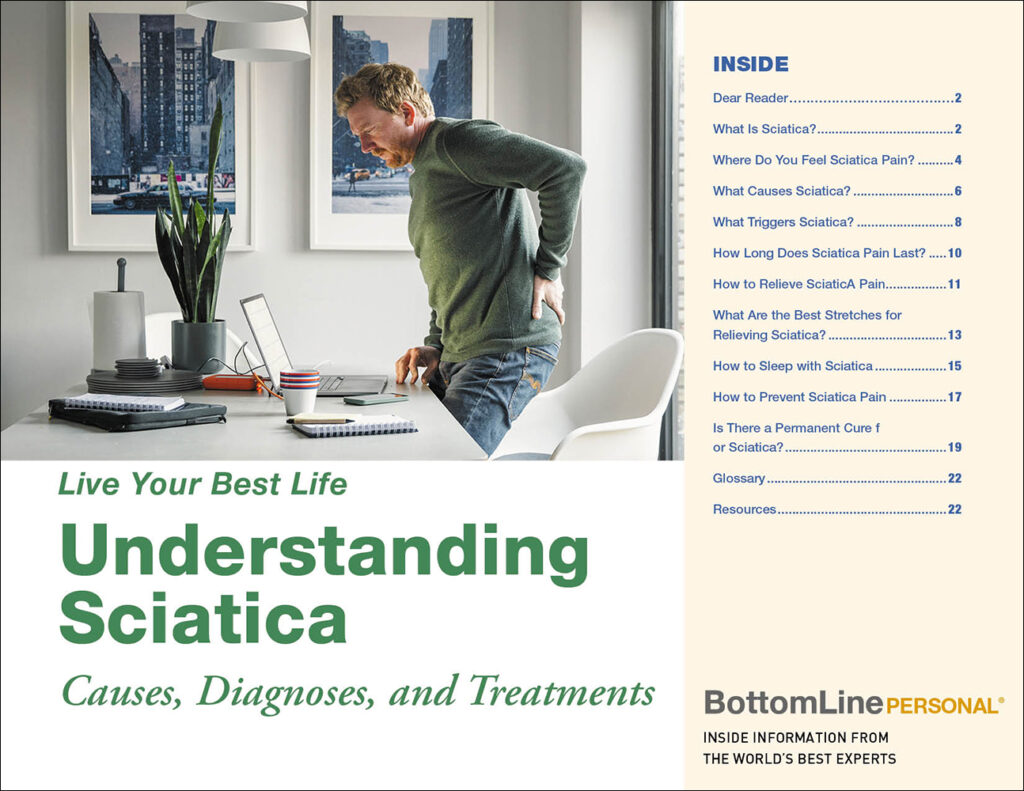
What’s Inside
Sciatica can be frightening and miserable. If it affects you, then you may not know how or why the pain radiates… what you can safely do at home to ease the pain… and when you should seek medical attention. Understanding Sciatica addresses these “unknowns” to put you on a clearer path toward managing your pain.
Within our guide, you’ll discover specific strategies for finding relief. The detailed sections deliver answers to frequently asked questions:
• Where exactly do sciatica symptoms strike?
• What causes sciatica… and what triggers it?
• Why does sciatica pain come and go… and how long does it last?
• What can I do to relieve sciatica pain?
• What are the most effective stretches for relieving pain?
• How can I prevent sciatica pain—and is there a permanent cure?
Get your copy today—and take an important step toward less pain, better mobility, and more comfortable days and nights. Sciatic pain is difficult to ignore. Understanding it can make all the difference.
Sneak Peeks
Here’s a head start on your mission to learn more about sciatica.
> Where does it start? Sciatica typically begins when something irritates or compresses the sciatic nerve. Common causes include a herniated disc in the lower spine, a narrowing of the spinal canal (spinal stenosis), or age-related changes such as degenerative disc disease or bone spurs.
> Where does it strike? Sciatica usually affects one side of the body, although it can occur on both sides. Pain may be felt in the lower back, hip, buttock, upper leg, calf, or even down into the sole of the foot and toes.
> Will sciatica become chronic? It’s impossible to predict whether someone’s sciatic nerve pain will be fleeting or chronic. But certain factors may indicate a longer sciatic-pain challenge—among them pain that has lasted for more than 30 days without relief; pain that gets worse when you sneeze or cough; or pain that’s worse when you sit down.
Order Understanding Sciatica today—and find relief!