Losing a job is stressful enough without an unexpected tax bill making things worse. But unemployment benefits are taxable income, and many people don’t realize it until they’re already filing.
We spoke with Damien Martin, a certified public accountant at Ernst & Young, who explains how unemployment taxes work and how to avoid getting caught off guard—so you can avoid nasty surprises when you file your return.
Is Unemployment Taxed?
Yes, the IRS considers unemployment benefits the same as wages: taxable income that must be reported on your federal return. Your state may also tax your unemployment payments.
“There’s definitely a perception out there that unemployment won’t be taxed,” says Martin. “But really, it’s still earnings, so that’s why it’s taxed that way. It’s just coming from a different source to replace cash flow in a time of transition.”
How Unemployment Benefits Are Taxed
Here’s how taxes actually work when you receive unemployment:
Federal Taxation of Unemployment Income
At the federal level, unemployment income is straightforward: every dollar is taxable and must be reported on your return. “Sometimes people are surprised by this,” says Martin. “I think the fact that tax isn’t automatically withheld from unemployment, people think it won’t be taxed. Well, that’s not exactly how that works.”
So, how much federal tax will you end up owing? Your overall tax situation will determine the final amount, including things like your total income for the year and tax bracket. “Your personal circumstances can really impact things at the end of the day.”
One good piece of news: you won’t have to worry about Medicare or Social Security taxes. Those don’t apply to unemployment income at all, which is one way they differ from regular wages.
State Taxation: Does Your State Tax Unemployment?
Residents of these states pay no state tax on unemployment benefits—either because the state has no income tax, or because it specifically exempts unemployment benefits.
If you live anywhere else, you may have to pay both federal and state taxes. Martin notes that this creates a common misconception: “If you’re in a state that doesn’t tax unemployment, you may think the IRS must not tax it either.”
States with no income tax (and therefore no unemployment tax):
- Alaska
- Florida
- Nevada
- New Hampshire
- South Dakota
- Tennessee
- Texas
- Washington
- Wyoming
States that have income tax but exempt unemployment benefits:
- Alabama
- California
- Montana
- New Jersey
- Oregon
- Pennsylvania
- Virginia
- Washington D.C.
Local Tax Considerations
Most cities and municipalities don’t tax unemployment benefits, so local taxes generally aren’t a concern—but there can sometimes be exceptions. Be sure to check the rules in your local area.
How to Pay Taxes on Unemployment Benefits
There are a couple of ways to pay tax when receiving unemployment:
Tax Withholding Options
Want to avoid owing a huge amount come tax time? The simplest way is to have federal taxes taken automatically out of your unemployment check, which is known as “withholding.”
Martin recommends this because it avoids creating a much larger liability at the end of the year. “It’s very difficult sometimes to go back and catch up later on,” he says.
The unemployment tax withholding rate is a flat 10%. So, if an unemployment payment is $500, $50 will be withheld, leaving you with $450.
If you choose withholding, you can fill out IRS Form W-4V (Voluntary Withholding Request) and submit it to your unemployment office. If you don’t go for withholding, set aside some money from each payment and try not to touch it.
Making Estimated Tax Payments
If you don’t elect withholding, the IRS may require you to make quarterly unemployment estimated tax payments instead—typically due in April, June, September, and January.
Whether you’re required to do this depends on how much you expect to owe for the year; the general threshold is $1000 or more in federal tax liability. A tax professional can help you calculate the right amount.
Unemployment Tax Penalties: What Happens If You Don’t Pay Enough?
If you end up owing more than you’ve paid through withholding or estimated payments, you’ll need to settle the balance when you file—and if you miss that deadline, penalties and interest begin to accrue.
Can’t pay the full amount? The IRS offers installment plans that let you spread payments over time. It’s worth applying: the penalty for not paying is generally worse than the interest on a payment plan.
How to Report Unemployment Income on Your Tax Return
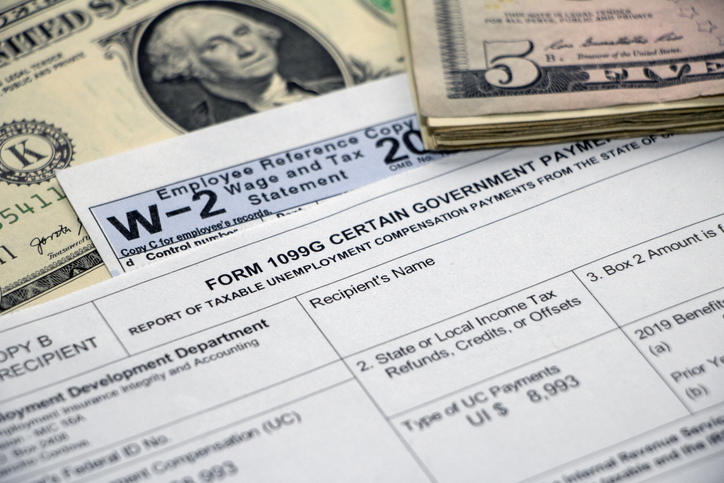
You use IRS Form 1099-G to report information about your unemployment income on your federal tax return. For unemployment and state taxes, you may have to fill out additional forms depending on where you live.
Understanding Form 1099-G
Your unemployment office should send this form to you sometime next January, well before you need to file your return. It will show:
- How much unemployment compensation you received during the year
- If any taxes were taken out of that amount
If you don’t receive the form by January 31st, get in touch with your office and see what happened.
Keep Form 1099-G with all your other tax documents. You’ll need it when filing your return.
Step-by-Step Reporting Instructions
Here’s what to do when it’s tax time:
- Locate Form 1099-G
- Find the amount listed in Box 1 (Unemployment compensation)
- Enter that amount on Line 7 of Schedule 1, Form 1040, Additional Income and Adjustments to Income
- Find the amount listed in Box 4 (Federal income tax withheld) on Form 1099-G
- Enter that amount on Line 25b of Form 1040/Form 1040-SR
Tax software and even AI can simplify this process, automatically routing your 1099-G figures to the right lines. Just make sure your inputs are accurate—Martin cautions that these tools are “only good if your information is correct.”
Common Questions and Concerns
What If You Didn’t Receive a 1099-G?
You’re still required to report unemployment income even without the form—so don’t wait. Most state unemployment portals make 1099-G forms available online, often before the paper copy arrives.
If yours isn’t there, contact your state unemployment office directly to request a replacement. Forms should arrive by January 31st; if yours hasn’t by early February, that’s your cue to follow up.
How to Correct Errors or Report Fraud
If your Form 1099-G contains incorrect details—wrong amount, wrong year, wrong Social Security number—contact the office that issued it immediately. Don’t simply ignore an incorrect 1099-G; the IRS receives a copy too, and discrepancies can trigger a notice.
If you receive a 1099-G for benefits you never claimed, that’s a sign your identity may have been used for a fraudulent unemployment claim—a form of identity theft that became widespread during the pandemic and continues today.
Report it to your state unemployment office, check your credit report for other suspicious activity, and consider placing a fraud alert with the major credit bureaus.
Will Unemployment Affect Your Tax Refund or Credits?
Yes—in several ways. Unemployment benefits increase your adjusted gross income (AGI), which can have a ripple effect across your tax return.
For example, the income might move you into a higher tax bracket, meaning you’re not eligible for income-based credits like the Earned Income Tax Credit (EITC), and it can reduce deductions that phase out at certain income levels.
The practical result: unemployment recipients who also worked part of the year sometimes end up owing more than they expected, even if they had taxes withheld throughout.
Why Might Two People with the Same Unemployment Benefits Owe Different Amounts of Tax?
Their overall tax situations may not be the same. As Martin explains: “Your tax rate, the deductions that you take, even the phasing out of certain things can affect what your total income is for the year.”
How Can I Work Out How Much Tax I Owe on Unemployment Benefits?
Tax software handles straightforward situations well—like if unemployment was your only income or close to it. But you may want to speak with a professional if your situation’s more complicated.
For example, if you had multiple income sources, a mid-year job change, self-employment income, or significant life changes (marriage, divorce, a new dependent), then a tax professional is worth the cost.