Americans hold $13.8 trillion in employer-based defined contribution plans, including $9.9 trillion in 401(k)s as of early 2026—and for most workers, that account will be the largest retirement asset they’ll ever have.
That’s where age-based benchmarks come in. The average 401(k) balance by age offers a practical way to measure your progress and spot possible gaps before retirement comes knocking.
Brian Anderson, editor-in-chief of 401(k) Specialist, helped us unpack what these numbers actually mean and which habits can help turn the tide on the path to a more comfortable retirement. “What’s more important than chasing that magic number is making steady progress by saving consistently over time,” Anderson says.
What Is the Average 401(k) Balance by Age?
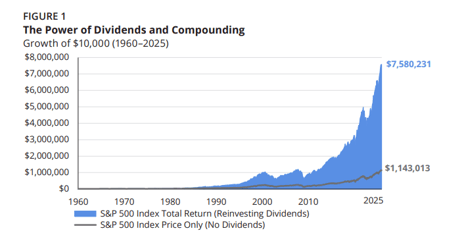
Retirement balances generally rise with age. It’s the consequence of having more years to contribute, and more time for compounding to work. A Hartford Funds analysis found that a hypothetical $10,000 invested in the S&P 500 in 1960 grew to $7.58 million by the end of 2025 with dividends reinvested, compared with $1.14 million from price gains alone.
Time is the asset most savers underestimate. Dividends accrued mean more shares, and those shares produce more dividends as time keeps feeding the cycle. The table below illustrates how balances tend to take shape when savers hit that range consistently.
Investors are not flying blind. Financial professionals generally recommend setting aside 10% to 15% of annual income for retirement, including 401(k) contributions, an employer match if one is offered, and any additional IRA savings. Hit that range consistently over a career, and the table below shows how 401(k) savings by age begin to take shape.
Keep in mind: the trajectory isn’t always smooth. Rollovers, withdrawals, job changes, and market swings can cause balances to level off or dip temporarily. That’s why these benchmarks are most useful as periodic checkpoints—not as final say but as lampposts along the road to retirement.
401(k) Balance by Age
|
Age |
Balance |
|
20-24 |
$7,700 |
|
25-29 |
$26,600 |
|
30-34 |
$51,700 |
|
35-39 |
$81,600 |
|
40-44 |
$120,100 |
|
45-49 |
$163,200 |
|
50-54 |
$215,700 |
|
55-59 |
$260,800 |
|
60-64 |
$257,400 |
|
65-69 |
$258,800 |
|
70+ |
$264,500 |
Source: Fidelity Investments
Average vs. Median 401(k) Balance: Why It Matters
The average reflects all account balances, while the median gives a clearer view of the savers in the middle. Let’s elucidate:
An average can make the typical 401(k) saver look richer than they really are. Add every balance and divide by the number of accounts, and a small group of retirement millionaires can pull the result sharply higher, making the headline figure feel out of reach.
The median 401(k) balance by age offers another view. It marks the saver in the middle, with half of participants holding more and half holding less. That can make it a more realistic measuring stick for investors comparing their savings with their contemporaries.
Vanguard’s latest data on workplace defined contribution plans, including 401(k)s, show just how wide that chasm can become. In 2025, the average participant balance was $167,970, while the median was $44,115. Among participants ages 55 to 64, the average reached $305,006, nearly three times the median of $107,269.
Neither figure tells the whole story—but together, they offer more useful context than either one alone. When your balance falls between the average and median for your age, you’re likely in reasonable shape relative to your peers.
How Does Your 401(k) Balance Compare?
With the stock market trading at record highs, it’s easy for savers to expect the same from their 401(k). And while the $1 million threshold has become retirement’s version of a Wall Street price target, the reality looks much different.
According to Federal Reserve data, fewer than 3% of Americans have $1 million or more saved in retirement accounts. Being above the average 401(k) balance for your age is impressive, but it’s not a victory lap. Falling below the median is not a final verdict, either.
The 401(k) balance by age table cannot see an IRA, a pension, a spouse’s plan, home equity, or the retirement date on which someone has set their sights.
If you’re trailing the averages, you’re not alone. A 2023 Bankrate survey cited by CNBC found that 56% of working adults believed they were behind on retirement savings, including 37% who felt significantly behind. The anxiety is widespread, but it doesn’t call for a desperate bet.
“I think ‘magic numbers’ people are told they should aim to accumulate in savings before retiring can serve as a decent wake-up call for many who may not have been as focused on their retirement savings as they should be. But the idea that everyone needs $1 million or $1.4 million saved for a comfortable retirement is unrealistic,” says Anderson.
Those seven-figure targets also tend to leave out Social Security, which Anderson noted could total roughly $500,000 in gross benefits for the average beneficiary over a 20-year retirement.
For investors just starting out, contributions do most of the heavy lifting early in a career, while compounding gains momentum as the account grows. At that stage, consistency and time may say more about one’s retirement trajectory than the balance itself.
“It isn’t ‘one size fits all.’ Retirement is far more personal than that, and individual circumstances matter. A person’s savings target should depend on factors such as lifestyle, health, expected longevity, income sources, where you live, and whether you plan to continue working in some capacity,” Anderson explains.
What Affects Your 401(k) Balance by Age?
Age supplies the runway, but it does not determine the 401(k) balance. Income, competing bills, access to a workplace plan, employer contributions, and years spent consistently investing all shape where a saver lands.
Anderson acknowledges the headwinds. “Workers today are dealing with things like higher housing costs, healthcare expenses and student loans that can make it difficult to set aside as much as they know they should for retirement.”
But he sees reasons for optimism: “Workplace retirement plans have never been stronger. The auto features combined with employer matching contributions and greater access to plans (thanks to the SECURE Act and SECURE 2.0) are moving participants in the right direction,” Anderson says.
Target-date funds (TDFs) are built around a simple premise: over a long enough horizon, discipline usually beats improvisation. They diversify the portfolio, rebalance when markets move, and gradually dial back risk as retirement approaches, all without asking the investor to make a fresh call every time Wall Street changes direction.
“For the vast majority of participants (and particularly for those under 50), target-date funds remain the appropriate default investment. They’ve been one of the biggest success stories in the defined contribution system because they provide diversification, automatic rebalancing, and age-appropriate risk management,” Anderson says.
How Much Should You Have in Your 401(k) by Age?
Salary multiples offer one answer to how much you should have saved by a given age—useful for orientation, but potentially out of sync with reality when mistaken for your true destiny. Fidelity’s guidelines call for:
- 1x your annual salary saved by age 30
- 3x by age 40
- 6x by age 50
- 8x by age 60
- 10x by age 67
The model assumes someone begins directing 15% of income toward retirement starting at 25, including any employer match, and retires at 67. Change the assumptions, and the target moves with them.
401(k) Contribution Limits
The IRS sets the outer rails with annual 401(k) contribution limits. In 2026, workers can contribute up to $24,500 to a 401(k).
Those 50 and older may add an $8,000 catch-up contribution, while savers ages 60 through 63 may qualify for the higher $11,250 catch-up. Those limits show how much room the account offers, not how much every household is expected to fill.
What to Do If You’re Behind on Retirement Savings
Falling behind can tempt investors to reach for a Hail Mary. But a retirement gap may be narrowed more safely by changing the flow of money into the account than by loading the portfolio with more risk.
“In the 401(k) world, the introduction of auto-features has helped participants tremendously in this regard,” Anderson notes. “Auto-enrollment, auto-escalation, and automatic default investments (such as target-date funds) have nudged people to get enrolled, gradually increase their contribution rates and be (and stay) invested appropriately.”
One place to look is the money already on the table. Investors who are able to capture the full employer match may then consider raising their savings rate gradually, even by one percentage point at a time. Automatic escalation can keep those increases moving without requiring a fresh decision every year.
Job changes are another pressure point. Cashing out an old 401(k) may solve an immediate problem but permanently removes money that could have compounded for years. Rolling it into a new employer’s plan or an IRA is almost always the better option.
How to Build a Stronger 401(k) Over Time
The market may reward one brilliant investment now and then. A 401(k) usually rewards something less dramatic: a sound process left alone long enough to work.
Anderson shared which habits separate strong long-term savers from the rest of the pack: “They consistently do the basics well over a long period of time. They start saving early, contribute consistently, capture the full employer match, gradually increase their contribution rate as their income grows, stay invested during market downturns, and periodically review their retirement strategy but don’t constantly tinker with it.”
The market supplies horsepower but rarely predictably. The S&P 500 fell 19.44% on a price-return basis in 2022, then rebounded 24.23% in 2023, 23.31% in 2024, and 16.39% in 2025. Investors who stepped aside during the 2022 selloff faced a second hard decision—when to get back in—and many missed recovery entirely. Staying invested through downturns is one of the most consistently documented habits of long-term savers.
What belongs inside the account has become a debate. A Wall Street Journal survey found that 48% of 401(k) investors used target-date funds (TDFs), while 10% were dissatisfied with their choices, preferring more nontraditional investments such as private markets and cryptocurrencies. To Anderson, the question is not simply active or passive, but whether each approach earns its place.
“Ultimately, the question shouldn’t be whether TDFs are still the right default; they generally are. The more important question is how those TDFs are constructed and whether thoughtful active management in certain asset classes can provide a meaningful improvement in participant outcomes,” he says.
Time still does much of the heavy lifting. Early contributions have longer to collect returns, and those gains eventually begin producing gains of their own.
“Maybe the most important is realizing the long-term benefit of starting to save for retirement early. Someone who starts contributing in their twenties, even modestly, often ends up with significantly more wealth than someone who waits until their forties and tries to make up for lost time,” Anderson says.
For investors who got a later start, the runway may be shorter, but the clock has not stopped. As Anderson puts it, “Compounding remains one of the most powerful forces in retirement investing.” And that principle holds true at any age.