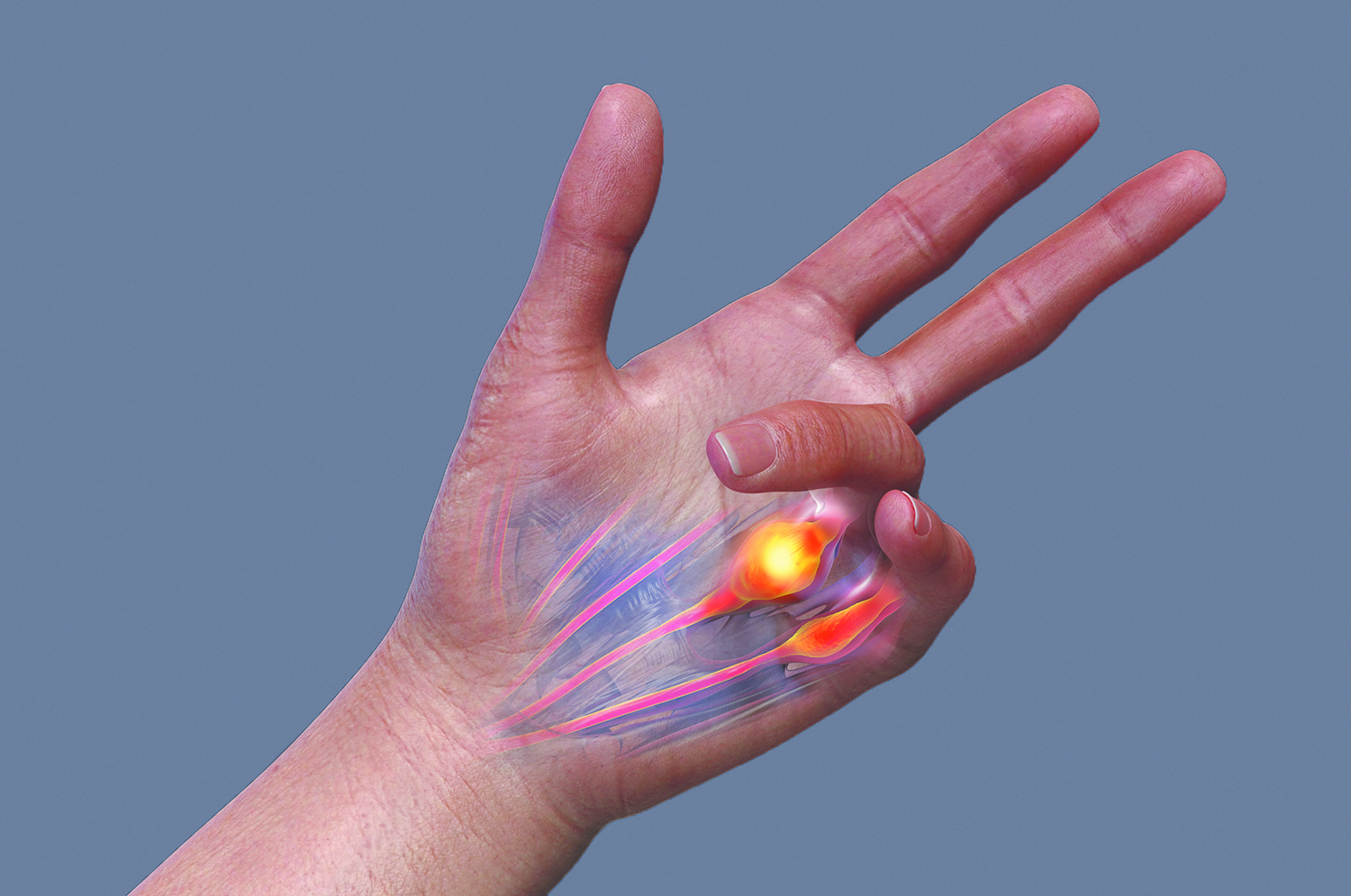
Dupuytren’s disease is the most common inherited connective tissue disorder. The disease can cause Dupuytren’s contracture, which in some cases can significantly affect hand function.
Although there is no cure, Dupuytren’s can be managed with treatment, including collagenase clostridium histolyticum (Xiaflex) injections.
History of Dupuytren’s Contracture
A French surgeon named Guillaume Dupuytren first described and performed surgery on this condition of the hand in 1831. Dupuytren’s disease (pronounced DUPE-uh-trins) is also known as Viking’s disease because it is common in northern Europeans, and the disease may have made its way from northern Europe by the Vikings.
“Myofiberblast cells lay down thick collagen below the skin that starts as nodules but eventually develop into cords that pull the fingers down into a flexed position,” explains Cleveland Clinic orthopedic surgeon Steven Maschke, MD. “Unlike trigger finger, where you can pull the finger straight, the cords prevent the hand from returning to a neutral position.”
Dupuytren’s contracture is not usually painful, but it can severely limit hand function. It may not be possible to straighten the fingers. Activities that require a flat hand can be especially challenging. It can be difficult to open the hand to fully grip objects or clean a tabletop, for example.
Dupuytren’s disease is not contagious. It is more common and more severe in men. Symptoms typically begin after age 40 but can develop at any age, including childhood. Typically, people who have symptoms at a younger age have more severe disease. This connective tissue disease can also affect the foot and penis (Peyronie’s disease).
Risk Factors for Dupuytren’s Disease
A 2020 study published in the Journal of Orthopedic Surgery and Research summarized 85 studies and estimated worldwide prevalence of Dupuytren’s disease at 8.2% of the general population, with increased risk associated with:
- Men
- Diabetes: highest in type 1 but also elevated in type 2
- Alcohol use disorder
- Smoking
- Family history of Dupuytren’s disease
How Xiaflex Treatment Works
Xiaflex contains an enzyme that helps break down the tissues causing the fingers to flex. The U.S. Food and Drug Administration approved the drug in 2010 as the first nonsurgical treatment for Dupuytren’s disease, and it usually requires insurance pre-approval.
“We inject the cord in the hand in three different locations and then wait two to three days before mechanically straightening the finger in the office,” says Dr. Maschke.
Xiaflex injections can be a little uncomfortable and feel like bee stings. Numbing injections administered the day the hand is reset also may sting. Usually, recovery takes just a few days. Sometimes, a tear in the skin from straightening the finger requires a few weeks to heal. There may be swelling or bruising on the hand, and some people feel a lymph node in the armpit for a week or two. Allergic reactions are rare.
What to Expect After Xiaflex Injection
Generally, people feel better a few days after the procedure. The surgeon will recommend occupational therapy to improve grip and wearing a splint at night to help support recovery and keep the fingers in a neutral position.
On average, the symptoms return five to six years after treatment, but relief may last as long as 10 years or fade after one year.
Other Treatment Options
People who take blood-thinning medications and can’t stop the blood thinners for treatment are not candidates for Xiaflex.
Other treatment options include aponeurotomy—using a needle to mechanically disrupt the cord. A surgery called fasciectomy can remove the problematic tissue. The recovery from surgery is typically six to eight weeks.