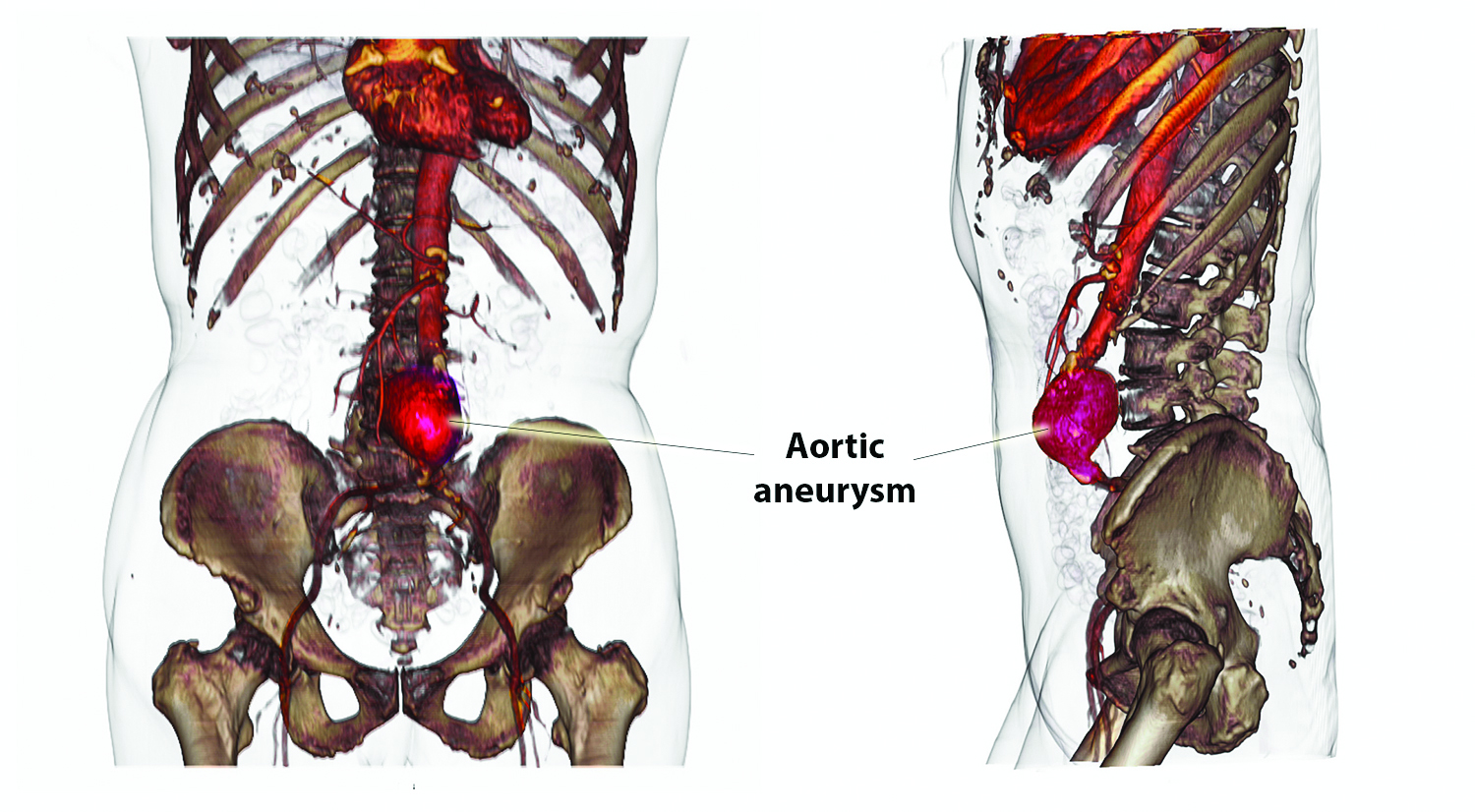
Arteries are tough and elastic. No matter their size or location, most remain intact for decades under relentless pounding from blood surging against their walls.
You might have heard of arterial aneurysms or know someone who had one. But what is an aneurysm? Simply put, it’s a weak spot that allows the vessel wall to balloon out.
Aneurysms can occur anywhere in the body, but they’re most common on the aorta and on the cerebral arteries in the brain. Aneurysms in the coronary arteries are rare, but they tend to occur where a bypass graft is attached to the aorta.
No matter where an aneurysm occurs, if it leaks blood, the result can be devastating.
“When an aneurysm in the aorta ruptures, the person has a 50% chance of making it to the hospital and a 50% chance of making it out of the hospital,” says Cleveland Clinic vascular surgeon Francis Caputo, MD.
That’s why it is wise to understand what actions to take if you experience symptoms or an aneurysm is discovered incidentally and to know how aneurysms are treated.
What Is an Aortic Aneurysm?
The aorta is the largest blood vessel in the body. It exits the heart at the aortic valve and travels up toward the head a few inches before doing a U- turn and dropping down through the chest and abdomen. Weak spots in the walls of the aorta are a common site for aneurysms.
Unfortunately, aortic aneurysms tend to be asymptomatic until they rupture.
“A ruptured aneurysm can cause severe back pain accompanied by a vagal event (a drop in blood pressure and heart rate that causes lightheadedness and nausea or fainting) and an impending sense of doom,” says Dr. Caputo.
Aortic aneurysms are four to six times more common in men than in women and generally occur after age 65. Most remain undiscovered until they rupture, appear on an imaging test performed for another condition, or are found during surveillance. “If you have a connective tissue disease, a family history of aneurysms or have smoked 100 cigarettes in your lifetime, you should undergo an ultrasound screening of your aorta,” Dr. Caputo recommends.
Monitoring Aortic Aneurysms
Despite their deadly nature, aortic aneurysms are generally not treated until they reach a certain size.
Small aneurysms have a low risk of rupture, and many never need treatment. However, the risk of rupture increases as an aneurysm grows. At some point, the risk of rupture becomes greater than the risk of surgical treatment.
“When an aortic aneurysm reaches 3 centimeters (cm) in diameter, it should be monitored yearly with ultrasound. At 4 cm to 4.5 cm, it should be monitored every six months,” Dr. Caputo says.
An aneurysm in the ascending aorta is at risk for dissection or rupture when it reaches 5.0 cm to 5.5. cm. Dissection means the inner layer of the artery wall tears, allowing blood to seep between the layers. This process prevents blood from flowing naturally.
If a person has a connective tissue disorder, the aneurysm grows more than 0.5 cm in six months or 1 cm in 12 months, or it has an unusual shape, surgery may be done earlier.
Treating Aortic Aneurysms
Aortic aneurysms are treated in two ways. A section of aorta containing the aneurysm may be cut out and replaced with a graft in an open surgical procedure. With increasing frequency, a graft is inserted inside the artery and positioned in place to reinforce or repair the artery. This less-invasive procedure is known as endovascular aneurysm repair.
“We are increasingly individualizing treatment, and the most up-to-date treatment may not be widely known,” says Patrick Vargo, MD, a Cleveland Clinic cardiovascular surgeon. “Once you know you have an aneurysm, it is important to seek the care of an expert. If your aneurysm is located in the chest above the diaphragm, see a cardiac surgeon. If it is located below the diaphragm in the abdomen, see a vascular surgeon.”
After surgery, the aorta should be checked every five years. “Surgery is a permanent fix, but the adjoining portion of the aorta may be prone to developing an aneurysm,” Dr. Caputo says. Stents placed in an endovascular procedure should be checked yearly to ensure they have not moved.
What Is a Brain Aneurysm?
Brain aneurysms (also called cerebral aneurysms) are not uncommon. In fact, there’s a 1 in 20 to 1 in 50 chance you have one. Most are small and remain stable over time. But when one bursts, blood spills out into the brain, where it can become trapped between the brain and the skull. The result is a catastrophic situation known as a subarachnoid hemorrhagic stroke.
“Half of these individuals will die, 25% will have severe disability, and 25% will recover,” says Cleveland Clinic vascular neurologist M. Shazam Hussain, MD.
The underlying cause may be the same as for aortic aneurysms: atherosclerosis, a genetic predisposition to weakened artery walls, uncontrolled high blood pressure and smoking.
“Hormonal factors may be involved as well, because women have far more cerebral aneurysms than men,” Dr. Hussain says.
Brain Aneurysm Symptoms
Like aortic aneurysms, brain aneurysms rarely cause symptoms until they rupture.
“A ruptured aneurysm will cause the worst headache of your life. We call it a thunderclap headache, and it will be unlike anything you have ever experienced,” Dr. Hussain says. “This is a medical emergency. Don’t wait around to see what happens. Call 911 and get to the hospital immediately.”
Treating Brain Aneurysms
Brain aneurysms discovered prior to rupture are monitored. “We follow these aneurysms every year or two to see if they are increasing in size,” says Dr. Hussain. “We start discussing treatment when an aneurysm reaches 4 to 5 millimeters (mm) in diameter. At 7 mm, treatment is recommended.”
Other factors are also considered. “Aneurysms located in the back of the brain are riskier than those in the front. Also, aneurysms that are irregular in shape or have daughter sac (an aneurysm on an aneurysm) may also merit early surgical intervention,” he explains.
Brain aneurysms are treated by preventing blood from entering the sac. For more than 70 years, this has been done by placing a clip across the base of the aneurysm in an open surgical procedure. Today, 90% of aneurysms are treated in a catheter-based endovascular procedure in which the sac is filled with platinum coils or a stent is placed inside the artery to block access to the sac.
How to Reduce Your Risk
Aneurysms cannot be prevented, but certain lifestyle measures can reduce the likelihood of developing one.
“Eat well, exercise, keep your blood pressure under control, and avoid smoking,” Dr. Hussain advises. “These are especially important if you have a family history of aneurysms.”