Most gastrointestinal (GI) symptoms have a simple, treatable cause. But for some people, indigestion, nausea, vomiting, and abdominal pain can be early signs of pancreatic cancer. Unfortunately, once symptoms of the disease become apparent, it typically is at an advanced stage. So, it’s important to know your pancreatic cancer risk factors and seek medical evaluation if you are experiencing possible pancreatic cancer symptoms.
What Is Pancreatic Cancer?
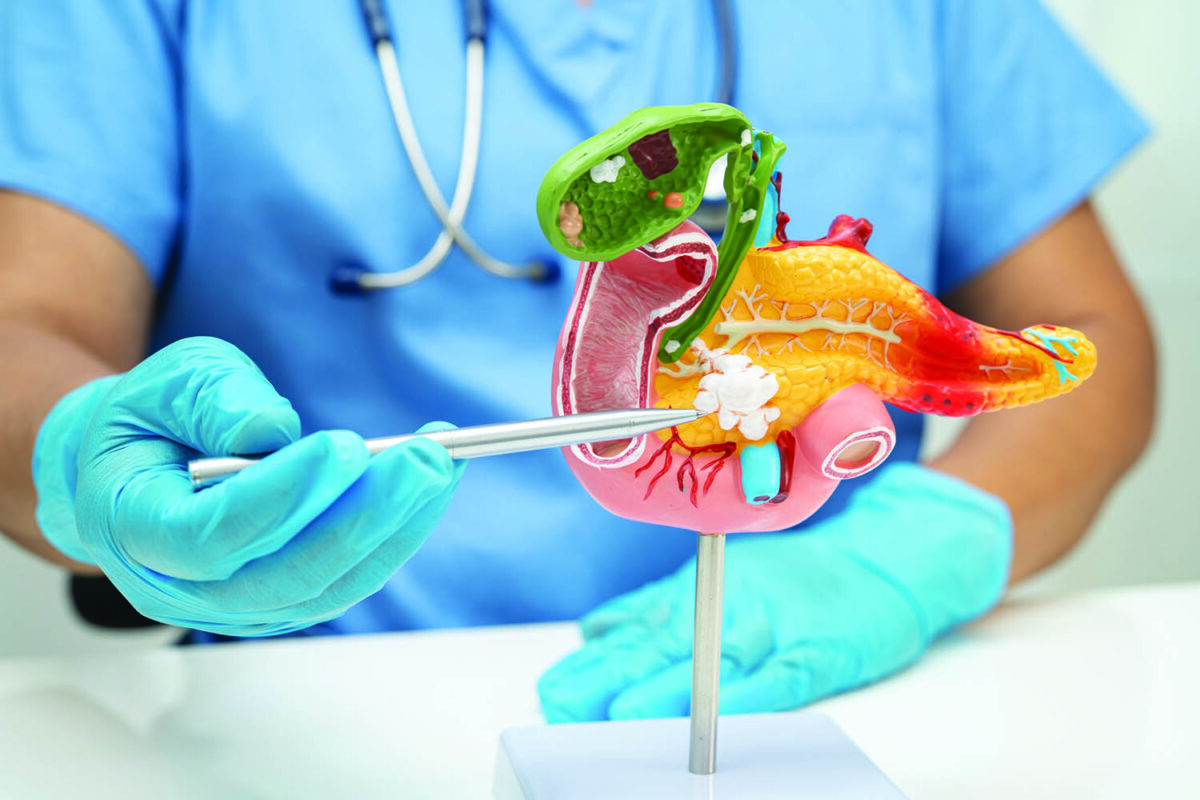
Pancreatic cancer develops when cells in the pancreas—a small organ that plays an important role in helping digest food and control blood sugar—multiply out of control. The most common type of pancreatic cancer is pancreatic ductal carcinoma, which begins in cells that line the tiny ducts that branch off of the main pancreatic duct. The latter transports digestive enzymes to the small intestine, along with bicarbonate that is manufactured in the pancreas and neutralizes stomach acid in the food that travels from the stomach to the small intestine.
Many of the symptoms that occur in pancreatic cancer arise because a tumor interrupts the flow of digestive juices through the network of ducts within the pancreas. If a tumor forms near the area where the pancreatic duct merges with the common bile duct, which transports bile from the liver, it may compress and block the bile duct. This process prevents bile (which helps the body digest fats) from reaching the small intestine.
Why Are Pancreatic Cancer Symptoms Hard to Detect?
Like many other cancers, pancreatic cancer may not cause obvious symptoms during its initial stages. Deirdre J. Cohen, MD, MS, from the Icahn School of Medicine at Mount Sinai, also notes that early signs of pancreatic cancer often are vague. “This means the symptoms may be dismissed or mistaken as signs of some other less lethal condition, like indigestion or gallstones,” Dr. Cohen says.
Where the tumor develops also influences disease symptoms. A tumor in the “tail” of the pancreas typically won’t cause obvious symptoms until it is quite large, whereas a tumor in the “head” of the pancreas causes symptoms sooner if it presses on the bile duct.
The fact the pancreas is buried so deep within the abdomen means that it is impossible to feel a pancreatic tumor during a routine physical exam. There also isn’t a recommended routine screening test for pancreatic cancer. The disease is so rare that screening healthy people probably would result in many false positives. Also, given the location of the pancreas, screening would require invasive tests that carry the risk of infection and irritation of the pancreas.
However, Dr. Cohen says surveillance protocols are in place for people with a strong family history of pancreatic cancer or genetic mutations that raise the risk for the disease. “These individuals typically are offered specialized magnetic resonance imaging scans or ultrasound scans to increase the possibility of early pancreatic cancer diagnosis,” she says.
Common Pancreatic Cancer Symptoms
While pancreatic cancer has few or no symptoms in its early stages, there is an association between new-onset diabetes and pancreatic cancer and jaundice and pancreatic cancer. But other symptoms that occur with the disease are common to other conditions. For example, unexplained weight loss can flag pancreatic cancer, but other unexplained weight loss causes include other cancers, peptic ulcers, celiac disease, and underlying infections.
As pancreatic cancer progresses, symptoms that appear may include abdominal and back pain, jaundice (yellowing of the skin and eyes), nausea, vomiting, and unexplained weight loss, among others. Again, keep in mind that less significant conditions can cause these symptoms too—they don’t necessarily mean that you have pancreatic cancer.
- Jaundice. Yellowing of the skin or eyes is most likely to occur with pancreatic cancer if a tumor is compressing the bile duct. Bile is manufactured constantly in the liver, and from there, it travels to the gallbladder, where it is stored until needed to digest fats. “If a pancreatic tumor blocks bile from exiting the liver, the bile builds up in the liver and eventually leaks into the bloodstream,” Dr. Cohen explains. “Bile contains a yellow chemical called bilirubin, and it is this that causes the yellow tint seen in jaundice.”
- Abdominal or back pain. Even a small pancreatic tumor can cause abdominal or back pain, because the pancreas is situated near a network of important nerves (the celiac plexus) that may be subject to pressure from the tumor. Pain also may be caused by digestive fluids backing up in the pancreas because a tumor is preventing them from exiting the organ. “The pain from pancreatic cancer tends to be constant and gnawing,” Dr. Cohen says. “It may be worse when a person is lying flat because this increases the pressure of the tumor on the celiac plexus. Leaning forward relieves the pressure and may help ease the pain.”
- Unexplained weight loss. You may be eating normally, but if digestive enzymes are unable to reach the small intestine, the food will pass through your GI tract undigested. The tumor itself also floods the body with inflammatory chemicals that cause the body to burn calories faster than it usually does. Other contributing factors include the fact that a tumor may press against the stomach so that you feel full after a small amount of food, while bile in the blood can make food taste unpleasant.
- Digestive problems. Nausea, vomiting, indigestion, and bloating are all associated with pancreatic cancer. These symptoms may occur because a tumor is preventing food from leaving the stomach, and because a lack of digestive enzymes is causing food to sit in the GI tract undigested. They also occur because a buildup of bile in the blood can affect a region of the brain that is responsible for nausea and vomiting, and because of the tumor pressing on the celiac plexus. “It also is possible for a tumor to affect insulin production in the pancreas,” Dr. Cohen adds. “Insulin helps regulate blood sugar, and if its supply becomes limited by a growing tumor, blood sugar levels will increase.”
- Fatigue and weakness that accompany pancreatic cancer are related to the nutritional deficiencies and the tumor tapping into your energy reserves to help it grow larger. Other symptoms, such as nausea and vomiting, also play a role in fatigue and weakness.
- Changes to stools and urine. Stools typically are dark colored because they contain bilirubin, but if the common bile duct is blocked by a tumor, bilirubin is not able to reach the intestines. If this occurs, stools may instead take on a grayish-white color. “Urine often changes color, too,” says Dr. Cohen. “This happens because excess bilirubin in the bloodstream is filtered through the kidneys and turns the urine dark brown instead of yellow.” She adds that in addition to changing color, stools may appear greasy looking. “This occurs if a tumor prevents lipase, an enzyme secreted by the pancreas, from exiting the pancreas,” she explains. “A lack of lipase in the small intestine means that undigested fats are passed in stools.”
- New-onset diabetes or blood sugar changes. Type 2 diabetes usually develops slowly, but it may develop quite suddenly in people with pancreatic cancer, owing to the fact that the tumor may interfere with insulin production. “This is a complicated relationship, though, given that diabetes itself is a known risk factor for pancreatic cancer,” Dr. Cohen says.
- Other possible symptomsof pancreatic cancer include itchy skin and depression. The first is due to excess bile in the bloodstream, while the second is believed to be related to inflammatory substances released by the tumor that impede the brain’s production of serotonin, a hormone that regulates mood. Blood clots may occur too, since the tumor makes the blood thicker.
Early Warning Signs: What to Watch For
Since the early signs of pancreatic cancer can be very subtle, Dr. Cohen says the best strategy for early diagnosis is to mention new or unexplained symptoms to your doctor, particularly if the symptoms occur together. “Persistent abdominal and back pain and unexplained weight loss are key,” she says. “If you have diabetes, another early warning sign is a sudden increase in your blood sugar if you previously had it well controlled.”
When to See a Doctor
Persistent pain, unexplained weight loss, and significant fatigue always warrant a call to the doctor. Older age often is accompanied by conditions that cause the same symptoms as those seen in pancreatic cancer. Don’t ignore them, even if you are almost certain some other condition is causing them.
Who Is at Risk?
It isn’t clear why pancreatic cancer develops, but some pancreatic cancer risk factors have been identified. Age is one of them—according to the American Cancer Society, about two-thirds of people who develop pancreatic cancer are at least 65, and the average age at time of diagnosis is 70. There also is a higher incidence of the disease in people with a family history of pancreatic cancer, smokers, people with diabetes, and individuals who are obese. The disease is slightly more common in men than in women.
Some research has suggested that drinking large quantities of soft drinks and eating large amounts of red meat—particularly processed meats like sausage, bacon, and deli meats—may raise the risk for pancreatic cancer. Consuming large amounts of alcohol over many years also is a risk factor. Research also has pointed to an association between periodontitis (inflammation of the gums) and pancreatic cancer.
Genetics also is a risk factor: An estimated 10% of pancreatic cancers are caused by inherited gene mutations. This may explain why cases are more common in individuals or families who have the BRCA1, BRCA2 and PALB2 breast cancer genes, colorectal cancer, pancreatitis, and ataxia (a neurological symptom that manifests as a loss of control over body movements). “Knowing the genes that put people at risk for pancreatic cancer may someday lead to a screening test that allows at-risk individuals to be identified early, when treatments are more likely to result in a cure,” Dr. Cohen says.
Pancreatic Cancer Treatment
First-line treatment for pancreatic cancer that has not yet spread to other body tissues involves surgery to remove all or part of the pancreas, and chemotherapy. “A combination of chemotherapy drugs is used, since multi-agent treatment is more effective,” Dr. Cohen says. “The choice of drugs may depend upon a person’s genetic mutations.”
Dr. Cohen adds that pain-relieving medication will be prescribed to ease pain caused by the tumor pressing against a nerve or other organs.
In August 2026, the U.S. Food & Drug Administration approved daraxonrasib (Rasonque) for people whose cancer has not responded to first-line chemotherapy drugs and those who cannot receive multi-agent chemotherapy due to overall poor health. In trials, people who received the drug survived for a median of just over 13 months, compared with about seven months for people who were treated with chemotherapy. People taking daraxonrasib also reported better quality of life and more tolerable side effects than those on chemotherapy. The drug’s side effects include rash, mouth sores, nausea, and diarrhea.
“It is likely that clinicians will get better at managing these side effects as they become more familiar with the drug,” Dr. Cohen says. “While the drug is not a cure, it is a huge step forward in treating this disease.”