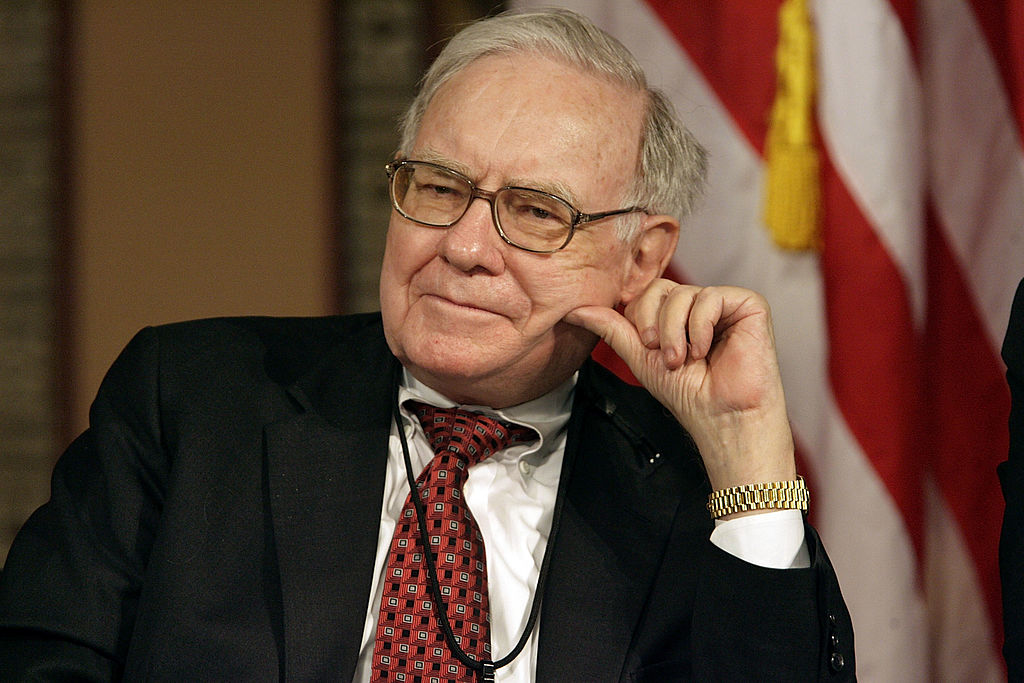
Earlier this year, Warren Buffett took the stage in front of 20,000 attendees at the Berkshire Hathaway annual shareholder meeting in Omaha, as he has for decades. But this time, the 94-year-old unleashed a bombshell on investors and the business world, announcing that he would step down as CEO at the end of 2025. Buffett’s reign at the industrial conglomerate has left him widely acclaimed as the greatest investor and capitalist in US history. Consider this: Since 1965, $1,000 invested in the S&P 500 index has grown to $368,000…while $1,000 worth of Berkshire Hathaway stock has grown to $55 million.
Who could possibly fill the so-called Oracle of Omaha’s shoes? How will his absence change Berkshire Hathaway, which owns dozens of different businesses ranging from Benjamin Moore and GEICO auto insurance to Fruit of the Loom and the freight railroad Burlington Northern Santa Fe? Is it still worthwhile to invest in Berkshire Hathaway? And at what price?
To help you decide what to do, Bottom Line Personal spoke to top wealth manager and Buffett expert John Longo, CFA, PhD. Five big takeaways….
1. Business as usual at Berkshire Hathaway
Part of Warren Buffett’s genius is that the company is built to survive him with its strong culture, clear corporate principles and core growth strategy—always put long-term shareholders first…give each of the company’s operating subsidiaries autonomy…use the excess cash they generate to pursue acquisitions and public equity investments, increasing Berkshire Hathaway’s value year after year.
Buffett’s hand-picked successor, 63-year-old Greg Abel, a former accountant from the Canadian prairies, is head of the company’s energy and utility operations and has been with the company since 2000. In 2018, Buffett also appointed Abel as vice chairman of all non-insurance operations. Starting next year, Buffett will continue to serve as chairman of Berkshire Hathaway and will be a sounding board for Abel.
Finally, Berkshire Hathaway isn’t in need of a radical overhaul because the company is doing just fine. According to its most recent quarterly report (second quarter 2025), Berkshire’s book value—the total value of its assets minus its liabilities—increased about 11% year over year. And while profits declined from last year due to a $1.1 billion loss in the insurance division related to the Southern California wildfires, the company’s balance sheet is pristine with cash reserves of nearly $345 billion (close to its record high the previous quarter).
My prediction: I don’t foresee any extreme changes at Berkshire Hathaway.
2. One historic change is likely
The last time Berkshire Hathaway paid a cash dividend to shareholders was 1967. Buffett has joked that he must have been “in the bathroom when that dividend was authorized.” Since then, he has steadfastly believed that he could generate more value by using the excess cash Berkshire generated to invest in existing businesses, acquire new ones and/or buy back company stock. Still, it’s very rare for such a large, mature company not to pay a dividend, and shareholders may have less patience with Abel’s capital-allocation prowess and Berkshire’s gigantic cash reserves.
My prediction: Dividends are coming in 2026 or 2027. Declaring even a small dividend would attract a new legion of income-oriented investors as well as pension funds and other institutional investors whose mandate requires that they invest only in dividend-paying stocks.
3. Greg Abel could become the Tim Cook of Berkshire Hathaway
The Apple CEO succession drama is instructive here. When Steve Jobs died of cancer in 2011, he was replaced by Tim Cook, a far less charismatic and visionary executive. But Cook’s exceptional operational skills and collaborative leadership style ensured Apple’s smooth transition and continued growth. In fact, Cook has created far more shareholder wealth and superior stock performance than Jobs did.
My prediction: Greg Abel will be a more hands-on—and perhaps hard-nosed—manager than Warren Buffett. I expect the younger and more energetic Abel could fine-tune operations at Berkshire by imposing tougher financial goals and encourage more collaboration across the company’s vast ecosystem.
4. Three big questions to watch
How the following major uncertainties play out in the coming years could have significant bearing on Berkshire Hathaway’s corporate earnings and how well its stock will perform for investors…
Can Greg Abel allocate the company’s $345 billion war chest as adeptly as Warren Buffett did?
Berkshire’s secret sauce all these years was Buffett’s ability to make highly profitable acquisitions, in addition to its well-known common stock investments. That will be a challenge for Abel because the type of family-run businesses that Buffett bought in the past are too small to move the needle at Berkshire, which is now worth more than $1 trillion. That said, Abel has particular expertise in the utility and energy sectors, which will see heightened merger-and-acquisition activity in the coming years given the booming demand for data centers, electricity and grid modernization. Abel also may be more willing than Buffett to look internationally for acquisitions.
Who will succeed Ajit Jain?
For nearly four decades, Jain has been the wizard behind Berkshire Hathaway’s insurance operations. Insurance is the company’s main profit engine, contributing more than half of Berkshire’s total annual earnings before taxes. Buffett once advised shareholders to “swim to Ajit” in the event of a shipwreck in which they could rescue only one drowning Berkshire executive. Ajit is in his mid-70s. Who eventually replaces him could carry as much weight for the company’s future as Buffett’s retirement.
Who will take over Berkshire Hathaway’s multibillion dollar stock portfolio?
Buffett was not just a CEO…he was also a renowned stock picker, investing large amounts of the company’s cash in a handful of stocks of other publicly traded companies. For decades, Buffett generated remarkable long-term performance from stocks such as American Express, Apple, Coca Cola and Moody’s, and his returns became a critical source of value creation at Berkshire Hathaway. The 36-stock portfolio alone is now worth $285 billion. (You can track the Berkshire Hathaway portfolio at CNBC.com/berkshire-hathaway-portfolio.)
It’s unclear who will make stock-picking decisions in the future. Buffett has said Abel will have final say on all big investment decisions, but it is not clear that he will also be picking dozens of individual stocks. One possibility: For the past decade, Buffett has assigned about 10% of the company’s overall stock portfolio assets to two former hedge fund managers—Todd Combs and Ted Weschler. They operated independently of Buffett and of each other, and they are believed to account for many smaller Berkshire stock investments, including Amazon.com, Charter Communications, DaVita, Liberty, Sirius XM Holdings and Verisign. It is likely they will be given much more capital to invest than in prior years.
5. Take a wait-and-see approach with Berkshire Hathaway stock (BRK.B)…for now
The company’s own stock has long traded at a “Buffett premium,” the extra value assigned to the conglomerate simply because Buffett always found a way to win for his patient shareholders. Since Buffett’s May retirement announcement, much of that premium has evaporated and the stock has fallen 12%, trailing the rebounding S&P 500 index by more than 20 percentage points since then. I think Berkshire Hathaway stock is fairly valued now—but it may trade in line with the market until investors get a full handle on what the company looks like in this new era.
What to do: Longtime investors in taxable accounts with a lot of embedded capital gains should hang on. Buffett himself has said he is not selling a single share of Berkshire Hathaway. With a robust balance sheet and underlying mix of strong businesses, it would take some serious missteps for the company to falter and lose a lot of value. At the same time, it makes sense to hold off on dramatically investing in more shares. It’s particularly telling to me that the company itself has not authorized any stock buybacks in more than a year—that’s an indication that bargain-minded Warren Buffett doesn’t think the company’s valuations look attractive enough to scoop up shares.