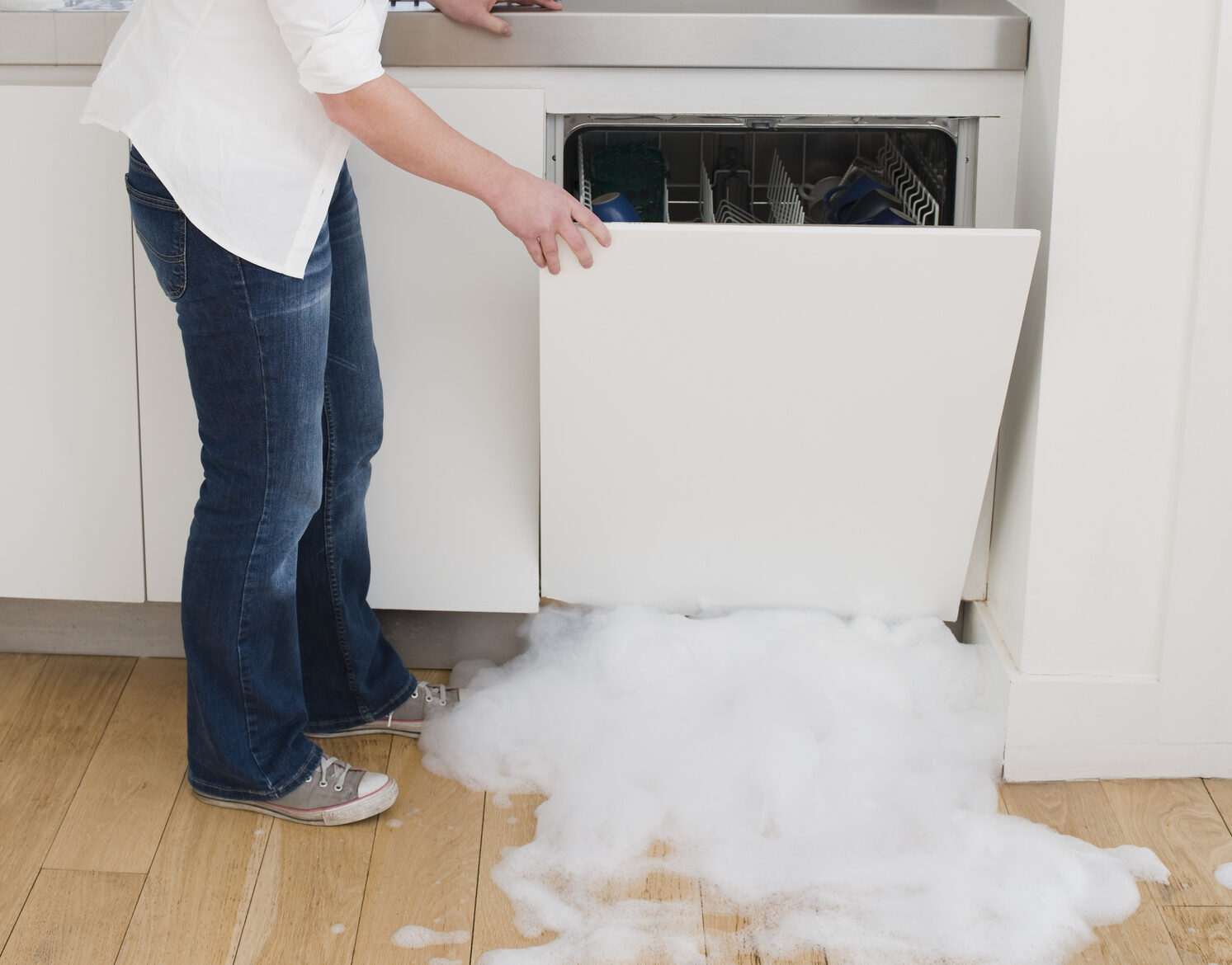
The question “Why is my dishwasher leaking?” often is followed by “How much is a repairman going to charge me to fix this?”
One drop of good news to absorb as you dry your floor: “A leaking dishwasher often is something a homeowner can handle,” says appliance repairman Ben Schlichter. “You might not have to call in a pro.”
Five common causes of dishwasher leaks that homeowners often can repair on their own…
Dishwasher Leaking from Bottom of Door
Gasket problems
Water can escape when the gasket that’s supposed to form a seal between the dishwasher door and body becomes damaged or dislodged. Even dirt or food debris stuck to this rubber or silicon gasket could prevent it from forming a seal, says Schlichter.
What to do: With the dishwasher turned off and the door open, examine this gasket closely. If it is dislodged, maneuver it back into position. If there’s dirt or debris on it, wipe it clean. If it is cracked or otherwise damaged, buy a replacement gasket online or in an appliance-parts store, typically for around $20 to $30. Replacing this gasket usually is a simple DIY job, according to Schlichter—you also can look for videos on YouTube that show what to do.
Clogged filter
If food debris blocks water from flowing out through the dishwasher’s drain, then water will pool in the tub, possibly even enough for it to overflow through the bottom of the door seal.
What to do: If water is pooled in your dishwasher after use—even if it is not leaking onto the floor—bail out as much of that water as possible…clear away any visible food debris…then remove and clean the unit’s drain filter. Soak the filter or use a scrub brush to clean it if necessary…then reinstall the filter. If you’re not certain how to access your dishwasher’s drain filter: Refer to your owner’s manual, or enter the dishwasher’s make and model plus the phrase “drain filter” into a search engine. If the dishwasher continues to not drain properly, look for an error code on the control panel and search online for its meaning…and/or call in an appliance repair pro.
Wrong detergent
If soap suds are escaping through your dishwasher’s door seal, the problem likely is your detergent, not your dishwasher.
What to do: Use only dishwasher detergent in dishwashers, never “dish soap” or other cleaners.
Dishwasher Leaking from Bottom of Unit
Leaking hose
The inlet hose that moves water from the water line under your kitchen sink to the underside of your dishwasher might be leaking…or the drain hose that carries water from the underside of your dishwasher to the drain line beneath your kitchen sink/garbage disposal might be leaking.
What to do: First, pinpoint the precise source of the leak. Use a flashlight to look for drips and your fingers to feel for moist hoses. If you don’t find these clues under your kitchen sink, remove the plate/panel at the base of your dishwasher so you can examine the hoses under the unit itself. If you still can’t tell where a leak originates, slip a towel, cardboard or paper under the dishwasher and/or sink, then use the position of the wet spot to focus your search. If the leak is from a connection at the end of a hose, tightening that connection might solve the problem. If the hose itself has sprung a leak, replace that hose.
Leaking drain pump or sump assembly
Sometimes the leak under a dishwasher comes from a component in the machine, not a hose or hose connection.
What to do: You’ll probably have to replace the leaking component to fix the leak. That might be within the typical homeowner’s abilities, depending on the model and which component is leaking, according to Schlichter. Replacing a drain pump usually is relatively easy, but replacing a sump assembly can be more challenging. Replacement drain pumps for many models are available online, sometimes for under $100, and YouTube videos can walk homeowners through the project.