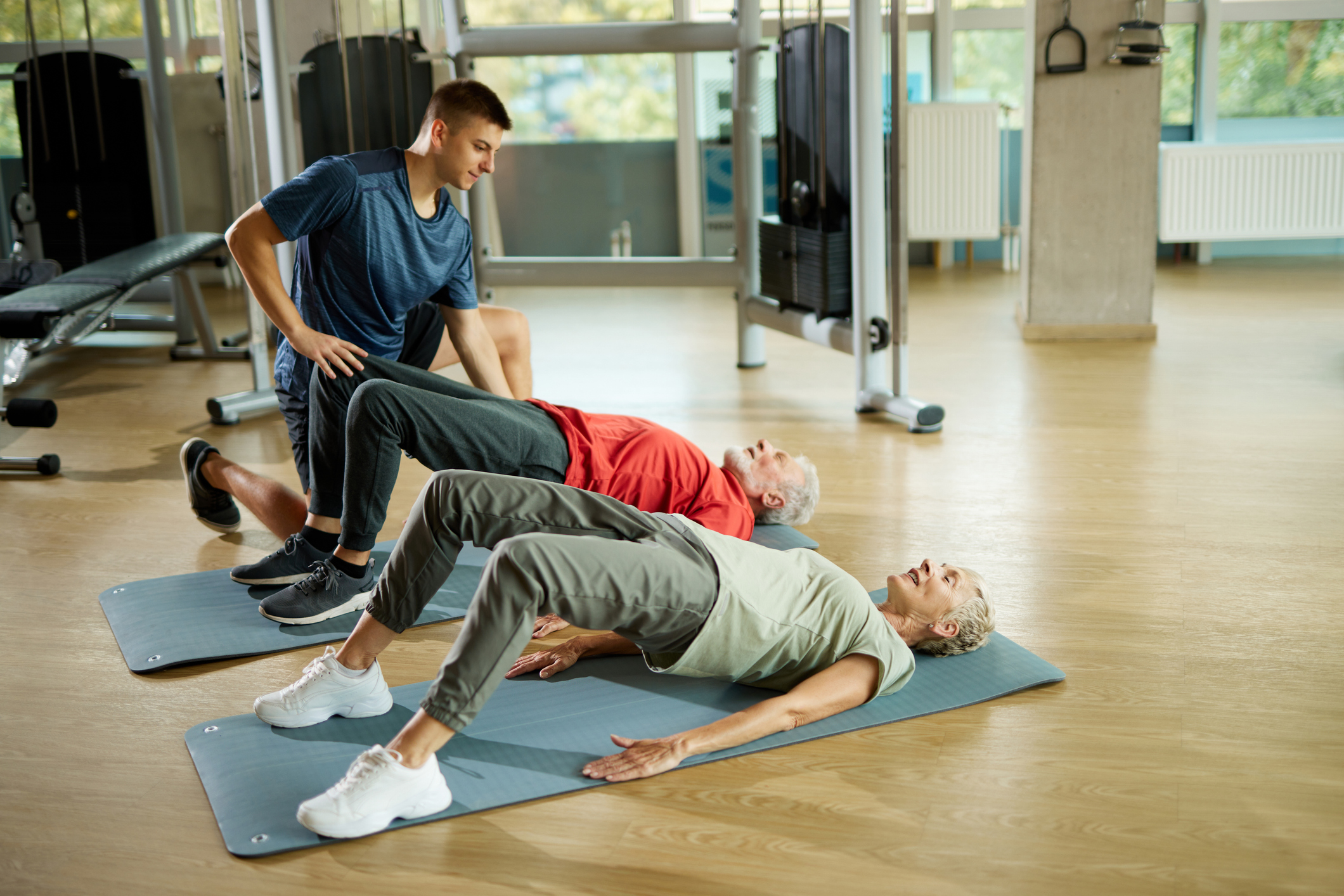
If you have knee pain from osteoarthritis, you might hesitate to do much in terms of physical activity. However, a number of exercises for knee pain can help improve your joint mobility and function.
“I treat a lot of patients with knee osteoarthritis who avoid exercise because they are afraid of making their symptoms worse,” says Cleveland Clinic physical therapist Andrea Hamilton, PT, DPT. “But when people avoid exercise, they have more debilitating symptoms due to loss of mobility and strength.”
Why You Need Exercises for Knee Pain?
Everyone naturally loses muscle mass over time. When muscles weaken and joints stiffen, daily activities become more difficult and the risk of falls and injury increases. Strength training helps counteract muscle loss, supporting the knees and reducing the risk of falls.
“When we’re addressing knee arthritis, it’s important to strengthen not just the muscles around the knee,” says Hamilton. You need to strengthen everything from the abdominal muscles (“core”) down, including the thighs, hips and calves. These muscles help stabilize the knees.
Regular movement also helps maintain and improve the range of motion of the knee, easing everyday tasks such as walking, climbing stairs, or standing up from a chair.
A well-rounded exercise program for knee osteoarthritis typically includes four key components: mobility, balance, strengthening and aerobic exercises.
Knee Stretches and Balance Exercises
Exercises to maintain or improve flexibility and mobility can help anyone with knee osteoarthritis. They are particularly recommended for people with severe arthritis and bony deformities that make it impossible to fully bend and extend the knee.
“Pedaling a bicycle can help to maintain and improve knee range of motion,” says Hamilton. Other exercises that help maintain or restore range of motion include quad sets for knee extension and heel slides for knee flexion.
Hamstring stretches (targeting the back of the thigh) and stretching exercises targeting the quadriceps (front of the thigh), gluteals (buttocks), hip flexors, adductors (inner thigh), and calves helps keep the surrounding muscles supple and reduces joint stress.
“Knee osteoarthritis and knee pain can cause loss of strength and power with daily movements like getting up from a chair and going up and down stairs,” says Hamilton. “Training movements like squats, deadlifts, step-ups and heel raises help with daily function because they translate to functional movement.”
It’s also important to work on stability with balance exercises, such the single leg balance stance.
Knee Strengthening
“A lot of knee stability is influenced by our core strength,” says Hamilton. If you are more stable through the core and hips, you’ll have less instability in the knee. Core strengthening can be achieved in many ways. “I encourage people to choose activities they enjoy, such as Pilates, yoga or tai chi, which can improve core strength and improve balance,” she says.
Examples of specific strengthening exercises are straight leg raises, bridges, side-lying leg raises and clamshells. For people with severe pain or limited mobility, many exercises can be performed while lying down or sitting, reducing joint stress while still building muscles.
Aerobic Exercise and Knee Pain
Aerobic exercise involves continuous movement and increases your heart rate and breathing. For people with more severe and debilitating knee arthritis, Hamilton recommends low-impact activities such as biking, swimming, using an elliptical machine or walking.
Start with 10 to 15 minutes at a low to moderate intensity and gradually increase to around 30 minutes two to three days a week. Progress gradually, with increasing intensity or duration of around 10% per week and based on symptoms.
Begin each session with a gentle warm-up, such as five minutes of easy pedaling on a stationary bike, to improve blood flow and reduce stiffness. “Even gentle movement can improve knee health by lubricating and delivering nutrients to the joint,” says Hamilton.
Knee Pain Management
It’s normal to experience some discomfort when starting a new exercise routine, but knee pain should be kept tolerable. Using a pain scale of 0 to 10, Hamilton advises people to keep pain at or below a 3 during exercise. If knee pain persists or increases for hours afterward, or if you notice increased swelling after exercise, reduce the intensity.
“Every exercise or movement can be brought down to a less challenging form and then progressed as strength and conditioning improves,” says Hamilton.
See below for more about exercises to build mobility and strength. However, the most effective way to start an exercise program is to see a physical therapist who can tailor an exercise plan to your specific needs and ensure that you are doing the exercises correctly.
Exercises for Mobility and Strength
For each of these exercises, aim for three sets of 10 repetitions on each side.
Quad sets
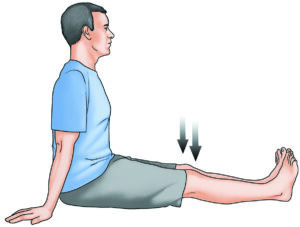
Sit on the floor, with one leg straight and the other knee bent. Straighten your extended leg, push your knee toward the floor, and hold it. Keep your back straight.
Heel slide
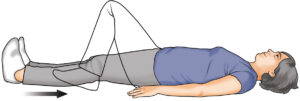
Lie on your back, with your knees straight. Slide the heel of your left knee toward your buttock and bend your knee. Hold for a few seconds and then return to the starting position. Repeat with the other knee. Alternatively, loop one end of a strap around the foot and slowly pull on it, sliding your heel on the ground to bring your foot toward your buttock while bending your knee.
Straight leg raise
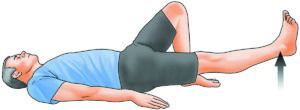
Lie on your back, with one leg bent and the other leg straight. Squeeze your thigh muscles in the straight leg and flex your foot, and then slowly lift your leg until it is parallel to the other thigh. Lower your leg back to the starting position and repeat.
Side-lying leg raise
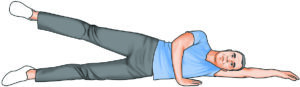
Lie on your side, with your top leg straight. Lift your top leg up toward the ceiling, and then slowly lower it back down. Do not let your hips roll backward or forward.
Bridges
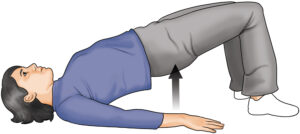
Lie on your back, with your arms resting at your sides, your legs bent at the knees and your feet flat on the ground. Tighten your abdominal muscles and slowly lift your hips off the floor into a bridge position, keeping your back straight.
Clamshells
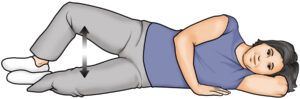
Lie on your side with your knees bent and your hips and shoulders aligned. Engage your abdominal muscles and raise your top knee up toward the ceiling, and then slowly return to the starting position and repeat. Do not roll your hips forward or backward.