Your doctor says your arm pain is due to tennis elbow, but you’ve never even swung a racket.
It doesn’t matter. If you’ve turned a wrench or ratchet, swung a hammer, raked leaves for hours or engaged in any other activity requiring repetitive elbow and arm movements, chances are good that you’ll eventually develop tennis elbow symptoms.
“Tennis elbow is an extremely common problem,” says Morgan Bertsch, MD, a Cleveland Clinic hand and upper extremity surgeon. “I think a lot of men at some point in their life will have at least one episode of it.”
Tennis elbow can often be managed effectively using simple treatments and self-help measures. If the pain persists, a range of nonoperative therapies can provide relief.
What Is Tennis Elbow?
Known clinically as lateral epicondylitis, tennis elbow occurs when recurrent stress of the forearm extensor muscles leads to wearing of the tendons that attach the muscles to the lateral epicondyle, the bony protrusion on the outside of the elbow. A similar but less common condition, golfer’s elbow (medial epicondylitis), occurs when this wear and tear affects the tendons on the inside of the elbow.
“It’s a gradual process starting with inflammation and then ultimately leading to tiny tears in the tendon itself, like a frayed rope,” Dr. Bertsch explains. “It’s just that repetitive motion that puts stress on those tendons at the elbow.”
Tennis elbow symptoms are triggered when you press on the outside of the elbow, extend your wrist, lift objects with the palm of your hand facing down or rotate your wrist upward as if turning a door knob. (Golfer’s elbow pain occurs when you press on the inside of the elbow, flex your wrist or turn it downward.) In some cases, the pain can be so severe that even basic movements like turning a steering wheel or raising a cup of coffee can hurt.
Tennis Elbow Treatment
Usually, a physician can diagnose tennis elbow based solely on a physical exam and a person’s description of the pain and the movements that trigger it, Dr. Bertsch says. If any questions remain, your doctor may order an x-ray, ultrasound or magnetic resonance imaging (MRI) scan.
Tennis elbow is treated initially with rest, activity modification (altering the movements and activities that cause pain), ice and use of over-the-counter analgesics like acetaminophen (Tylenol®) or nonsteroidal anti-inflammatory drugs, like ibuprofen (Advil®, Motrin®) or naproxen (Aleve®). You might find that wearing a counter-force strap around the forearm (just below the elbow) can reduce strain on the joint. Also, while you sleep, wearing an over-the-counter wrist splint can hold the wrist in a relaxed position and prevent you from flexing it and pulling on the damaged tendons.
Your healthcare provider will recommend gentle exercises to stretch the muscles in your forearms and, after the pain eases, light forearm strengthening exercises (see the examples in “What You Can Do”). Most people with tennis elbow try these simple measures for six weeks before moving on to further treatments, Dr. Bertsch says. These more advanced therapies include injections of cortisone or platelet-rich plasma, in which platelets and growth factors are extracted from your blood and then injected in a solution back into the elbow to help with healing. Another treatment, shockwave therapy, promotes healing by delivering high-energy acoustic waves that help increase blood flow to the area.
Experts are increasingly using a minimally invasive procedure known as percutaneous tenotomy (TenJet®) to manage tennis elbow. In this treatment, a needle-like device inserted through a small incision in the skin delivers a high-powered stream of saline that breaks down and removes damaged tissue and stirs the healing process.
If tennis elbow has persisted for several weeks and you haven’t been able to treat it successfully at home, or if the pain is preventing you from performing your day-to-day activities or doing your job, consider seeing a sports medicine physician to discuss these more advanced nonoperative treatments, Dr. Bertsch recommends.
Overall, tennis elbow is unlikely to cause significant complications, and only about 1% of people with the condition require surgery to correct it. Nevertheless, it’s best not to ignore it.
“If you don’t get to it while it’s in that early phase with the rest, anti-inflammatories and simple treatments, it might become more of a chronic problem and it might take longer for it to resolve completely,” Dr. Bertsch says. “We know that most people with tennis elbow get better without needing a procedure or surgery, but that period of time can be up to a year.”
What You Can Do
● Warm up and gently stretch your forearm muscles before any activity requiring repetitive use of your elbow.
● If you have tennis elbow, lift objects with your palm facing up, not down, to avoid stressing the outside of your elbow.
● Expand the grips on your tennis racket, golf clubs or tools so you don’t have to grip them so tightly and stress your elbow.
● Work with your healthcare team to quit smoking (if you smoke) and optimize your weight. Smoking and obesity contribute to a pro-inflammatory state in your body that can predispose you to tennis elbow and poor tendon health in general.
● Consider these exercises that stretch and strengthen your forearm muscles and may help with tennis elbow:
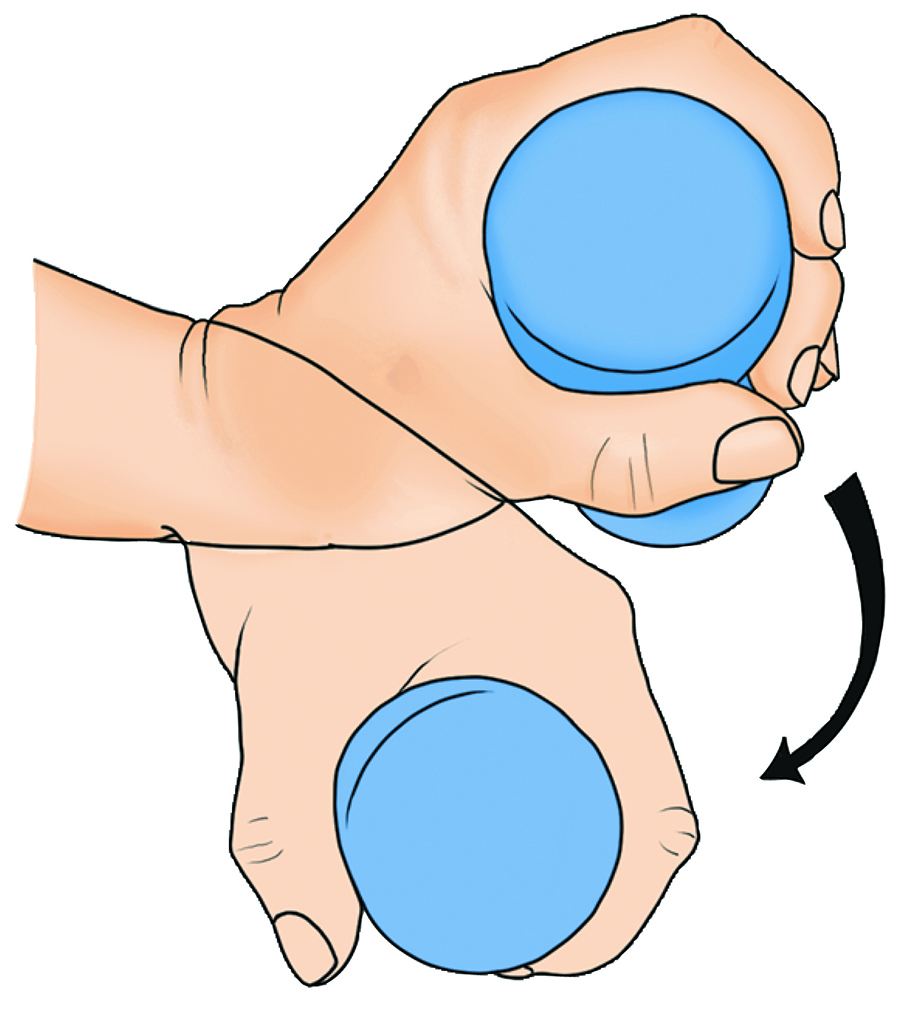
Reverse Wrist Curl
Rest your forearm on a bench or table, palm down, with your wrist at the edge. Holding a light dumbbell, gradually lower the weight. Then, use your opposite hand to help raise the weight back to the starting position. Do 10–15 repetitions, using your opposite hand to return to the starting position.
Resistance Band Exercise
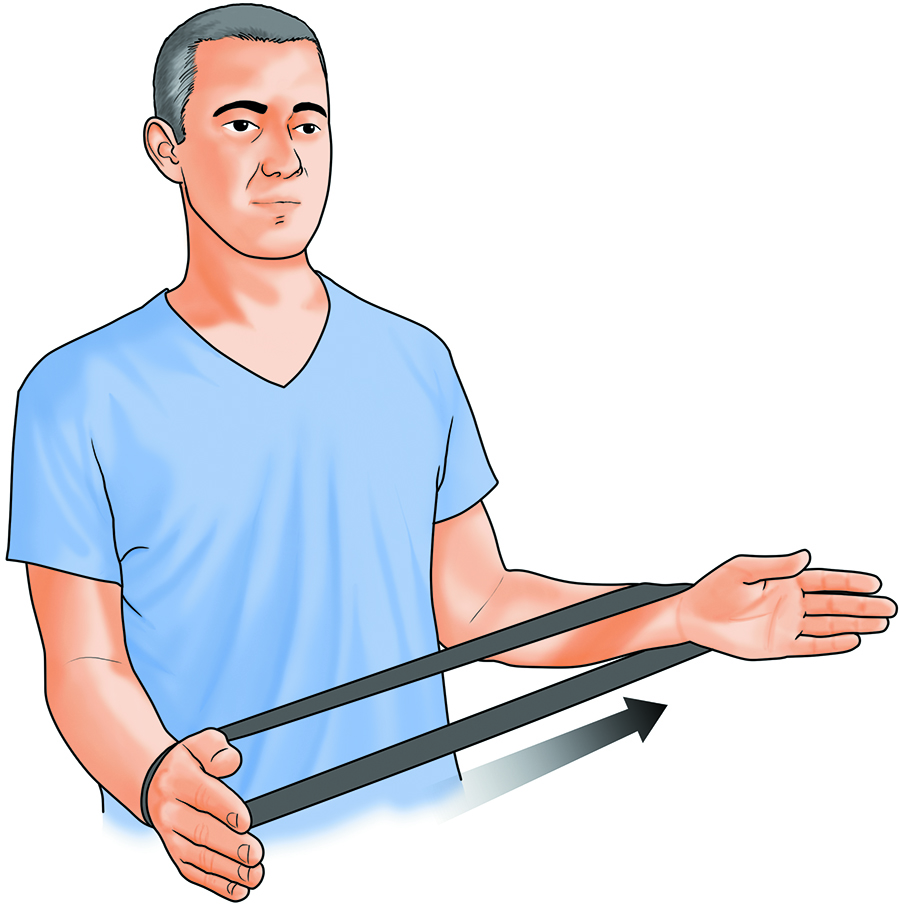
With your elbows bent and at your sides, loop a resistance band around both hands. Using your left arm as an anchor, pull your right arm outward, keeping your elbow tight against your right side. Do three sets of 10 repetitions.