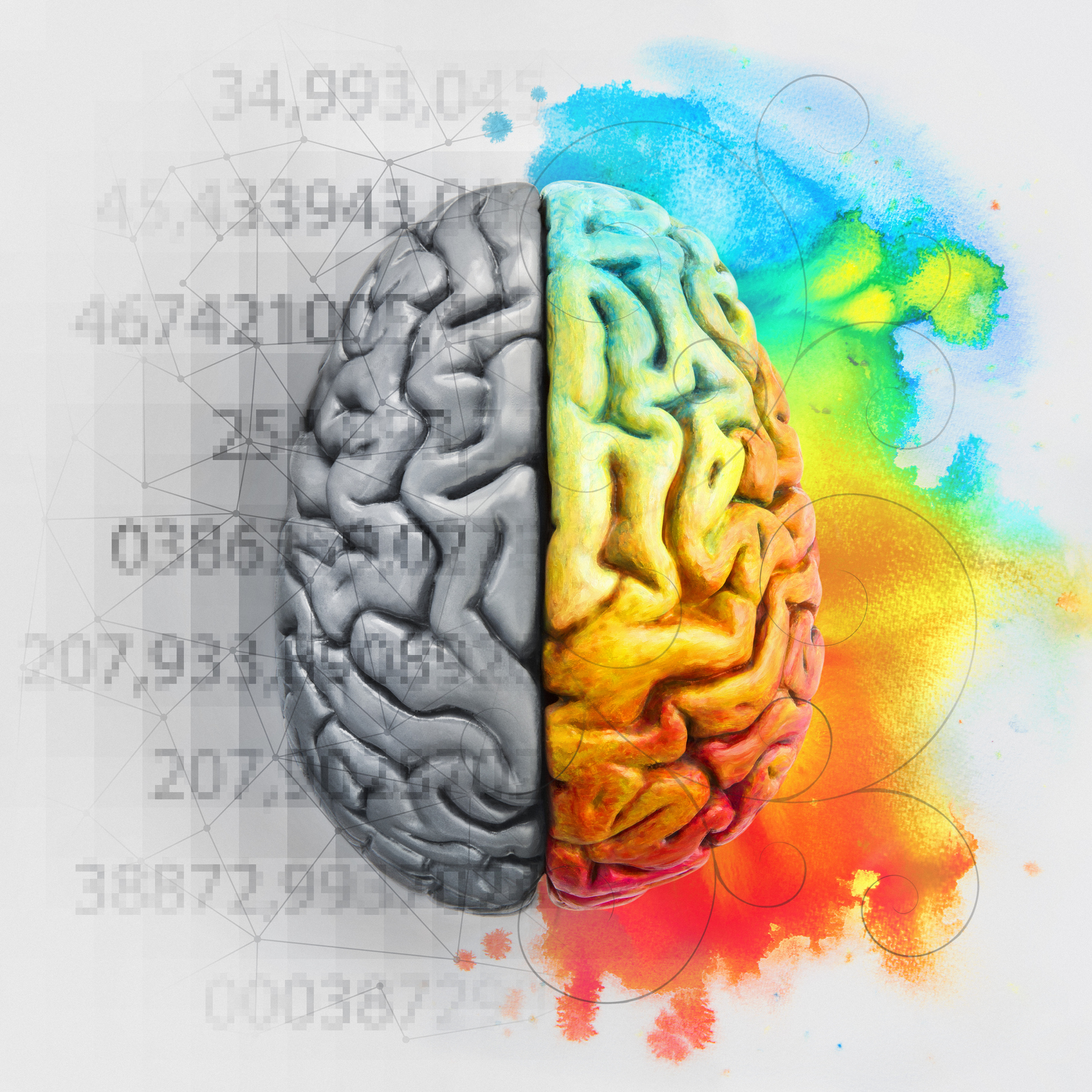
Are you a righty or a lefty? It seems like a simple question: about 90 percent of the population are right-handed—they prefer to use their right hand for most tasks, particularly those that require some finesse. The left-handed 10 percent use their left.
But beneath the surface, it gets more complicated. The brain has a right and left side, too, and there are differences between how they work and what they do. And according to a widespread belief, a lot more than which hand you write with is at stake: “Right-brained” people, the theory goes, differ in personality, talents, tastes and desires from the “left-brained.”
It sounds credible, but is it true?
Right brain vs left brain
The human brain is essentially split down the middle. Its two hemispheres are similar in size, shape, structure, and function but they are not identical.
The clearest difference: each hemisphere operates the opposite side of the body. The left side of your brain moves and processes sensations from your right arm, leg, abdomen, etc, and right brain does the same for the left side.
In smaller, more subtle ways, the two sides have different roles in thinking, feeling, and doing. The best-defined involves language. The Broca’s area is central to the ability to speak, sign and write; Wernicke’s area plays a key role in understanding what’s said, signed and written. For most, but not all people, these parts of the brain are located in the left side.
The right side of the brain, on the other hand, appears to take the lead in more nonverbal functions in most people, such as recognizing faces and the emotions conveyed by facial expressions, drawing pictures, and orienting yourself in space.
But things are not so simple. Though the brain is divided, the two halves are well connected: thick bundles of nerve fibers constantly carry messages back and forth. The thickest and most important of these is the corpus callosum, but even if this is severed, the hemispheres continue to communicate via smaller nerve tracts.
By the same token, the brain functions in an integrated way. One side may have a more prominent place in a function like speaking or responding emotionally to a familiar face, but the other side will invariably be activated as well. Even in something as apparently left brain-dominated as understanding speech, for example, certain aspects, like intonation (was that a question or an emphatic statement?) are largely processed in the right hemisphere.
To complicate matters further, the basic geography of the brain, such as having language centers in the left brain, isn’t absolute. For 3 percent of right-handers and 30 percent of lefties, Broca’s and Wernicke’s areas are in the right hemisphere.
How the brain got this way
Humans, like other living creatures, are the product of evolution: the way we’re put together, body and mind, developed over eons. We’re designed for survival: what worked for other creatures was handed down to us. We see evidence of brain laterality (differences between sides of the brain) in non-human primates like apes, other mammals, birds, all vertebrates. Scientists came to understand this quite recently. Until roughly a quarter-century ago, most believed that laterality was uniquely human.
Laterality is clearest in many animals, as with people, in handedness (or “pawedness,” or “clawedness”). Some 65 percent of chimpanzees handle objects preferentially with their right hands. Some 90 percent of parrots pick things up with their left claws. According to a meta-analysis in the journal Laterality, about two-thirds of dogs and three-quarters of cats have a favorite paw (they’re equally likely to be righties or lefties). There’s evidence of bias toward one side or the other in invertebrates like insects, and even in living things that lack a brain, like plants that twine clockwise or counterclockwise.
On the simplest level, the division of labors between right and left brain has the advantage of efficiency. Not only does this arrangement reduce duplication of effort, making one side dominant for a specific task keeps interference between brain areas to a minimum.
Beyond that, the split-brain arrangement makes it possible to multitask in a way that promotes survival. Repeated experiments have shown that chicks, for example, preferentially use their right eye (and presumably their left brain) to look for food on the ground, while keeping their left eye (and right brain) on the sky to keep watch for predators.
Nature doesn’t reinvent what works. In evolving from other animals, the human brain was built on the same blueprint. Although we rarely need to make split-second assessments of whether to fight, flee, or be friends, the capacity to recognize faces and judge emotional expressions remains the province of the right brain – and as a result the left visual field in species with forward facing eyes.
The left brain, on the other hand, dominates vital but less urgent capacities, Iike fine motor skills to manipulate objects, tasks that require a coordinated sequence of actions, like opening a door or cooking a meal, and the logic to put them together. Language, according to some theories, evolved from well-controlled and coordinated hand movements – which may also explain why the brain doesn’t care if it’s vocal or gestural – both are hierarchical motor sequences
Right-brained? Left-brained?
Given the association between sides of the brain and specific functions like speech and emotional expression, and the fact that most people are either right- or left-handed, it would seem logical that some individuals are left brain dominant, and therefore rational, methodical, and mathematical, while right brained people are more likely to be emotive, intuitive, and artistically inclined.
But in fact, decades of research have failed to show such a correspondence. Despite the avalanche of self-help books, websites, and such explaining differences in personality, talents, and proclivities by brainedness, there’s little scientific evidence for it. A left-brain vs right-brain test (that asks you to agree or disagree with statements like “I like working with words,” “I could not live in a mess,” and “I don’t bother to read instructions before putting something together”) might provide an entertaining and even instructive personality profile, but it’s unlikely to reveal much about how your brain works.
Put simply, the side of the brain that takes the lead depends on what’s being done, rather than who’s doing it. One widely cited study at University of Utah analyzed more than 1000 brain scans and found that, at rest, there was no difference in overall brain activity among individuals.
This is not to say that the sides of the brain work the same way in everyone. People differ in how distinctly labor is divided between hemispheres, and how closely the two sides coordinate and communicate.
Even handedness, the most obvious manifestation of laterality, is not simply binary but a matter of degree. Some people are strongly right-handed or left-handed—the difference in dexterity and control between hands is stark—while others are better able to use the non-dominant hand, and some 3 percent are ambidextrous: they can use either with equal facility. Less extreme handedness suggests greater integration between the hemispheres.
This matter of cross-brain communication may be quite meaningful. There is reason to believe that creativity, often promoted as the grand prize of the left-brained, actually reflects a well-developed degree of inter-hemispheric integration. On the other hand, some research suggests that in conditions like autism-spectrum disorders, communication is over-abundant; a melange of signals overwhelms the brain’s capacity to function in an orderly way.
In laterality as in so much else, it seems, moderation is key. Call it “the Goldilocks effect”—not too much, and not too little, but just right.