
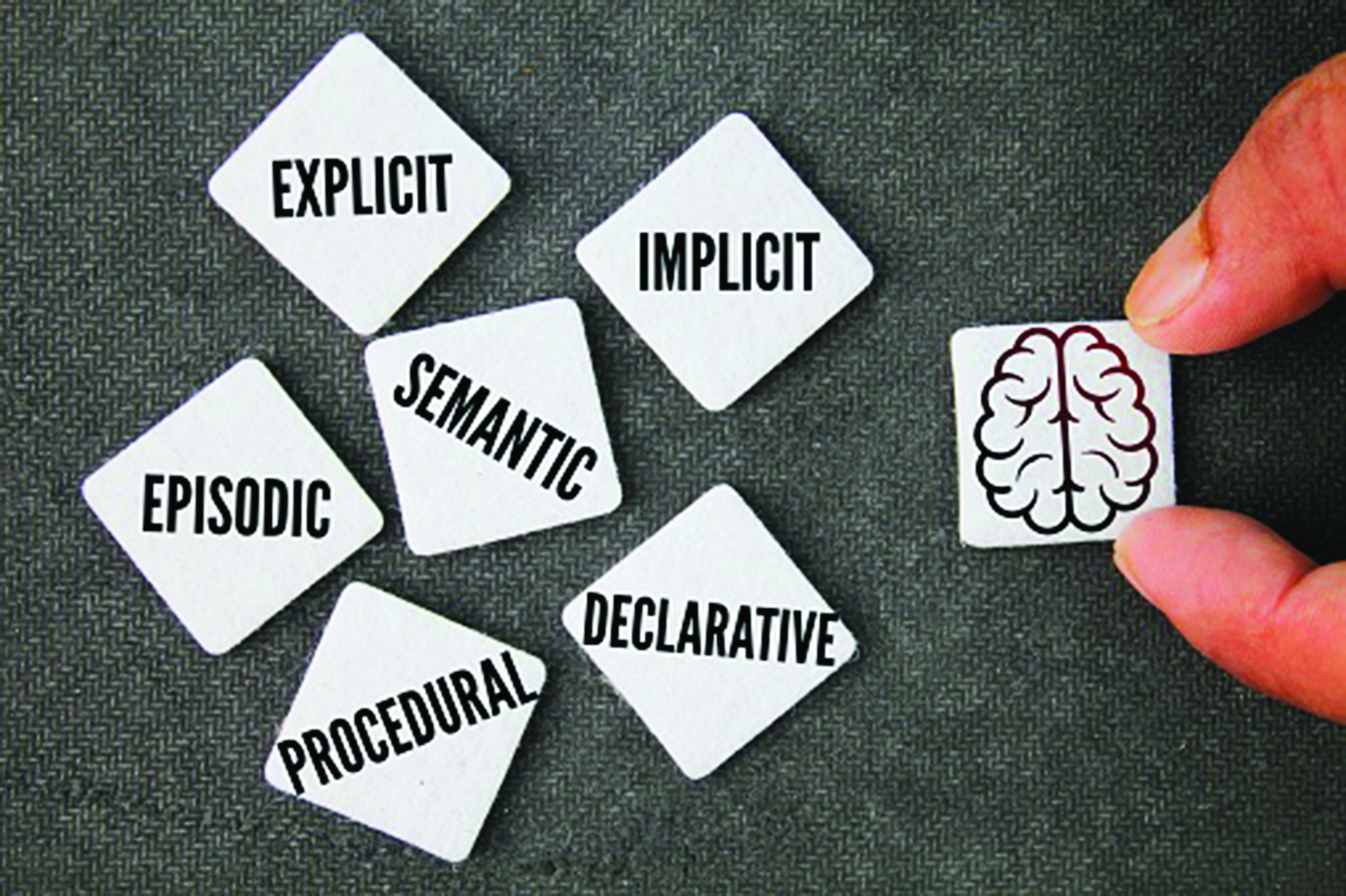
The colors of the rainbow. How to compute a percentage. The difference in the meanings of “overlook” and “oversee.” The importance of D-Day. Your mind is filled with facts, concepts, skills, and other types of knowledge, collectively known as semantic memory.
Semantic memory is more than a random collection of trivia. It helps you learn about the world, use language to communicate with others, and equips you to respond to a variety of situations.
“This information is stored in a complex, distributed network of brain regions, and is generally relatively resilient in advancing years,” says Janet Sherman, PhD, clinical director of the Psychology Assessment Center at Massachusetts General Hospital. “However, while the memory for this meaningful information is well preserved as we age, it is not uncommon for older individuals to experience greater difficulty retrieving this information quickly—when it is needed—which can lead to some frustration. This difficulty with retrieving or ‘finding’ words, names, or facts that we know is not uncommon, and patients often tell me that, while it’s frustrating to them, they notice that their same-age peers have the same difficulty.”
Fortunately, there are ways to boost your semantic memory and strategies to try when it’s hard to pull something from that vast library of knowledge you’ve accumulated through the years.
What Is Semantic Memory?
Semantic memory is the collection of meaningful information you have learned throughout your life. It differs from episodic memory, which is the storage of personal experiences. A semantic memory example would be a fact such as “Ottawa is the capital of Canada.” Episodic memory can contain details of a trip you once took to Ottawa.
To better understand episodic vs. semantic memory, consider the context of your memories. Semantic memory is context independent, meaning the information is not tied to a specific time or place. Episodic memory, in contrast, is entirely dependent on context, binding the “what” with the “where” and the “when.”
Semantic memory also differs from procedural memory. Semantic memory supplies the “what” in your knowledge bank, while procedural memory is the unconscious “how-to.” For example, identifying a bicycle is the responsibility of your semantic memory. Your procedural memory makes sure you remember how to ride it.
Theoretically, there’s no limit to your semantic memory. Learning new information can go on throughout your life. Indeed, a lifetime of learning new facts, concepts, and skills may help keep your thinking skills sharp for a long time.
When Semantic Memory Stumbles
When people experience mild cognitive impairment (MCI) or other significant changes in memory and thinking skills, their recollection of song lyrics, vocabulary, and many other examples of general knowledge can often remain surprisingly intact. Still, everyone draws a blank sometimes. Generally, though, forgetting a state capital or the number worn by a favorite baseball player of your youth isn’t a cause for worry.
“As neuropsychologists, we don’t become concerned unless the retrieval difficulty is so significant that it interferes with the ability to communicate in an effective manner—for example, leading to very long and frequent pauses in speech,” Dr. Sherman says. “We also become concerned when it’s not just retrieval that is impacted, but when the knowledge itself has been significantly diminished or lost. When this is the case, individuals not only experience difficulty finding the right words to express themselves but also have difficulty recognizing words and what they mean.”
She adds that these difficulties suggest a significant degradation of semantic memory. “This difficulty is not a part of normal aging, while decreased efficiency with rapid access to the information is not uncommon with increased age,” Dr. Sherman explains.
When individuals encounter difficulties with word retrieval, they can benefit from using strategies to either help locate the missing word or reduce their stress about their latest word-finding challenge. Dr. Sherman suggests the following to her patients:
- Use strategies to talk around the word. If you can’t find the word you want, try describing what the word means, find a synonym for it, or use a different communication strategy, such as gesturing. “These strategies will allow you to preserve your communicative intent,” Dr. Sherman says.
- Try to find the word by thinking about what it sounds like. “You can go through the alphabet to try and find the first letter or sound or think about how many syllables the word has,” Dr. Sherman says. “This information can sometimes trigger the word.”
- Think about the concept. For example, what category does the word belong to?
- “While we are used to words quickly and automatically ‘popping’ into our mind, when that doesn’t happen, give yourself a couple of seconds,” Dr. Sherman says. “The word might just ‘pop’ back in.”
Strengthen Your Semantic Memory
While certain strategies can help when retrieval of semantic memory misfires in the moment, others can help bolster your command of dates, names, and other important pieces of information.
Adapting the mindset of a lifelong learner is an important approach. Learning new languages has been shown to improve several brain functions, including semantic memory. And you don’t have to become fluent to reap certain brain benefits. Simply the practice of learning new grammar rules and vocabulary, and practicing reading, writing, and speaking a new language—even at an elementary level—can make a difference.
Challenging your knowledge base in other ways may be beneficial, too. Playing Jeopardy or trivia games can help because you have to respond to external prompts.
Also, read for pleasure and for information. News articles, books, and other materials that give you new perspectives on events and issues can be very helpful. Likewise, gather new information and reinforce things you’ve already learned through travel, museum visits, and other cognitively stimulating activities.
“Engage with crossword puzzles and word games like Scrabble to keep your ability to access information in your semantic memory working at its best,” Dr. Sherman says. “And keep up your socialization. Talking with others and listening to what they have to say is a way to keep you mentally sharp and to engage your semantic memory.”
