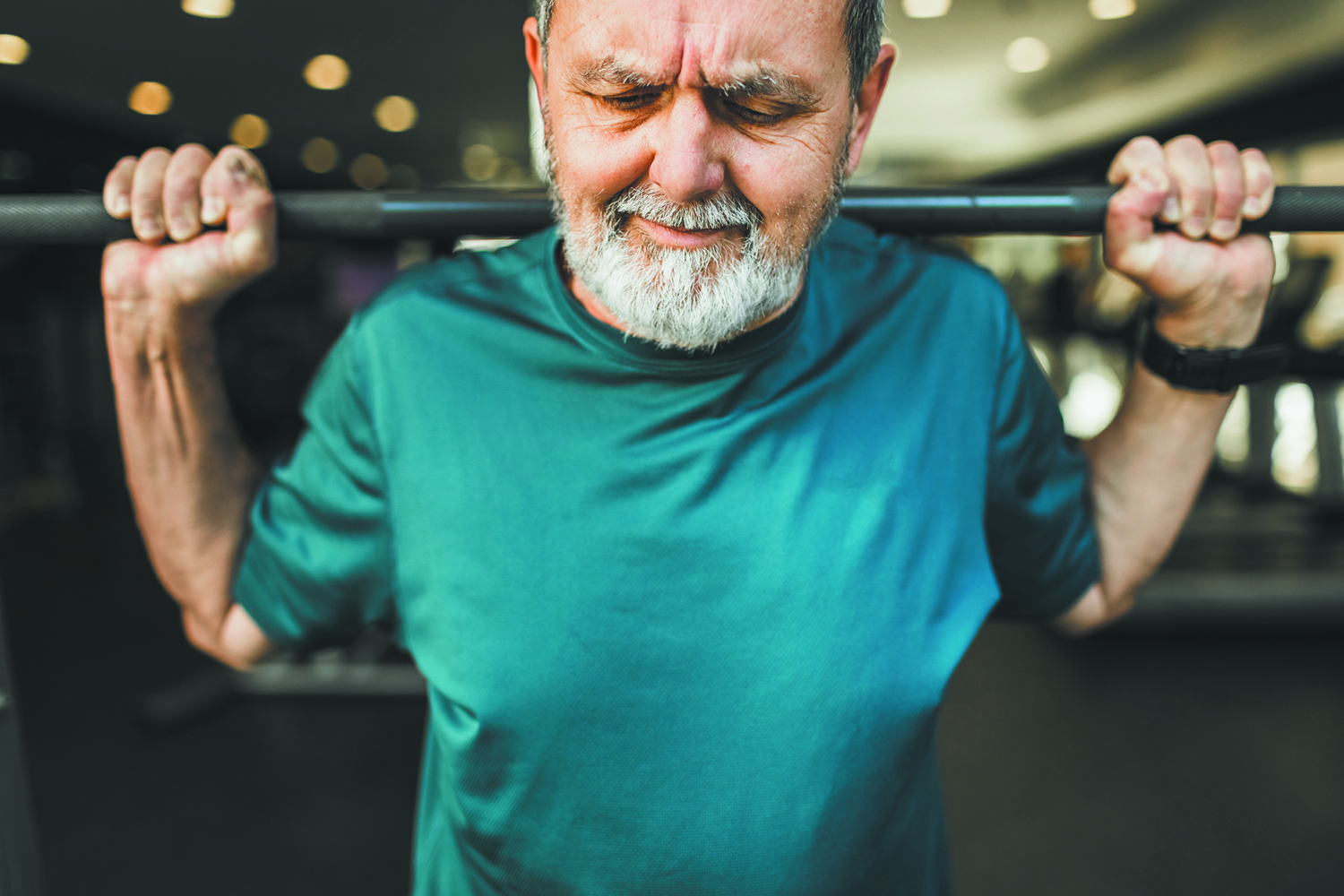
Go inside most gyms these days and you’ll the latest trend: heavy weightlifting. And it’s not just younger men and women who are engaging in it. In their fight against sarcopenia, older people are choosing heavy lifting, too. It’s an extremely effective and efficient way to reshape and strengthen your body and also counter sarcopenia, or age-related muscle atrophy.
What Is Sarcopenia?
Sarcopenia refers to the normal, age-related loss of muscle mass and strength that begins quietly in early adulthood but speeds up when people reach their 60s. Contributing factors include changing hormone levels, slower muscle repair, less efficient protein metabolism, chronic low-grade inflammation and lack of muscle training.
Sarcopenia symptoms include muscle weakness, reduced muscle mass, slow walking speed, difficulty climbing stairs, and impaired balance. Many people also experience trouble rising from a chair, fatigue, and increased risk of falls and injuries.
While some muscle loss is normal with aging, it’s in your best interest not to just surrender to the process. What this aging reality signals is the need to address ways to develop and maintain optimal muscle. Doing so not only helps you feel better, but it also greatly enhances healthy aging overall.
Subdue Sarcopenia with Resistance Training
Expert guidelines recommend that adults engage in strength (resistance) training on at least two to three nonconsecutive days per week. According to Mathew Kovalchick, a UCLA orthopedic board-certified physical therapist, ageism is one of the biggest barriers for older adults to overcome when deciding whether to meet this goal by lifting heavy weights.
“It’s wrong to assume that just because someone is older, they’re fragile or incapable of doing hard things,” he emphasizes. “Today’s older population is often both mentally and physically fit and capable of more than we expect or are taught by our previous mentors. Heavy lifting doesn’t replace other important activities like endurance, balance, or functional training, but it can be a great addition to a well-rounded routine.”
Among the key benefits of heavy resistance training (HRT) is that it helps you move with less effort, thereby making everyday tasks like climbing the stairs, walking around the block, or carrying groceries feel easy. If you’ve ever lived in a fit body, you know how good it feels. If you’ve yet to experience this feeling, the good news is you can, at any age. No matter how old you are, you build muscles when you make the effort.
Whether you’re getting back into it, looking to boost your current fitness level, or just getting started, HRT is well worth the effort. A stronger body not only improves physical function, but also mental well-being. It also increases confidence, energy, and positivity, and, importantly, can prevent sarcopenia in older individuals.
Resisting Muscle Atrophy: What Science Shows
Current clinical guidelines and numerous studies agree—resistance training is a very effective intervention against sarcopenia. Training muscles with weights, resistance bands, or body weight halts muscle decline and builds strength, balance, and confidence. Studies have documented that resistance training shows measurable improvements in grip strength and walking speed, even in people who are just beginning or who have struggled with consistent exercise.
A randomized controlled trial, published in BMJ Open Sport & Exercise Medicine in June 2024, involved 451 well-functioning older adults in Denmark, average age 71 (range 64–75; 61% women). Participants were randomly assigned to one of three groups for a year: HRT, moderate-intensity training (MIT), or a control group that continued usual physical activity.
The HRT group performed supervised full-body resistance exercises three times per week at a commercial gym, while the MIT group engaged in moderate circuit training using body weight and exercise bands as resistance. Outcomes were measured at baseline, after the one-year intervention, and then two and four years later. After four years, 369 participants completed follow-ups.
The study found that those who did HRT preserved their leg strength over four years (virtually unchanged from baseline), while the control and MIT groups experienced declines. This study powerfully shows that starting HRT even at an older age not only boosts strength and function in the short term but can also sustain these gains for years, providing compelling motivation to prioritize muscle-building exercise for lifelong resilience and independence.
A Real-World Approach to Beat Sarcopenia
Oftentimes, the biggest hurdle to engaging in resistance training and fighting sarcopenia isn’t physical—it’s psychological. Many people may worry about injury, embarrassment, or simply not knowing how to begin. The key is to start simple and keep showing up. Resistance bands and body-weight routines are an excellent place to begin, gradually adding free weights or machines as confidence grows. Tracking progress and noting steady progress keeps motivation high and reduces dropout rates.
“Don’t get hung up on how much weight you lift or what others are doing,” Kovalchick advises. “Progress happens when you train consistently at a level that challenges you.”
Whole-body movements and gradually increasing load and complexity work best. “This means two to three workouts a week, built around big muscle group exercises—such as squats, rows, and presses—with eight to 12 repetitions per set,” Kovalchick says. “It’s the steady increase in challenge and volume, more than pure intensity, that drives real gains.”
Research suggests that heavier loads (typically 70% to 80% of what you could lift once) maximize strength gains, but lower loads still build muscle and often suit those seeking pain-free movement or endurance. Some studies have found benefits using elastic bands and vibration platforms for those unable—or unwilling—to work with heavier weights. Machine-based resistance routines are also safe and highly effective, making them a good fit for those training both at home and in community gyms.
Yes, heavy weights are beneficial, but you need to understand where your personal starting point is and when and how much weight to add. Create a plan and follow the plan for best results. The emphasis is progressive overload, individualization, and specificity. For that, guidance from an expert is golden. A personal trainer or a physical therapist can design your ideal routine and ensure proper exercise form, which is crucial to reduce injury and accelerate progress. The main idea is no sloppy movements or using momentum to fling weights around. It’s about you controlling the weight, not the weight controlling you.
Maintaining Gains and Overcoming Challenges
Lack of time is one of the most common excuses for not exercising. To experience the benefits of exercise, it must become routine. Evidence suggests that muscle strength and size can be preserved for months with as few as two sessions per week—each including two to three sets of eight to 15 repetitions—provided that the intensity remains adequate. Falling off the routine is common, but the solution is to treat exercise like any important appointment: block time, join group classes, or work with a coach to help you stay accountable and exercising regularly.
Everyone has commitments and everyone has excuses. Don’t fall into that trap. The health payoff of exercise consistency is significant. You’ll feel better, move more with greater ease and grace, and in all likelihood, you’ll have more energy and a more positive outlook.
Sarcopenia is a part of aging, but fully succumbing to muscle loss doesn’t have to be your reality. Resistance training—tailored to ability and interests, performed consistently, and supported by good nutrition—remains the safest, most effective path to maintaining strength. As Kovalchick says, “Age sets the starting point, not the finish line. With the right plan and attitude, anyone can reclaim muscle and confidence—no matter their decade.”