Peyronie’s disease is a common problem that affects an estimated 10% of men at some point in their lives.
The primary treatments for men with bothersome Peyronie’s disease have been injections of the drug collagenase clostridium histolyticum (Xiaflex) or surgery to correct the deformity and help straighten the penis. While surgery remains effective, our early experience with Xiaflex was underwhelming. Studies showed the treatment could reduce penile curvature, but the degree of improvement we saw in our clinical experience was often suboptimal.
That was until relatively recently. Now, we’re seeing substantial improvements in appropriately selected men after we evolved our Xiaflex treatment protocol. This new approach requires more engagement from patients, but it’s producing better results and generally requires fewer treatment sessions.
What Is Peyronie’s Disease?
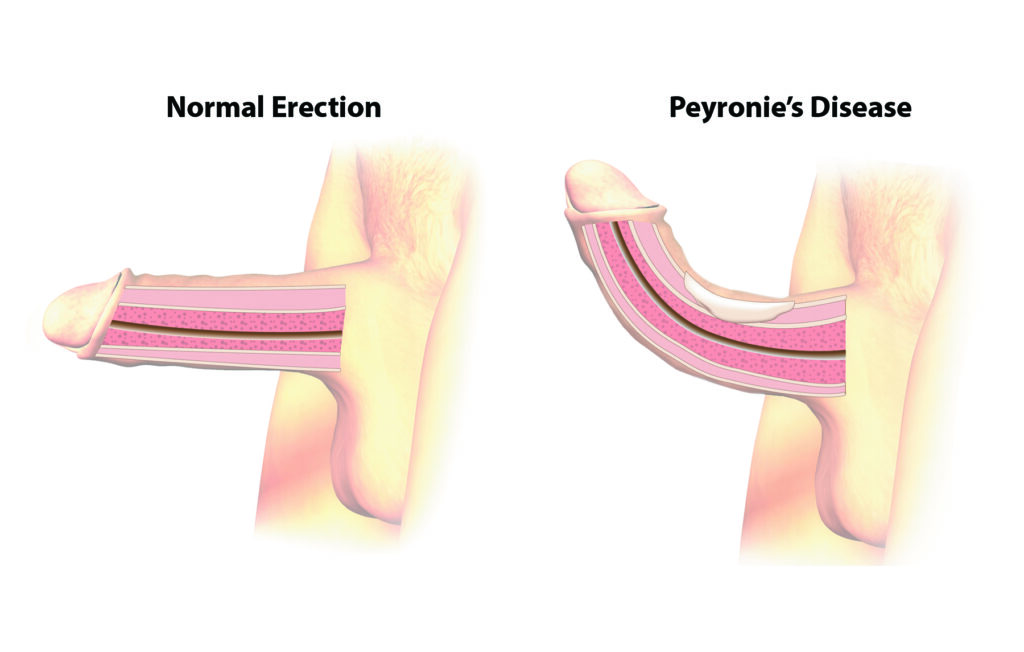
Peyronie’s disease is thought to be a result of microscopic vascular injury to the penis that, in the average man, might not be noticeable. But in men predisposed to Peyronie’s disease, that trauma leads to exaggerated scar tissue formation in the tunica albuginea, the sheath covering the erectile chambers of the penis, thereby making it less elastic.
The scar tissue fails to remodel, or normalize, causing collagen fibers in the tissue to tether together and form a plaque. This plaque prevents the penis from expanding equally and symmetrically during an erection, resulting in a curved penis, usually toward the side of the penis where the scar tissue forms. It can also reduce penile length or girth and create an indentation that produces an hourglass deformity in the penis.
Tobacco smoking and diabetes are the primary risk factors for Peyronie’s disease, so working with your health-care team to avoid them can help reduce your likelihood of developing this disorder. One theory holds that erectile dysfunction can cause Peyronie’s disease because a penis that is not fully erect is more susceptible to injury during intercourse. Yet 80% of men presenting with Peyronie’s disease cannot recall any specific trauma or event that led to their condition. Nevertheless, we know that Peyronie’s disease and erectile dysfunction are associated because Peyronie’s disease can cause blood to leak from the penis and interfere with the ability to achieve or maintain an erection, resulting in erectile dysfunction.
Peyronie’s disease doesn’t affect urination or ejaculation, and it may or may not be painful. It’s not life-threatening, but it can interfere with sexual activity and be psychologically devastating. It can wreck a man’s self-image and confidence and cause him to withdraw from his partner or prevent single men from seeking out potential partners. The severity of Peyronie’s disease doesn’t seem to matter: Some men can be extremely bothered by mild penile curvature, while others with a more severely curved penis remain sexually active and feel no need to seek help for it.
A New Approach to Peyronie’s Disease Treatment
Xiaflex is an injectable medication that breaks down collagen to weaken and soften the scar tissue causing Peyronie’s disease. The treatment is an option for men with a penile curvature of 30 to 90 degrees who do not have an hourglass penile deformity.
In the conventional Xiaflex protocol, men receive two injections spaced one to three days apart, followed by a session of plaque modeling, which entails stretching and bending the penis to break up scar tissue. This treatment cycle is repeated at six-week intervals, as needed, for up to four cycles (a total of eight injections). Patients are taught to perform their own stretches at home and are advised to refrain from sexual activity for one month after each treatment cycle to prevent penile fractures, a potential complication of Xiaflex treatment.
Several innovations have improved upon this strategy. Though the treatment cycle remains the same (two injections plus penile modeling), we’ve reduced the interval between each of the three visits to less than 24 hours. We couple Xiaflex with penile traction therapy, using a device known as RestoreX. This approach is based on data showing that this combination can boost the improvement in curvature from Xiaflex. Men use the device for an hour a day during Xiaflex therapy and, ideally, before and for three months after treatment. Also, they’re prescribed daily tadalafil (Cialis) therapy, which data suggest can facilitate more improvement and help prevent worsening of the curvature.
Most notably, during the modeling visit, we perform more vigorous stretching to achieve a release of the scar tissue, sometimes accompanied by an audible “pop.” Afterward, patients wear a compression dressing around the penis for five days, and we instruct them on how to apply the wrap and monitor for swelling at home.
Since making these changes, the improvement has been dramatic. We used to set the expectation with patients that we would do a total of four cycles of Xiaflex—two injections and one modeling visit each for a total of 12 visits. Now, with the new protocol, we counsel patients that we’ll do one cycle and reassess, and then the patient will decide if he wants to continue. Most patients require no more than one to two cycles to get where they want to be.
So, our standard nowadays for men with mild-to-moderate curvatures that require treatment is usually to start with Xiaflex. If we’re not able to achieve the results a patient wants, we can consider surgery.
Inquire About Peyronie’s Disease Treatment
We’ve seen a number of men who received Xiaflex treatment elsewhere and gained no benefit and who have experienced significant improvement with this new protocol. So, if you have Peyronie’s disease, ask about this new approach—note that at this point, this treatment protocol is being performed by only a few practitioners highly specialized in managing Peyronie’s disease. Also, review your surgical treatment options for managing Peyronie’s disease, and take steps to lower your risk of this condition.