Helen Keller said, “Blindness separates people from things, but deafness separates people from people.”
That separation from people may partly explain the link between hearing loss and dementia. Since hearing connects you with other people, it’s not surprising that hearing loss can prompt you to withdraw from your friends and family, unable to join in conversations or interact effectively. Social isolation is one factor underlying the connection between hearing loss and dementia.
Hearing loss can have significant effects on your cognition and your quality of life. As such, experts now recommend that all adults be screened for hearing loss beginning at age 50. Problem is many people ignore hearing loss or fail to acknowledge it, even when they’re told they have it.
“For whatever reason, hearing loss with aging is considered normal. It’s common, but that doesn’t make it normal, and it doesn’t mean it’s something you have to live with,” says Sarah Sydlowski, AudD, PhD, a Cleveland Clinic audiologist. “So just like high blood pressure or other conditions, when hearing loss is identified, it’s important to do something about it. We are learning there are a lot of other ramifications that go along with it.”
Hearing Loss and Dementia
The Lancet Commission on dementia has identified hearing loss as one of 14 modifiable factors that increase the risk of dementia. In a recent study of 2,246 people, ages 66 to 90, investigators concluded that identifying and managing hearing loss in middle age could help reduce the risk for developing dementia in later life (JAMA Otolaryngology-Head & Neck Surgery, June 2025)
Research suggests your risk of dementia decreases the more you engage your brain with intellectual and social activities. Hearing stimulates your brain, too, but with hearing loss comes a reduction in auditory stimulation and, potentially, cognitive ability. By struggling to hear and understand what’s being said, you tax your brain by forcing it to work harder to fill in the information gaps (i.e., the words you miss). Some data suggest that hearing loss is associated with accelerated brain aging and shrinkage, or atrophy.
“We all start the day with a bucket of energy, and if you’re taking scoops out just to be able to focus and hear, you don’t have enough left for everything else,” Dr. Sydlowski says. “When you have to work hard to enjoy a conversation in a noisy restaurant, you’re less inclined to go. But if you’re not in noisy environments and having conversations in groups, it becomes harder to do it.”
A chief reason why untreated hearing loss and dementia commonly co-occur is that being unable to hear keeps you from connecting with other people. Social interaction challenges your brain to interpret verbal and visual cues and respond accordingly—think of it as a workout for your mind. But, if you can’t hear and interact well with friends and family, you may withdraw from them and avoid social encounters, thereby depriving your brain of this vital exercise.
“I had someone tell me that the worst part about not hearing is when everybody starts laughing and you don’t know what was funny and if you should laugh. That’s a common complaint I hear from patients,” Dr. Sydlowski says. “We see people with hearing loss choose not to participate in things. If you have social isolation, if you aren’t able to stay connected and vital, it’s going to affect your brain health.”
On a positive note, a review of data from 100 studies involving more than 8,500 people found that correcting hearing loss with hearing aids was associated with improved social quality of life (JAMA Otolaryngology-Head & Neck Surgery, July 3, 2025). Another recent study, involving 977 people with hearing loss, found that those who corrected their hearing deficit retained an average of one additional person in their social network and experienced improvements in measures of loneliness over three years (JAMA Internal Medicine, July 1, 2025). Other research suggests that the use of hearing aids or cochlear implants may help reduce the risk of dementia.
Other Concerns
Some data suggest an association between hearing loss and cardiovascular health, as the tiny blood vessels in the ear can become blocked with atherosclerotic plaque. As such, hearing loss may be an early warning of underlying cardiovascular disease. Also, the social isolation and loneliness resulting from hearing loss can contribute to depression, which itself is tied to increased cardiovascular risk.
Additionally, a recent meta-analysis of 27 studies involving more than 5 million people found that hearing loss was associated with a significantly increased risk of falls (JAMA Otolaryngology-Head & Neck Surgery, May 2025). Your hearing and balance (vestibular) systems are connected in the inner ear, so anything that affects your hearing may affect your balance as well, Dr. Sydlowski says. And, you use hearing along with others senses (e.g., vision, feeling/proprioception) to navigate the world around you, and when one of those senses is dysfunctional, you may be less connected to your environment and more susceptible to a fall, she adds.
Seek Help for Hearing Loss
Most people do a poor job at recognizing declines in their hearing and the degree of hearing loss they have, studies have shown. If you notice you frequently have difficulty following conversations (especially in quiet environments) you have to turn up the television or radio very loud to hear it or friends and family express concerns about your hearing, undergo an evaluation.
“There’s some literature that suggests most people wait seven to 10 years after they suspect a problem before they have a hearing test,” Dr. Sydlowski says.
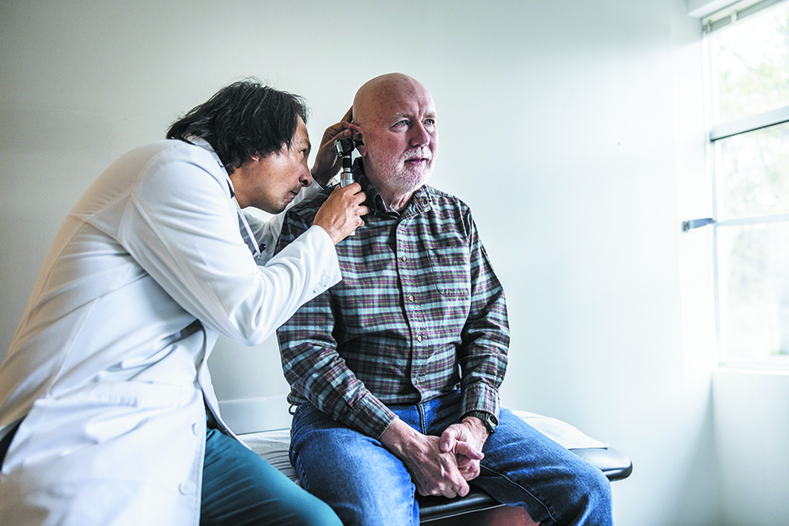
In recent guidelines, the American Academy of Otolaryngology recommends that starting at age 50, all adults be screened for hearing loss during a healthcare encounter. If screening suggests hearing loss, physicians should examine the ear canal for earwax buildup, infection or other problems and then refer the patient for an audiological exam if the problem persists.
Dr. Sydlowski notes that many people hesitate to use hearing aids because they don’t want to “look old” or be perceived as stupid. “Oftentimes, we’ll tell them to think about what you’re missing now or the times when you chime in and the comment you make doesn’t quite make sense in the conversation,” she adds. “That’s going to have a much bigger impact on how people perceive you than what you’re wearing on your ear.”
An audiologist can customize hearing aids or cochlear implants to match your individual hearing needs. The price of these devices varies depending on the level of technology, and most insurance providers do not cover the cost. Medicare Part B does not cover hearing aids, but it does cover cochlear implants for people who meet certain criteria.
Over-the-counter (OTC) hearing aids offer an alternative for people with mild to moderate hearing loss, and some data suggest some can be as effective as traditional hearing aids. However, quality OTC hearing aids may be similar in price to those programmed by an audiologist, so your best choice may be to invest in optimal fitting, Dr. Sydlowski says. Before pursuing any OTC option, it’s best to have a professional hearing test and ask if an OTC option could provide enough benefit.
Whatever device you choose, it’s best to address hearing loss sooner than later so that you can adapt to them more easily and begin to lower your risk of social isolation, dementia and other potential complications sooner.
“An important point for people to understand is if you start using hearing aids earlier, when the adjustment they provide is more minimal, then it’s an easier adjustment for you to make. It’s a much easier process and experience if you don’t wait,” Dr. Sydlowski advises. “Also, if an ear has not been stimulated for a period of time, there is a point where we can’t stimulate it enough. If you haven’t been hearing certain sounds, if your brain has reorganized and lost the ability to process those sounds, that clarity can be much more difficult to restore.”
- The sounds you hear are muffled.
- You have difficulty hearing in group settings, on the phone, in noisy environments and when you can’t see the person who is speaking.
- You often ask others to speak more slowly, clearly or loudly, or to repeat what they’ve said.
- You turn up the television or radio/stereo volume to a level that others find undesirable.
You may have more severe hearing loss if:
- You struggle to hear conversations in quiet settings
- You have difficulty hearing loud sounds, such as automobiles, loud music or noisy appliances.
Source: National Institute on Deafness and Other Communication Disorders
- Have your hearing tested at least once if you’re age 50 or older, and then have it rechecked at an interval your hearing specialist recommends. (Note: Medicare will cover the cost of a hearing exam if your health-care professional orders it to determine if you need medical treatment.)
- Wear hearing protection (even if you wear hearing aids) whenever you’re in loud environments.
- Manage your blood sugar and other cardiovascular risk factors, and get screened for hearing loss if you have type 2 diabetes or cardiovascular disease, both of which can affect your hearing.
- Ask your doctor if any medications you take can cause hearing loss. Some examples include very high doses of aspirin, erectile dysfunction medications (e.g., Cialis, Viagra), and certain chemotherapy drugs.
- Review all your hearing-aid options, and work with an audiologist to choose the one that’s right for you.
- Find out if your insurance covers the cost of hearing aids or the hearing exam.
- Learn about the return/refund policy and warranty for your hearing aids, and see your audiologist within that right-to-return period to make any necessary adjustments to your device.
- When considering an OTC hearing aid, check:
- The return policy (if any). A return policy is not required of OTC devices.
- The label. Check for language that states the device is FDA approved.
- The battery life. Check if the hearing aid has a rechargeable battery, if so, how long it lasts.
- The capabilities. Look for features like noise reduction and Bluetooth connectivity.
- The history. Check to see if the device been used and returned and then refurbished.
- The long term. Consider how your needs for the future, such as if your hearing changes or if you have dexterity problems that make it difficult to adjust the hearing aid.
Source: Sarah Sydlowski, AuD, PhD, Cleveland Clinic