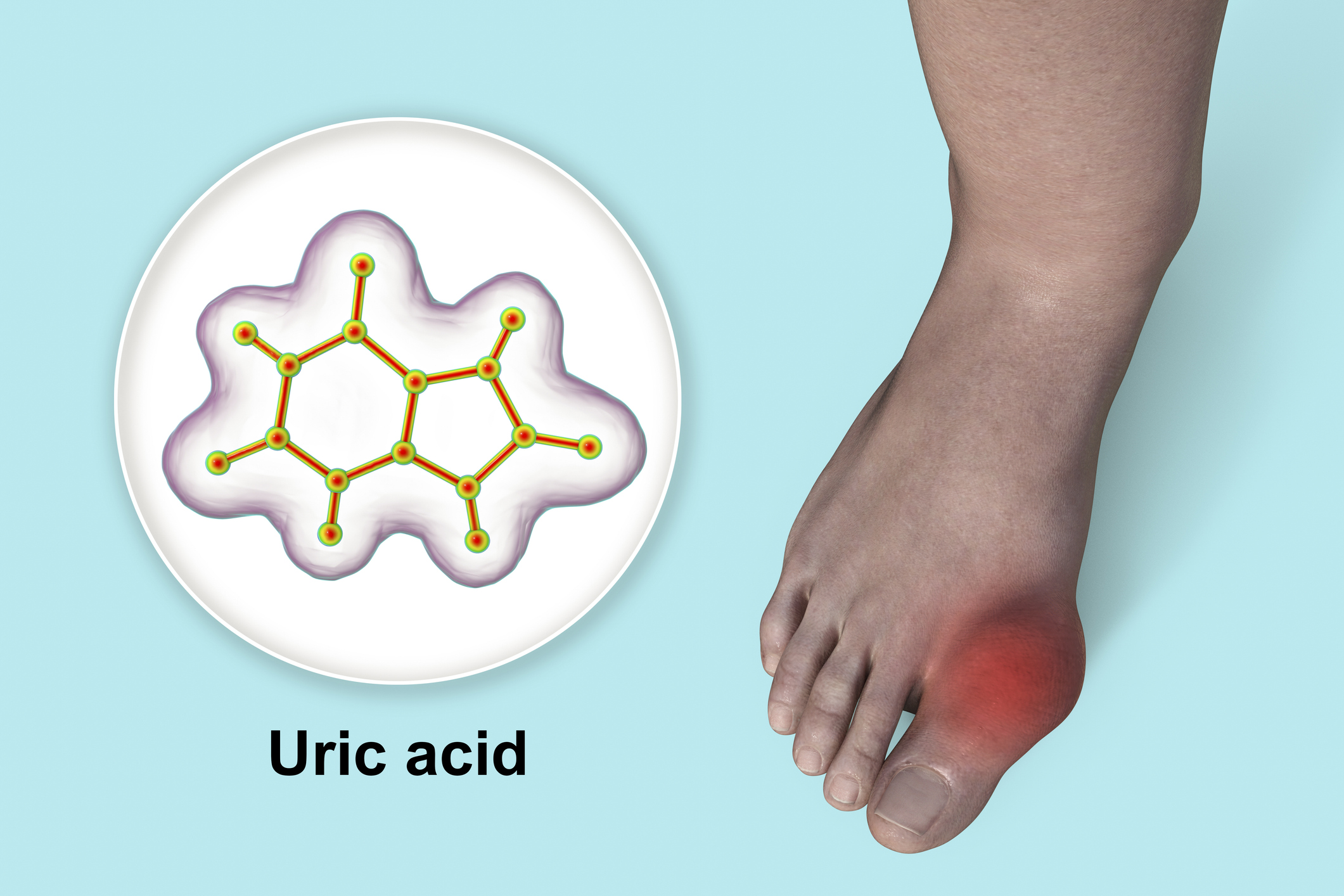
Gout is like an iceberg. We see only the tip—often only one episode of severe pain, like a throbbing big toe in the middle of the night—but there’s a whole lot more brewing under the surface especially once the terrible pain has subsided. That’s why, beyond relieving a painful flare, treating the underlying condition itself will have the biggest health impact, explains Puja Khanna, MD, MPH, of University of Michigan Medical School, where she directs numerous gout clinics.
What Is Gout?
Gout is caused by the body’s overproduction and underexcretion of uric acid, the waste product that is a result of the body’s handling of purines. Our body makes and breaks down cells every day—that’s normal physiology. Purines are organic chemical compounds that are a part of the building blocks of cells and are found in certain foods such as meats. Typically, your kidneys remove 75% of this uric acid and the gut removes the rest regularly. The problem occurs when uric acid can’t be effectively cleared and builds up in the body.
Uric acid, measured in milligrams per deciliter (mg/dL), travels within the blood in a soluble form throughout the body. And normal processing of uric acid by the kidneys continues if the level in the blood remains below 6.8 mg/dL. But at levels above that, uric acid becomes insoluble so it turns into crystals that can deposit themselves in joints, organs and other tissues (according to some research, uric acid been found in 246 sites in the body). While most people think of a painful, red, swollen and tender big toe joint as the chief gout symptoms, you also can have back pain if those crystals deposit in your spine…or even lose your vision if crystals deposit in your eye.
Gout is commonly thought of as an arthritic condition, but it is truly a systemic and chronic disease. By the time you have that swollen toe, you’ve actually had gout for decades. And just because you treat a flare, that does not mean that you no longer have gout. You might experience a quiet period after an acute flare, but uric acid is continuing to crystallize in the body. If the underlying buildup of uric acid continues unabated, it can result in advanced disease with the uric acid crystals creating tophi, hard, visible lumps under the skin.
While foods high in purine can be triggers, just being a beer lover, for instance, is not the only reason people develop gout. Several genetic mutations have been found in the kidneys that cause the body to hold on to uric acid, so a family predisposition to gout plays an important role in developing gout. Having kidney and gut conditions also can contribute to the body’s inability to throw off uric acid…and even under normal circumstances, kidney function declines 10% every decade of life, increasing risk for gout.
Gout Medication: Managing a Flare
One of the biggest challenges to successfully managing gout is that attacks are episodic, and people often don’t see their doctors early enough in the disease process. Instead, they may take over-the-counter pain medications on their own to stop the discomfort caused by the inflammation but not the underlying problem and forget about it until the next flare. While you definitely need to treat the flare, you also need to have your uric acid level measured…have X-rays taken to check for joint damage…and set up a two-pronged plan—managing the flare and then managing the uric acid stores.
Medication for gout flares centers on NSAIDs (aspirin, ibuprofen and naproxen)…the plant-based alkaloid colchicine…and steroids. The right one depends on your unique health status and which one works best for you. There may be reasons you can’t take NSAIDs, such as kidney disease or heart failure. Colchicine could negatively affect the kidneys, liver and bone marrow so even if you can tolerate it, it’s prescribed for less than two weeks, and it’s not appropriate for people with anemia or advanced kidney or liver disease. The steroid cortisone taken orally for a very short period of time has the least amount of side effects.
It is best to start the medication your rheumatologist prescribes as soon as you feel the beginnings of a flare. Often described as “twinges,” flares typically last between five and 10 days—that’s how long it takes the body to produce cytokines that help rid the body of inflammation. When medication is started within a matter of hours of an acute attack, symptoms will resolve far sooner than if you were to start medication on the fifth, seventh or 10th day. But the choices for acute flare management are limited…
Colchicine. The protocol is to take two tablets as soon as you feel a flare starting…another tablet in an hour…and a fourth tablet in six hours. You are essentially front-loading the medication in your body to reduce the inflammation at its onset. For the next three or four days, you’ll take colchicine once or maybe twice a day and then the flare usually runs its course. Drinking lots of water also will help the kidneys flush out those inflammatory toxins.
Steroids. Oral steroids for a few days can quickly calm the inflammatory process.
If these treatments don’t help, you may be a candidate for a newer class of drug called IL-1 inhibitors. These target NLRP3 inflammasome, the protein complex within cells that plays a role in gout flares by activating the pro-inflammatory cytokine IL-1β. Canakinumab (Ilaris) is an injectable approved for acute flares. Anakinra (Kineret), another injectable IL-1 inhibitor, can be used if you’re hospitalized. Downsides: These drugs are expensive and insurance approval is difficult to obtain.
On the horizon: Currently in late-stage trials are NLRP3 inhibitors that more effectively target the IL-1β cascade…may relieve a flare with just three doses…and should become available in pill form, as well as injection, when approved.
Gout Medication: Lowering Uric Acid Levels Is Job One
Primary care doctors often fixate on treating only the acute flares, but gout needs daily management, called urate lowering therapy, to reduce uric acid, keep it low and, in turn, prevent flares. None of the flare medications do that—they only address the inflammatory cascade that caused the flare.
What is the most popular medication for gout? A xanthine oxidase inhibitor such as allopurinol or febuxostat can help manage gout by keeping uric acid levels low enough where you stop experiencing flares. These pills are taken daily, and blood work should be monitored periodically for safety.
If these aren’t effective, a rheumatologist may recommend probenecid, a URAT1 inhibitor that targets a specific gout pathway and helps the kidneys excrete uric acid or pegloticase (Krystexxa), a specific enzyme that breaks down uric acid so it can be more easily excreted (given every two weeks by infusion).
Important: You must stay on uric acid–lowering medications. Otherwise, levels will build back up again.
Tailoring the right medication dose for your uric acid level is key and something many primary care doctors are not familiar with. Example: It takes 100 milligrams of allopurinol to lower uric acid by just 1 mg/dL. That’s typically the initial dose but not sufficient for most people. If your uric acid level is 10 mg/dL, you’ll need at least 400 mg a day to lower it to 6 mg/dL. If you develop tophi, which are large deposits of uric acid crystals, you might need to get it down to even lower levels such as 2 or 3 mg/dL. Every month, the dose will be increased by 100 mg up to a maximum dosage of 800 mg. Expect some finetuning until your doctor finds the right dose for you.
Important: These medications activate the uric acid stores in the body, so it is actually common for them to set off painful flares in the first few months. To keep people from stopping the drug, doctors also prescribe a flare medication prophylactically. Typically, you will take a small dose of your flare medication, such as colchicine, for only the first five to seven days of each month for roughly six months. Because of the risk for long-term side effects, colchicine and NSAIDS should not be taken long term.
On the horizon: Several more effective and safer URAT1 inhibitors currently are in clinical trials.
The Key Is Prevention
There are various reasons a breakthrough flare can happen even when you’re on uric acid–lowering therapy. Some are lifestyle related that you can address, while others should be discussed with your rheumatologist or primary care physician.
Your diet is high in purines, increasing the amount of circulating uric acid. Poultry, steak, seafood, alcohol (not just beer), foods with high fructose corn syrup and additives in electrolyte-replacement drinks are just some of the culprits. Keep a diet journal to identify your triggers.
You’re dehydrated. This can be from not drinking enough water or from taking diuretics, which increase urine production, for other health conditions. When your kidneys don’t have enough fluid, they will hold on to substances they’re supposed to normally excrete. This is the number-one reason for gout in patients over age 70.
You have psoriatic arthritis, poorly controlled diabetes or cancer, leading your body to break down more than the average number of cells and resulting in more circulating uric acid.
You’re taking anti-rejection medications after a transplant. These can cause your body to retain uric acid.
You’re not on the optimal dose of uric acid-lowering medication or aren’t being monitored by a rheumatologist.
When primary care doctors treat gout like an acute episodic disease and not a chronic one, they are less likely to get to the root of the problem or know about the proper dosing of medications and other steps. It is best to see a rheumatologist familiar with the condition and the proper medications to control it.