Everyone loves getting out in the sunshine—after all, the sun brightens our mood and transforms skin made pallid by gloomy winter months into what is sometimes referred to as a “healthy color.” But that color isn’t healthy at all, and even though sun exposure does have some benefits for your health, it also raises the risk for skin cancer, including a particularly lethal form: melanoma. Here’s what you need to know about the disease.
What Is Melanoma?
Melanoma is so named because it starts in cells called melanocytes. These cells produce melanin, the pigment that gives skin and hair its color. Other common forms of skin cancer involve other types of cells. Basal cell carcinoma originates in cells found in the deepest part of the epidermis (the outer layer of the skin), and squamous cell carcinoma starts in the upper layer of the epidermis.
As with other cancers, skin cancers develop because of uncontrolled cell division. But while both basal cell carcinoma and squamous cell carcinoma grow slowly and have a low or moderate risk of spreading, melanoma grows quickly and can rapidly spread to other parts of the body.
“Melanoma is less common in the general population compared with basal cell and squamous cell carcinoma,” says Banu Farabi, MD, a Mount Sinai dermatologist. “However, if melanoma is detected at a late stage, mortality is higher.” She adds that melanoma can be diagnosed in its earliest stages with regular skin checks before it becomes more aggressive.
How Common Is Melanoma?
The American Cancer Society and the Skin Cancer Foundation estimate that about 234,600 cases of melanoma will be diagnosed in 2026. Of these, about 122,600 will be in-situ (confined to the top layer of the skin), while 122,000 will be invasive (meaning that they have penetrated into deeper skin layers). About 8,500 people will die from melanoma. The disease is the third-most common cancer in people ages 20 to 39, but men under age 50 are less likely to develop it compared with women in that age group. That changes in older age—men ages 65 and older are more likely to get the disease than women.
Melanoma Causes and Risk Factors
All cells contain DNA, a material that encodes genetic information and also instructs cells to self-destruct if they are damaged or too old to function correctly. “If DNA is harmed, cell death may not occur,” Dr. Farabi explains. “Instead, damaged cells may grow and divide uncontrollably, eventually forming a tumor.”
DNA can be damaged by genetic mutations, exposure to toxins, and the radiation contained in the sun’s ultraviolet (UV) rays. “Decades of exposure to these rays delivers a dose of radiation that may result in the abnormal proliferation of melanocytes and, eventually, melanoma,” Dr. Farabi says. “Because cumulative sun exposure is a significant factor in melanoma, increased age does increase our susceptibility to the disease, especially if we weren’t careful about sun protection in our younger years.”
She adds that a tan used to be seen as “healthy,” and something to aim for, but now there is greater awareness that a tan signals skin damage due to UV radiation. Think using a tanning bed is safer? Not so—tanning beds substantially raise the risk of melanoma and other skin cancers, and recent research from Northwestern University found that people who use tanning beds were more likely to develop melanoma on areas of the body that had low cumulative levels of sun damage. Tanning bed users also were more likely to be diagnosed with more than one melanoma.
Other melanoma risk factors include having fair skin, red or blond hair, and blue or green eyes; having a large number of moles; having moles more than 6 millimeters (mm) in diameter; a previous diagnosis of melanoma or nonmelanoma skin cancer; and a family history of melanoma in a first-degree relative (mother, father, sibling).
“People with dark skin have some degree of natural protection against UV radiation but are at greater risk for melanoma of the hands, feet, and nails,” Dr. Farabi notes. “There also is evidence that melanoma may be detected at a more advanced stage in people with darker skin.”
Signs and Symptoms of Melanoma
Most people have at least one mole, a flat or raised round dark spot on the skin caused by melanocytes clustering together. Dr. Farabi notes that most moles are benign, but atypical moles (moles that are larger than normal, with an uneven or jagged border and varied colors including brown, black and gray) are associated with a greater risk of melanoma.
Two-thirds of melanomas develop as new moles, while the remaining third arise from an existing mole that changes. Early-stage melanomas are most often flat, but bleeding is a late sign of advanced melanoma. Another thing to keep in mind is that melanoma can develop on the nails, where it typically manifests as a dark line under the nail. Other symptoms include dark skin next to the nail, the nail separating from the nail bed, and a bump under the nail.
Types of Melanoma
Although melanoma can develop in and around the eye, and in the mucous membranes (for example, the nasal passages and inside the mouth), the vast majority of melanomas occur in the skin. There are four main subtypes:
- Acral lentiginous melanoma occurs on the palms of the hands, the soles of the feet, and the nailbeds, and is the most common form of melanoma in people of color. “The lesion can develop from new-onset linear pigmentation on the nail unit or present as a mass that causes an abnormal nail shape and discoloration, and later spreads close to the nail folds of the skin before penetrating deeper,” Dr. Farabi says.
- Lentigo maligna melanoma typically develops on the face, ears, and neck and is more common in older people with sun-damaged skin. It can grow for five to 15 years before becoming invasive.
- Nodular melanoma presents as a firm symmetrical bump, lump, or nodule, and is the most aggressive form of melanoma. “It becomes rapidly elevated on the skin and spirals downward and deeply into the layers of skin,” Dr. Farabi says. “By the time some people recognize something is wrong, it has already become invasive.”
- Superficial spreading melanoma is the most common type of melanoma. It initially involves the upper layers of skin.
How Is Melanoma Diagnosed?
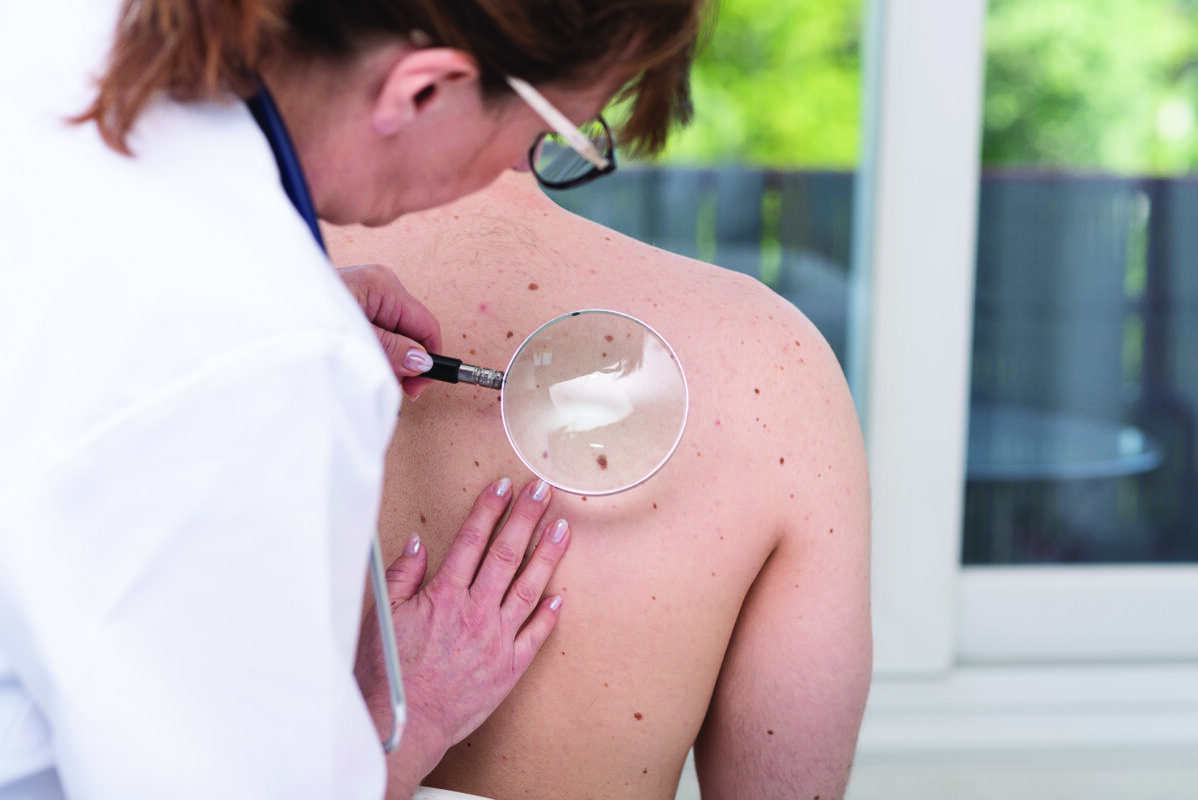
Melanoma is diagnosed through a skin examination and biopsy.
If you are at high risk for skin cancer, it’s worth setting aside 15 minutes each month to examine your skin. Do so in good light, in front of a full-length mirror. Don’t forget to check between your toes, the soles of your feet, and your genitals, since melanoma can develop on areas of the body that are not regularly exposed to the sun.
It’s a good idea to keep a record of where your existing moles are so that you can keep track of any changes. The ABCDEs of skin cancer provides a useful guide for what kinds of changes warrant a dermatologist appointment:
- A = Asymmetry—one half of the mole does not match the other half
- B = Border irregularity (blurred, notched, ragged)
- C = Color variegation, including shades of brown, black, and tan, with streaks of red, white, or blue.
- D = Diameter >6mm (or larger than the eraser on the end of a pencil)
- E = Evolving or changing (size, shape, color)
People who have risk factors for skin cancer also should consider getting a thorough skin check from a dermatologist at least once per year (you may be advised to see your dermatologist more often if you have a large number of moles or have previously had skin cancer).
If your dermatologist is concerned about a new mole or changes in an existing mole, they probably will take a biopsy (sample) of the mole and send it to a lab for examination. If melanoma is diagnosed, it will be staged to determine how advanced the cancer is.
Stages of Melanoma
Melanoma staging helps your doctor formulate a treatment plan for your melanoma and can provide information on your likely prognosis. Melanoma stages run from 0 to IV. Stages II through IV have subgroups—A, B, C and D—which are characterized by variations in tumor thickness and the presence of ulceration. The lower the number and letter, the better the prognosis.
Melanomas that are diagnosed through a biopsy are categorized as Stage 0, I or II because a skin biopsy does not determine whether the melanoma has spread elsewhere in the body. Finding out requires a lymph node biopsy, which usually is carried out during surgery to remove the tumor. “Lymph nodes are small bean-shaped structures located throughout the body that play a role in the immune system,” Dr. Farabi explains. “If a lymph node biopsy is found to contain cancer cells, this is an indication that melanoma has spread beyond its initial site.”
- Stage 0: The tumor is confined to the upper layers of the skin (known as in situ melanoma).
- Stage I: The tumor is less than 2 mm thick. It has spread to the dermis (the middle layer of the skin, beneath the epidermis) but no deeper.
- Stage II: This stage is determined by the tumor’s thickness in millimeters (from less than 2 mm to greater than 4 mm) and ulceration. There still is no evidence that the cancer has spread to the lymph nodes or elsewhere in the body.
- Stage III: This stage indicates that the tumor has spread to or may be in transit to nearby lymph nodes, but there is no evidence that it has spread to distant areas of the body.
- Stage IV: The melanoma has spread to distant parts of the body, including organs and soft tissues.
Treatment Options for Melanoma
Surgery is the main approach for treating melanoma, and some people with the disease require no further treatment. Tumors typically are removed in a procedure called wide local excision. The surgeon also will remove a skin border (known as the surgical margin). If a lymph node biopsy is needed, it will be done at the same time. The biopsy is sliced into several cross-sections (known as bread loafing) and examined in a lab. If the surgical margin is found to contain cancer cells, you may need further surgery.
Another surgical technique, Mohs micrographic surgery, may be used for early-stage melanomas in cosmetically or functionally sensitive areas like the face, ears, and backs of the hands, since it preserves more tissue.
“In Mohs surgery, a thin layer of the tumor and skin margin are scooped out and immediately examined,” Dr. Farabi explains. “If abnormal cells are seen, another thin layer is removed, with a slightly wider margin if necessary. This sequence continues until the specimen is completely free of abnormal cells.”
Melanoma treatment also may involve medications. “Immunotherapy drugs work by enhancing or suppressing the immune system, while targeted therapy takes aim at abnormal molecules inside cancer cells that signal the cells to multiply out of control,” Dr. Farabi says. These drugs also often are used as adjuvant therapy (additional treatment given after surgical removal of skin cancer), to prevent cancer recurrence or treat cancer that has spread.
While skin cancer drugs are effective, they come with side effects, including fatigue, skin irritation, nausea, vomiting, constipation, diarrhea, high blood sugar, and anemia, among others. If you experience any side effects, tell your doctor. Don’t be tempted to skip a dose of medication to avoid its effects, since doing so may impact your recovery.
Radiation therapy also may be used to treat melanomas that cannot be removed by surgery. “Radiation cannot cure melanoma, but it can shrink tumors that otherwise would cause discomfort and relieve symptoms associated with melanoma that has spread to the other organs,” Dr. Farabi says.
Melanoma Prevention
Melanoma is preventable with simple sun-safe strategies. If you can, stay out of the sun when it is at its most intense (between 10 a.m. and 4 p.m.). If you can’t, be sure to use broad-spectrum sunscreen with a sun-protection factor (SPF) of at least 30 on any exposed skin. “Don’t forget to use the sunscreen on your eyelids, lips, ears, and scalp if you are not wearing a hat,” Dr. Farabi advises. “Reapply the sunscreen at least every two hours, always after swimming, and if you are perspiring excessively.”
Use sunscreen on cloudy days too, since UV rays can penetrate cloud cover. If you don’t like how sunscreen feels on your skin, consider investing in lightweight UV-proof clothing that keeps you cool while protecting your skin. Dr. Farabi adds, “It also is advisable to wear a wide-brimmed sunhat and sunglasses and seek the shade if you are outside when the sun is at its strongest.”