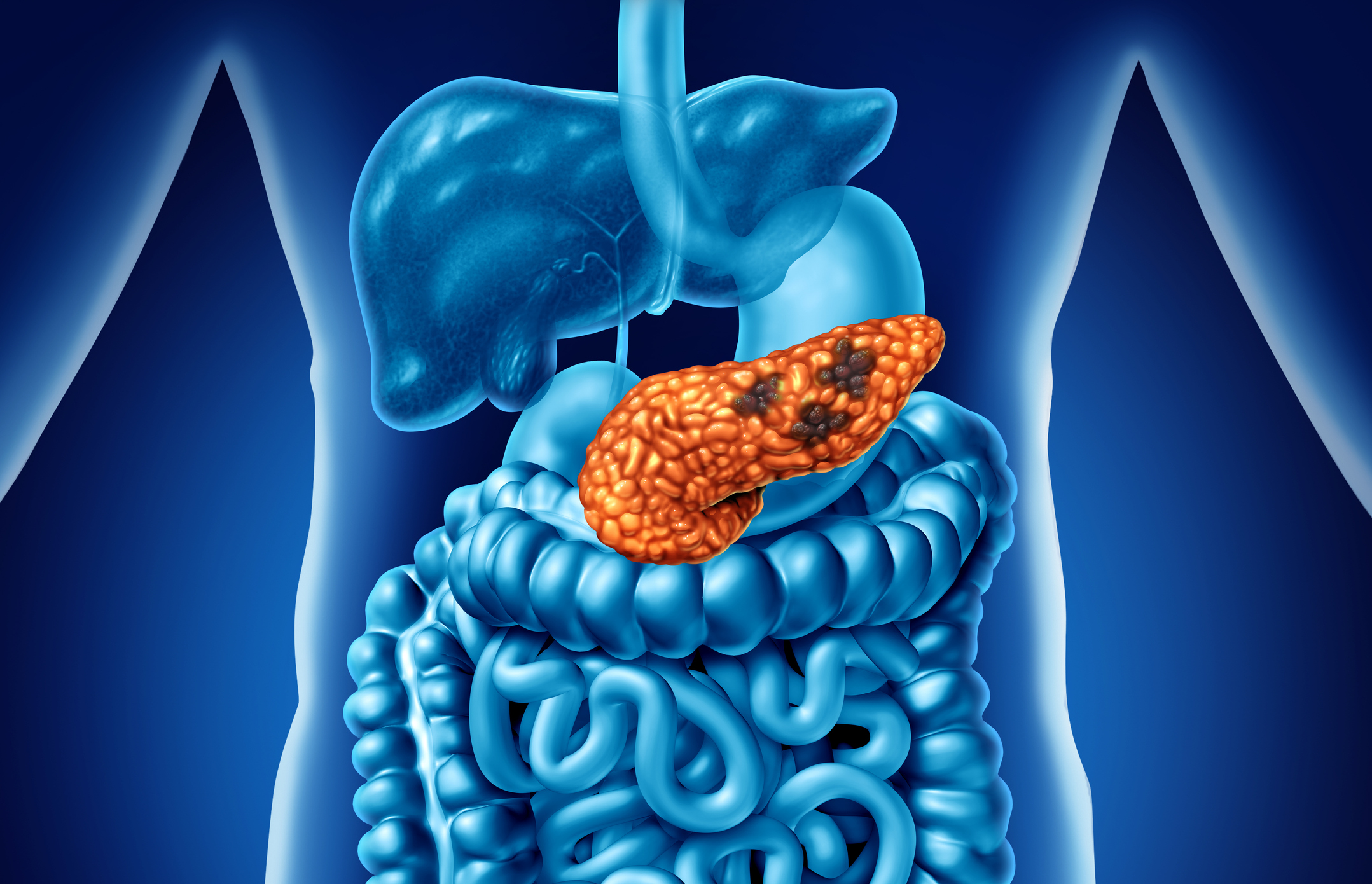
It’s never easy to hear you have cancer, but a diagnosis of pancreatic cancer can be especially daunting. Once diagnosed with the disease, only about 13% of patients are still alive five years later, according to National Cancer Institute statistics. That compares with about 28% for people with lung cancer and 65% of people with colon cancer. Each year, some 67,000 Americans learn that they have pancreatic cancer, and 52,000 die.
Why is pancreatic cancer so deadly? It is fast-growing and notoriously hard to diagnose and treat. Its symptoms are vague and nonspecific, and include abdominal pain, nausea and vomiting, flatulence, fatigue, weight loss, jaundice and what doctors call steatorrhea, a condition marked by greasy, pale-colored, foul-smelling stools.
Result: Pancreatic cancer often is diagnosed late in the course of the illness because these symptoms can easily be attributed to other ailments, including common digestive disorders, influenza and even food poisoning. Pancreatic cancer also can trigger a sudden rise in blood sugar levels, which might instead be mistakenly blamed on a new diabetes diagnosis.
Add to that where the pancreas is located in the body. Nestled between the liver and spleen, with the stomach and bowel in front and the spine behind, the pancreas is hard to reach with endoscopes or visualize with computed tomography (CT), magnetic resonance imaging (MRI) and other diagnostic scans that are used to detect malignancies. And, of course, if a tumor is detected in the pancreas, surgeons can have a hard time successfully reaching and removing it.
Bottom line: By the time pancreatic cancer is diagnosed, it’s likely to have spread locally or to other parts of the body—making successful treatment very difficult. And despite ongoing research efforts, treatment for pancreatic cancer hasn’t advanced much in recent years. Bottom Line Personal spoke to pancreatic cancer specialist Gregory Botta, MD, PhD, for more on pancreatic cancer.
Limiting Your Risk
No doubt you already know the basics to reduce your risk for all kinds of cancer—eat a healthful diet…keep your weight under control…don’t smoke…limit consumption of alcohol…and get regular exercise. These strategies also help prevent chronic inflammation of the pancreas, or pancreatitis, which is a key stepping stone in the development of pancreatic cancer.
The other risk factor is a family history of the disease—there’s not much you can do about that—but knowing that you are at risk can help you and your doctor stay vigilant.
When the Diagnosis Is Pancreatic Cancer
It’s vitally important to seek treatment at an institution with a multidisciplinary team that includes medical, surgical and radiation oncologists. Look for a center designated as a National Pancreas Foundation Center of Excellence…contact the Pancreatic Cancer Action Network for specialists…or look for one affiliated with the Canopy Cancer Collective. These robust and specialized cancer institutions offer the full range of treatment options for pancreatic cancer, including surgery, chemotherapy and radiation therapy…along with psychological and lifestyle support. The doctors at these institutions stay abreast of the latest developments in treatment and can help patients evaluate and enroll in clinical trials of experimental treatments.
When Surgery Is Appropriate
You may be a candidate for surgery if scans show that your cancer hasn’t spread from the pancreas and if the tumor hasn’t impinged significantly upon critical blood vessels. Surgical removal of all or part of the pancreas—in combination with chemotherapy—is the only existing treatment that offers a chance for a cure. Once a part of the pancreas has been removed and the gastrointestinal tract has been surgically modified, patients will have altered digestive habits. Adequate nutrition (work with a nutritionist), pancreas enzyme replacement and blood sugar management, sometimes with insulin, are essential to recovery. But only about 20% of newly diagnosed pancreatic cancer patients are candidates for surgery, according to the Pancreatic Cancer Action Network.
Depending on the tumor’s position within the pancreas, different surgical techniques may be used. In many cases, surgeons remove part of the pancreas, the gallbladder, part of the small intestine and nearby lymph nodes. This extensive, complex surgery is known as pancreatic duodenectomy, or the Whipple procedure. The operation takes several hours and requires a highly skilled surgeon—ideally one who performs more than 15 Whipple procedures a year, according to the Pancreatic Cancer Action Network. Patients who undergo the procedure typically spend about a week in the hospital.
Beyond Surgery
Some doctors give pancreatic cancer patients a course of chemotherapy before surgery. Others operate first and do chemo afterward or even do chemo both before and after surgery (clinical trials now under way should determine which of these approaches is most effective). If the cancer has spread (metastasized) or blood vessels have been impinged, surgery may not be an option. Then chemotherapy and radiation therapy are the only real treatment options, and their goal is to try to prolong life at the best quality. Unfortunately, no single treatment can make pancreatic cancer go away forever.
Medical oncologists typically employ one of two long-used multidrug chemotherapy protocols when treating pancreatic cancer—FOLFIRINOX, a combination of the drugs 5-fluorouracil, leucovorin, irinotecan, hydrochloride and oxaliplatin…or a combination of gemcitabine and nab-paclitaxel. These protocols have proven more effective than single drugs alone because they kill cancer cells via different mechanisms.
A course of chemotherapy for pancreatic cancer typically lasts six months before the side effects limit further treatment. The drugs are given intravenously in a doctor’s office, clinic or hospital. But sooner or later most tumors become resistant to the drugs…and/or some patients find side effects become intolerable. These range from nausea, vomiting, constipation or diarrhea, hair loss, loss of appetite, neuropathy and extreme fatigue. These side effects occur over time, and not everyone experiences all of them. The multidisciplinary team should develop a plan for how treatment will continue once chemo is no longer an option—and that typically is by facilitating enrollment in a clinical trial.
Useful resource: The National Library of Medicine’s online database of clinical trials at ClinicalTrials.gov. Each cancer center also has a webpage with up-to-date trials being offered. Additionally, drug manufacturers generally have this information posted on their websites.
Radiation is used on a case-by-case basis—usually to facilitate surgery by treating along a major blood vessel affected by a pancreatic tumor…along with chemotherapy in patients who are not candidates for surgery…or to treat individual metastases that crop up following surgical treatment for pancreatic cancer.
On the Horizon
Scientists worldwide are working to develop new treatments for pancreatic cancer as well as a simple blood test that could reliably detect it in its earliest, most treatable stages. Example: One team at Oregon Health Sciences University announced earlier this year that their experimental test PAC-MANN can spot pancreatic cancer with 85% accuracy. But at this point neither PAC-MANN nor any other reliable screening blood test is available. Most screening currently takes place with a combination of endoscopic evaluation and MRI.
Immunotherapy has proven to be of little use against pancreatic cancer, in part because tumors of the pancreas tend to have no immune response. Further, pancreatic cancer has few genetic mutations that make malignancies “targetable.” But doctors are now hopeful that experimental agents under evaluation may prove safe and effective—and thus provide another treatment option for pancreatic cancer patients.
Especially promising: Oral drugs known as KRAS inhibitors (KRAS is the name of a gene that exists in mutated form in up to 90% of pancreatic cancer patients). Now under development by a handful of pharmaceutical companies, these drugs could be approved for clinical use within the next few years.