
Body temperature, heart rate, respiratory rate, and blood pressure. They’re considered the four vital signs used to measure your body’s basic functions and general physical health.
These days, many experts suggest that this list is incomplete and that a fifth vital sign should be added to it: grip strength. Research suggests that hand grip strength is an important measure of muscle function and physical capability that closely correlates with overall health and longevity.
“It’s a predictor for many things,” says Ardeshir Hashmi, MD, a Cleveland Clinic geriatrician. “Grip strength provides a basic composite measure of muscle, nerve, and bone health. So, it’s a very good prediction tool about how someone is doing right now and how they will do in the next year, five years, and 10 years. It’s easy to do, inexpensive, and it’s not overly complicated.”
What Is Grip Strength?
You need good grip strength to open a jar, give a solid handshake, grip a golf club or use a hammer or other tools effectively.
Simply put, grip strength is a measure of the amount of force you can generate when you grasp something. It can be broadly classified into three types:
- Crush grip is your ability to squeeze things between your fingers and the palm of your hand. This is the type of grip you use during handshakes, squeezing a ball, or holding a tennis racket.
- Pinch grip is the grip you use when holding something between your thumb and fingers without using your palm (think of grabbing a plate or turning a key).
- Support grip is your ability to hold heavy items for extended periods, using the muscles in your whole hand and forearms. You employ this type of grip whenever you carry groceries or perform deadlift exercises.
Why Is Grip Strength Important?
Grip strength reflects the strength of muscles in your hands, wrists and forearms, but it’s more than that. It serves as a gauge of muscle strength throughout your entire body and a measure of sarcopenia, the gradual replacement of muscle with fat tissue that commonly occurs with aging.
As such, grip strength can help determine your level of mobility, physical endurance, balance, and thus your risk of frailty, your odds of suffering a debilitating fall, and your likelihood of remaining independent now and in the future. It’s been identified as a reliable indicator of your ability to perform (and continue to perform) instrumental activities of daily living, such as driving, cooking, grocery shopping, and managing medications.
The loss of mobility and physical function that poor grip strength can predict has been associated with an increased risk of loneliness (since you cannot physically get out and spend time with family and friends), which can adversely affect your emotional and cognitive health.
Research suggests that poor grip strength also correlates with reduced longevity and an increased risk of chronic medical conditions like heart disease, cancer, and poor lung function (e.g., chronic obstructive pulmonary disease [COPD]). In fact, one study demonstrated that reductions in grip strength were associated with increased risks of heart attack, stroke and death from cardiovascular and other causes (The Lancet, July 18, 2015).
Dr. Hashmi notes that grip strength is an objective measurement that also can help predict how well a person will withstand and recover from surgical procedures or medical treatments like chemotherapy or radiation for cancer.
“You want to have this information, especially if you’re going to be undergoing a major medical or surgical procedure,” he adds. “Or, if you’re having a procedure, a grip strength test will help us determine how you’re doing currently and what you need to do to get in the best shape possible before the procedure.”
How Is Grip Strength Measured?
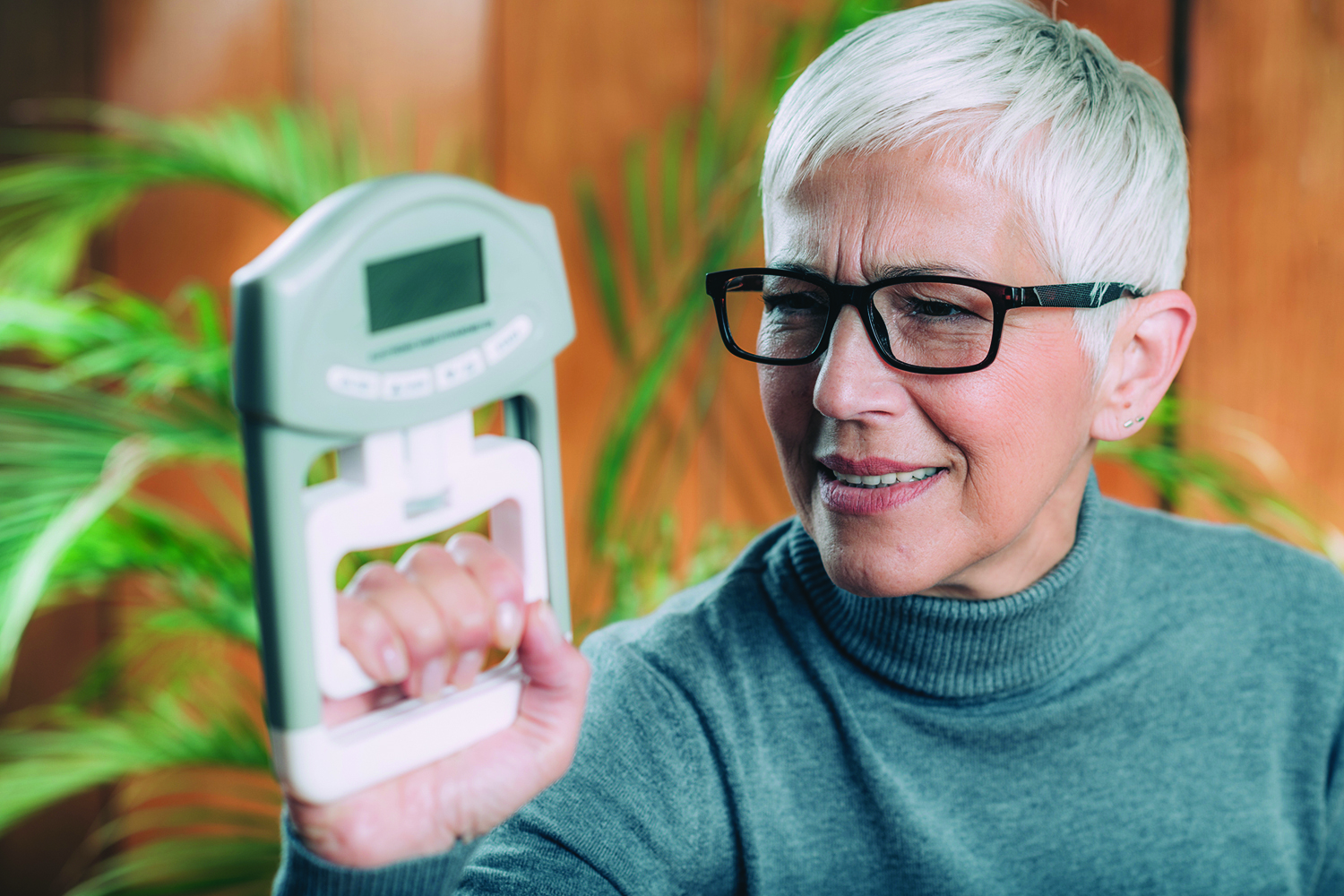
Your doctor can measure your grip strength using a device known as a dynamometer. With your elbow flexed at 90 degrees, you squeeze the device three times and use the highest measure—some clinicians use the average of the three results. Alternatively, you can purchase a dynamometer, measure your grip strength at home, and share the results with your physician. (The cost of the devices can vary widely, ranging from $20 to several hundred dollars.)
Grip strength is measured in pounds (or kilograms) of force applied. For most men, it peaks in their 20s and 30s, averaging about 110 to 120 pounds, Dr. Hashmi says. By the time you reach your 60s, it can fall to 50–60 pounds or less.
“The number to remember is about 56 pounds,” Dr. Hashmi advises. “Below 56 or especially below 50 means a higher risk of frailty and sarcopenia. You have to maintain it at least above 50 and, preferably, try to stay in the 70s or 80s. The higher the grip strength, the better.”
Be aware that hand arthritis, carpal tunnel, or other orthopedic or nerve-related problems can affect the results of the test, so you and your healthcare provider will have to account for these factors. It’s best to measure grip strength periodically and look at how it changes over time, Dr. Hashmi advises.
“I recommend having it tested at least once a year, starting at age 50,” he says. “The annual wellness visit or a yearly physical is a very good time to do it. It is surprising how much it tells us. We have our own impressions about how we’re doing health-wise, but I think checking grip strength is a good habit to get into, at least as you’re getting older.”
Your physician can use several assessments to gauge your muscle strength and your risk for sarcopenia, frailty and falls:
- Grip Strength: Measured using a dynamometer. Middle-aged and older men should try to maintain a grip strength of 70 to 80 pounds. Anything less than 56 pounds (and especially less than 50 pounds) indicates a higher risk of frailty and sarcopenia.
- Gait Speed: A measure of how quickly you can walk a prespecified distance (usually 4 meters, or about 13 feet). A speed of less than 2.5 feet (0.8 meters) per second indicates a higher risk of frailty.
- 30-Second Chair Stand: Start in a seated position, with your feet flat on the floor and keeping your arms folded across your chest. Rise to a full standing position, and then sit back down again. Repeat for 30 seconds. Below-average scores (indicating increased fall risk) for men are less than 14 times for ages 60–64, less than 12 times for ages 65–74, less than 11 times for ages 75–79, less than 10 times for ages 80–84, less than eight times for ages 85–89 and less than seven times for ages 90–94. For women, below-average scores are less than 12 times for ages 60–64, less than 11 times for ages 65–69, less than 10 times for ages 70–79, less than nine times for ages 80–84, less than eight times for ages 85–89 and less than four times for ages 90–94
- Timed Up & Go: A measure of how quickly you can rise from a seated position, walk 10 feet at a normal pace, turn, walk back to the chair at a normal pace and sit down again. An older adult who takes 12 seconds or longer is at a higher fall risk.
Sources: Centers for Disease Control and Prevention; Ardeshir Hashmi, MD, Cleveland Clinic
How to Improve Grip Strength
One of the simplest ways to boost your grip strength is to squeeze a ball as you go about your daily activities. Squeeze a racquetball, squash ball, or a ball of similar consistency every day, but refrain from using a tennis ball or anything firmer, as it may worsen hand pain or arthritis. You also can use spring-loaded hand grippers or perform wrist curls using appropriately weighted dumbbells.
Be sure to include plenty of protein in your diet to help support muscle building and reduce your risk of sarcopenia. The Dietary Guidelines for Americans recommend prioritizing protein foods at every meal—e.g., seafood, red meat, eggs, and plant sources like beans, peas, lentils, and soy—aiming for a protein goal of 1.2 to 1.6 grams per kilogram of body weight per day. (For a 200-pound man, that equates to 109 to 145 grams of protein per day to meet the recommendation—200 divided by 2.2 multiplied by 1.2 or 1.6.)
Don’t focus only on your grip strength so that you can perform better on a dynamometer. To preserve your musculature and combat sarcopenia, perform strength-training exercises on at least two to three nonconsecutive days per week, focusing on the major muscle groups of the shoulders, arms, chest, back, and legs, as well as the hands.
“Grip strength will naturally decline with age if you don’t do anything about it, but you can actively counter it,” Dr. Hashmi says. “You could have one person in their 80s and one in their 60s, and if the 80-year-old has been countering that physiological decline, their grip strength may be greater. Objectively measuring that gives me a better idea about how this person is going to do in the next five or 10 years. So, it’s really the fifth vital sign that can indicate frailty, the presence of it and the risk for it.”
