
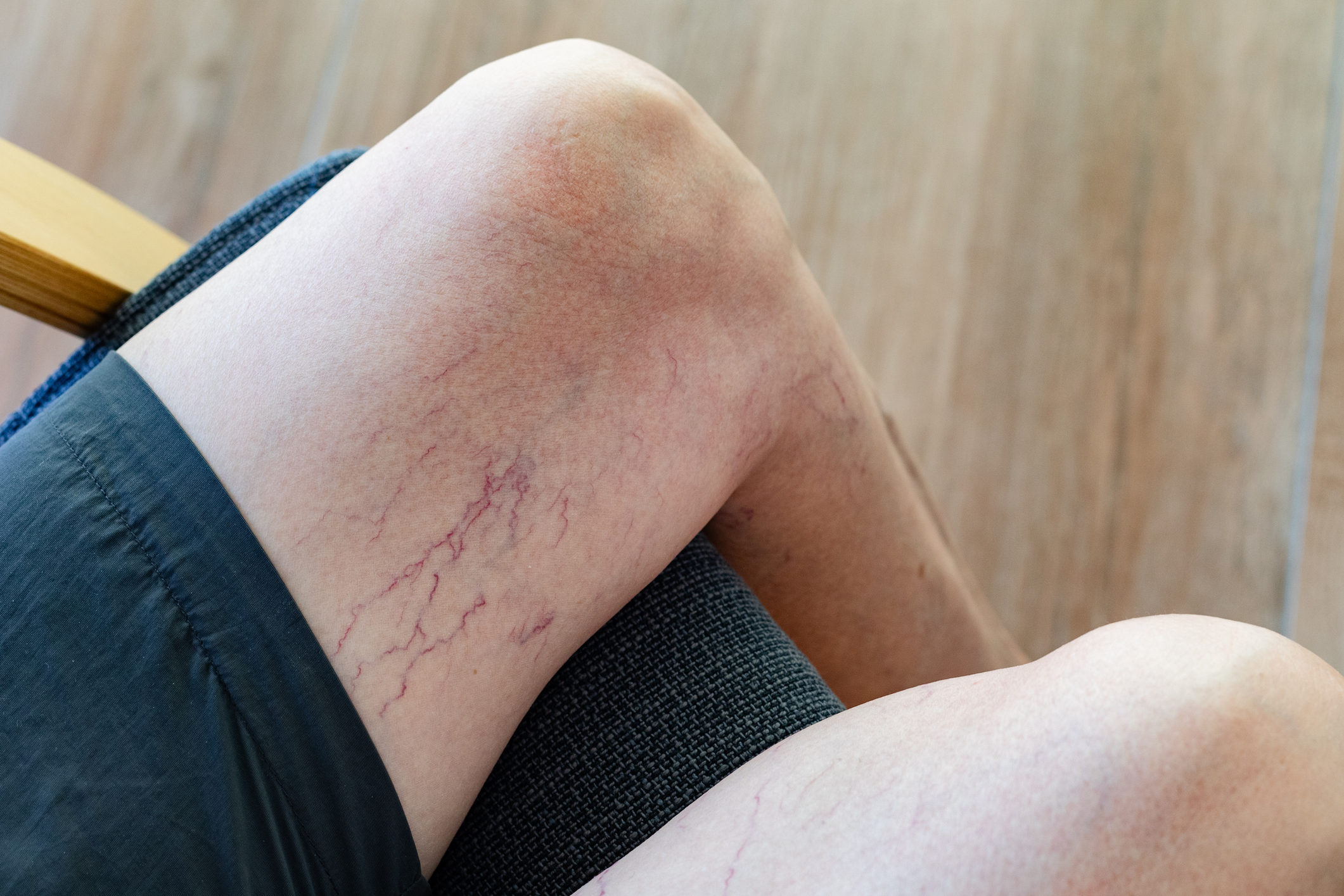
Have you noticed unwanted veins on your legs or your face? Are you wondering if they are spider veins and, if so, what to do about them? Bottom Line Personal turned to Ryan M. Smith, MD, assistant professor in facial plastic and reconstructive surgery at Rush University Medical Center for answers.
What Are Spider Veins?
Not every noticeable vein is a spider vein—some are broken capillaries…others are varicose veins. All three are quite common and can sometimes be confused. Here are the main differences…
Spider vein
Also called a telangiectasia, thread vein, stellate flare, stellate vein or sunburst vein, a spider vein is a cluster of small blood vessels that have become dilated over time. They show up as thin yet noticeable red or purple lines, typically one or two millimeters in width. A spider vein can be a flat or a slightly raised single line…or sometimes two or more will appear side by side. Some spider veins, referred to as “arborizing,” look like tree branches. While spider veins can occur anywhere on the body, they tend to develop on the legs and face, where you may spot them more readily.
Important distinction: A separate but similar-looking cluster of thin lines called a spider angioma or spider nevus is different from a spider vein. Spider angiomas may be single or multiple. They have a distinct appearance—with a central red spot, representing the body of the spider, surrounded by radiating weblike tiny lines that resemble legs. Spider angiomas are benign but can result from liver disease, elevated estrogen levels, thyroid problems or ulcers. The distinction is important because something that looks like an angioma could potentially warrant blood work or other testing.
Burst capillary
This is commonly a response to a trauma. Capillaries are thin, delicate blood vessels. Examples: If you’ve been throwing up, you might see that you have burst capillaries in your eyes…and the bruising you see after an injury is essentially burst capillaries. These are very fine, usually red lines that typically aren’t dangerous. Many go away on their own with time.
Varicose vein
Varicose veins tend to bulge, look twisted and have a blue-purple color. They are the result of damage to the tiny valves within the veins in the legs. They’re usually bigger and thicker than spider veins, three or more millimeters wide, and can be much longer. Unlike spider veins and burst capillaries, varicose veins have the potential to be a health concern and can raise the risk for bleeding, a blood clot and skin ulcers.
Of the three types of veins above, varicose veins are the most likely to be painful. In cases where trauma has caused burst capillaries, there may be pain as expected after any injury but not from the noticeable thin line or bruise itself.
What Causes Spider Veins
There are two theories about the formation of spider veins. An early theory suggested that they’re the result of a problem with the valves within the vein that make sure blood is always flowing in one direction—toward the heart. When those valves stop working correctly, that venous return, or blood flow, doesn’t occur as it should. Causes include genetic factors, obesity, pregnancy, hormone effects, periods of prolonged sitting or standing, and infrequent exercise.
Blood pools within the veins, stretching them out over time and causing them to stick out. While this is indeed the mechanism by which varicose veins form, a study from Newcastle Laser Center in Australia found that only about 23% of people with spider veins had such valve problems.
The second, more widely accepted theory is that spider veins are the result of low oxygen or inflammation that prompts a response called neogenesis—damaged blood vessels try to regrow but do so in an unorganized or overabundant way. That new disorganized growth of blood vessels causes the sprouts to form and become noticeable. Low oxygen and inflammation are caused by the usual suspects—obesity, periods of prolonged sitting or standing, and smoking.
There also can be a genetic component to spider veins—up to 90% of people who have a family history of spider veins will develop them.
Pregnancy seems to be an independent risk factor. Women can be up to four times more likely
than men to have spider veins, and their risk goes up with every pregnancy. Their appearance may be related to the skin stretching that occurs during pregnancy and/or to hormone levels (estrogen and even testosterone can exert an influence on blood vessels) as well as to being relatively less active and the lower-leg swelling that commonly occurs during the third trimester.
Spider veins can resolve spontaneously especially after a significant health change or improvement—such as after pregnancy, weight loss or with increased physical exercise. Some may not resolve in areas where the skin has been affected. That means many of these risk factors can be mitigated with lifestyle habits. Lose weight if necessary…don’t smoke…avoid long periods of inactivity, especially if you have a job that involves a lot of sitting or standing…take regular breaks to stretch…exercise and move more in general. These steps can help prevent spider veins or prevent them from getting worse.
Are Spider Veins Dangerous?
Very rarely do spider veins cause symptoms, and when they do, symptoms typically are mild such as slight burning or itching. It is possible but very uncommon to experience pain, especially in the lower extremities—such discomfort is more often associated with varicose veins. What bothers people, especially women, is when they occur on the face, making them more of a cosmetic problem than anything else.
Caution: If you have a family history of skin cancer or have spent a lot of time in the sun, you may want to consult with a dermatologist to make sure that any skin changes are harmless, especially if you notice the central red spot with radiating lines that may represent a spider angioma.
How to Get Rid of Spider Veins
Spider veins often can be camouflaged with concealer or corrective makeup. A skilled makeup artist or a dermatologist familiar with coverage products can guide you to the right color choice for your complexion. A green base coat often is very effective at concealing the red or purple lines of spider veins. Look for sweat-resistant products, especially in warm weather months or if you exercise vigorously.
If makeup is not effective enough, there are medical treatments available from dermatologists and surgeons trained in treating vein disorders. Most of the following therapies are performed as an outpatient procedure, depending on the extent of treatment and the patient’s medical history. Insurance coverage, though, is rare for benign lesions, such as for spider veins. For symptomatic varicose veins or cases in which blood clots or bleeding has occurred, insurance coverage may be possible.
Intense pulse light (IPL) therapy is a laser therapy that specifically targets visible blood vessels. The heat generated by the laser causes the blood vessel to collapse and fade away in a matter of weeks. It may take more than one session to get rid of the vein. There’s no down time, though you may have some redness for a few hours.
Radiotherapy, or radiofrequency ablation, uses a high-frequency pulse sent through a fine needle to collapse the vein, which will then be absorbed and disappear in a few weeks. This minimally invasive technique is done with a local anesthetic. There’s little or no down time, though you may experience mild redness, bruising or scabbing that should go away within days.
Results of both these treatments will depend on the size of the spider vein and how far below the surface of the skin it is. If neither is successful enough, there are two other common yet more invasive approaches…
Sclerotherapy involves injecting a chemical agent into the vein to make it shrivel, break down and disappear after a few weeks. A numbing agent may be applied to prevent any discomfort during the procedure, and you won’t have any downtime afterward. It may take more than one session to get rid of the vein.
Microphlebectomy involves making tiny incisions to surgically remove the vein. Though still considered minimally invasive, you likely will have a tiny white scar afterward in place of the vein, so it’s important to understand the trade-off. Recovery involves at least a few days of rest before getting back to your usual activities. Because this is surgery, this treatment usually isn’t recommended for a spider vein unless it was in a very noticeable location, such as on the bridge or tip of the nose or the upper lip. When done, however, it is extremely effective—the vein will be gone and won’t come back in that location.
